ajhlovestheatre

  • Home
  • About
  • Contact
  • Blog

  • TROILUS AND CRESSIDA – ⭐️⭐️⭐️ – Shakespeare’s tragicomic satire gets a striking but bonkers new rendering

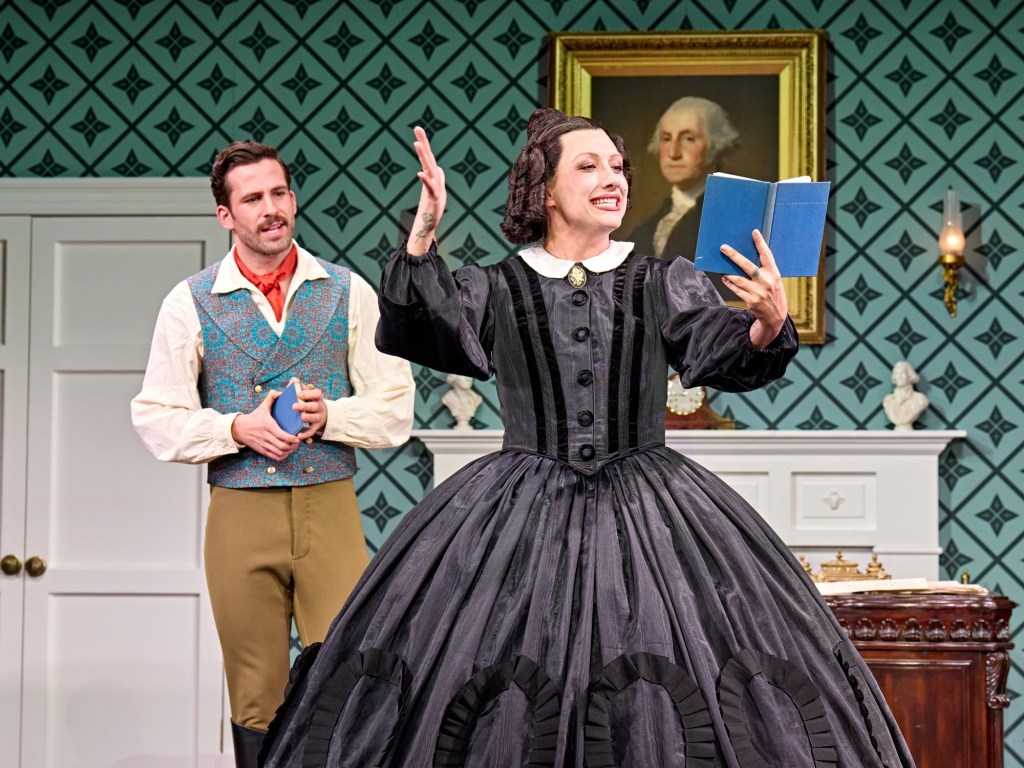
    Samantha Spiro, photograph by Helen Murray

    TROILUS AND CRESSIDA

    by William Shakespeare 

    directed by Owen Horsley

    Shakespeare’s Globe, London – until 26 October 2025

    running time: 2 hours 45 minutes including interval 

    https://www.shakespearesglobe.com/whats-on/troilus-and-cressida/

    In all honesty, you can see why Shakespeare’s anti-war satire-cum-love story doesn’t get done all that often. It’s is all over the place tonally, and, although a mid career play, it sometimes feels like the bard was trying to cram in as many echoes of his earlier ‘greatest hits’ as possible. So we get the doomed lovers of Romeo and Juliet, the warring battles of the Histories, the ribald humour of the Comedies and an exotic setting (Ancient Greece and Troy) comparable to that of the Roman plays Julius Caesar and Titus Andronicus. The abhorrent treatment of women from the latter also rears its ugly head in Troilus and Cressida. 

    Instead of trying to make a coherent whole out of the various strands and milieux, director Owen Horsley (who did last year’s gorgeous, queer-accented Twelfth Night in Regents Park) embraces the lunacy and allows the play to speak for itself, albeit through a flamboyant, modern(ish) dress prism. The result is an uneven, surprisingly camp, rendering that, when it works (mainly the Trojan sections and whenever Samantha Spiro’s gender-swapped Pandarus, now Cressida’s aunt, is on stage) is zany, unsettling and just tremendous fun, but can, at other times, tend to be plodding and confusing. The havoc wreaked by poor leadership, military and civic, is profoundly felt though.

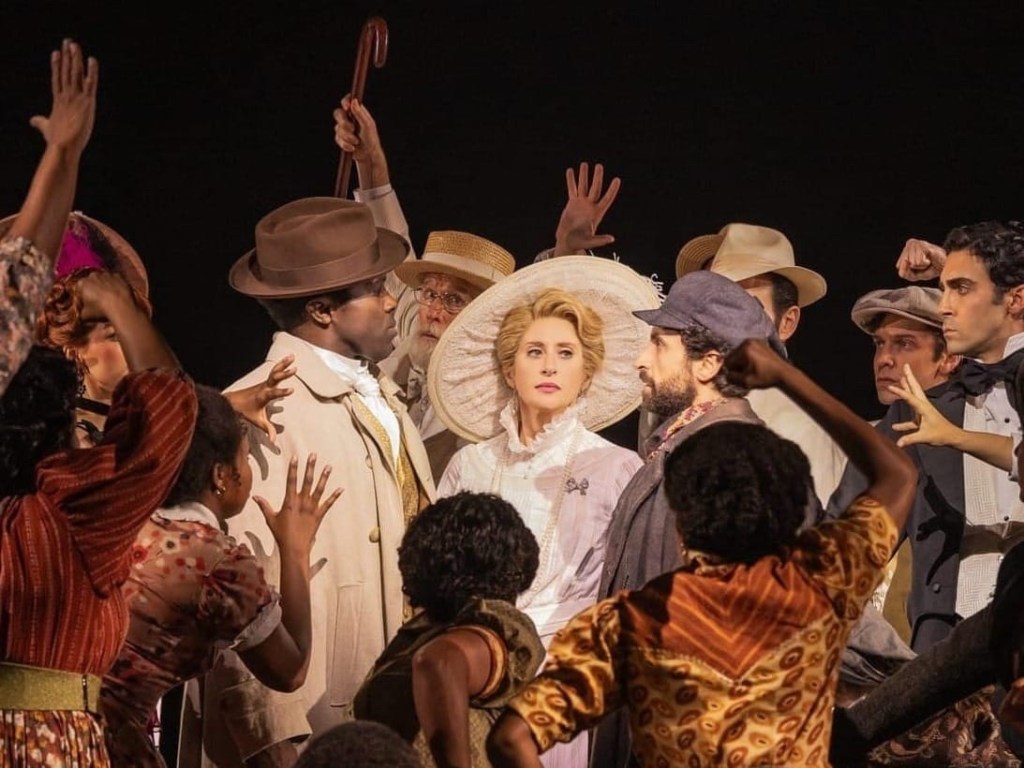
    If a messy play is matched with a messy but boldly theatrical production, there’s still a hell of a lot here to savour. Anachronisms abound in Horsley’s concept and Ryan Dawson Laight’s designs: Kasper Hilton-Hille’s confidently spoken Troilus lounges about in shiny leisurewear while his sister Cassandra (Jodie McNee, also doubling as Ulysses) bellows through a megaphone and sports a CND slogan-daubed parka coat. Tadeo Martinez’s Helen of Troy fanboy Alexander is a social media influencer who wields an enormous ‘APPLAUSE’ sign at the groundlings when the warriors Ajax, Hector et al come on like participants in a garish fashion show, and David Caves as mighty Achilles looks like an Old Compton Street muscle daddy who has gone spectacularly to seed. 

    It initially all seems so deeply unserious what with the provocative poster of Helen of Troy’s half open, lipsticked mouth plastered all over the Globe’s yard and a giant Grecian statue’s foot dominating the stage, that the darker elements of the play (and it does get pretty dark) feel startlingly out of place when they come. Maybe that is the point but it’s such a bewildering gear change that it threatens to upend any engagement with the piece. 

    The contrast between the vividly attired Trojans and muted, austere Greeks is mainly well done although the former are so much more fun than the latter, and the multitude of accents amongst the cast doesn’t help us with working out who is related to who etc. The first appearance of Lucy McCormick’s glittering, marvellous Helen of Troy, all sequins and breathy joie de vivre supported by Matthew Spencer as a screamingly camp Paris, is pure showbiz, but concludes alarmingly, suggesting that we’ve all just been had. Eamonn O’Dwyer’s off-kilter musical score unsettles too, like a colliery band playing a film soundtrack that’s by turns lush then funky.

    Many of the individual performances are superb. Hilton-Hille and Charlotte O’Leary are appealingly unconventional as the titular lovers, a gritty, modern couple with agency and wit, although this approach makes their relative passivity when Cressida is promised by her father to the opposing Greeks, seem a bit odd. McNee’s uptight, lesbian Ulysses is very striking and Caves gives Achilles just the right mixture of aggression and dissolution. Oliver Alvin-Wilson is glorious and multi-layered as warrior Hector, an outward nobility and physical grace masking an all-too-flawed inner life. 

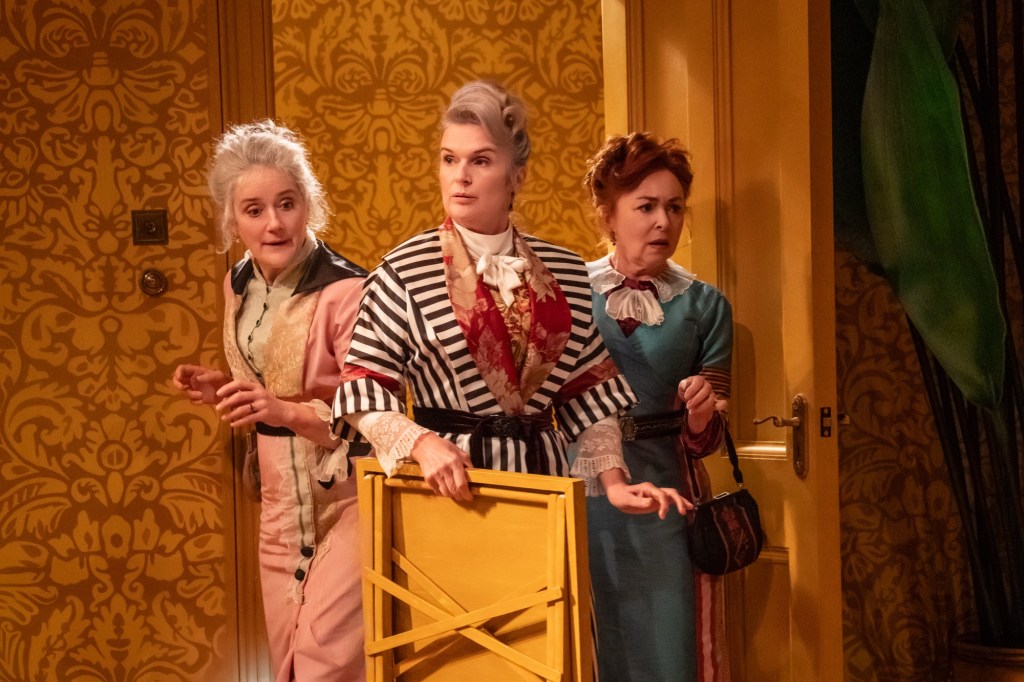
    Best of all is Samantha Spiro as Pandarus: garrulous, meddling, amoral, in this version a woman, and the individual responsible for driving the lovers together. She’s conceived here as a chirpy, cockney-accented Mother Courage but armed with beauty products (in a case marked ‘War Paint’) rather than the spoils of war, equal parts Music Hall, Eastenders, Carry On and classical tragedy. She’s hilarious and endearing yet strangely worrying: ultimately a survivor, despite being permanently on the verge of coughing her guts up. Spiro is fearless with the language, and makes the cynical final speech, predicting ongoing sickness and decline for mankind as a whole as war rages on, into something simultaneously chilling and pitiful. Watching her, bloodied and disheveled yet attempting to lead the audience in a mirthless singalong like one of Julie Walters’ most baroque comic creations, is to see an actress at the top of her game, full of pathos, wicked craft and sheer theatrical bravura. 

    It’s a memorable, ingenious performance that anchors a production so eccentric it runs the risk of floating away. Ultimately, enjoyable as this Troilus and Cressida is, it also demonstrates why the play isn’t universally beloved. Still, it’s worth seeing, for the performances and the sheer inventiveness of Horsley’s vision, but it might be worth reading a synopsis of the plot before you go.

    October 14, 2025

  • MARY PAGE MARLOWE – ⭐️⭐️⭐️⭐️ – Tracy Letts’ unconventional life saga is a feast of glorious acting

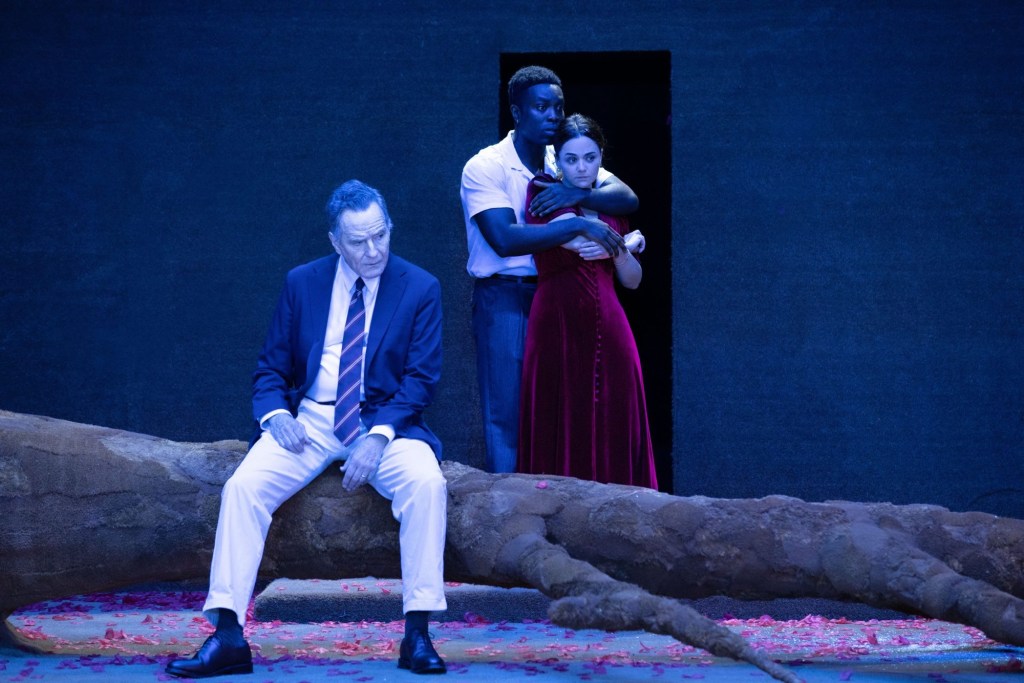
    Hugh Quarshie and Susan Sarandon, photograph by Manuel Harlan

    MARY PAGE MARLOWE

    by Tracy Letts

    directed by Matthew Warchus

    The Old Vic, London – until 1 November 2025

    running time: 100 minutes no interval 

    https://www.oldvictheatre.com/stage/mary-page-marlowe/

    Take an apparently unremarkable life, cut it into pieces, throw those fragments up in the air then see where they land, and you have Mary Page Marlowe. Tracy Letts’ 2016  play, first seen at Chicago’s prestigious Steppenwolf Theatre, is a minor key yet compelling look at a flawed, relatable woman who endures a long life marked by sometimes questionable choices and a diffidence that makes her strange yet captivating theatrical company.

     Anybody who comes to Matthew Warchus’ oil-smooth but emotionally resonant production, staged in the round, primarily to see Susan Sarandon in her London theatre debut may be surprised at how much of an ensemble piece this is, and perhaps even more by how little the absence of a scenery chewing central turn matters. The acting thoughout is utterly flawless and Sarandon is magnificent, but so is everybody else. The title role is split between five actresses portraying Mary Page at various points in her life and each one (in descending age: Sarandon, Andrea Riseborough, Rosy McEwen, Eleanor Worthington-Cox, Alisha Weir) is tremendous. If Sarandon’s portion isn’t overly taxing, she is so real, generous and magnetic that you’re unlikely to feel short changed, and better to appear in a manageable but still impressive stage role than to over-extend and come unstuck as poor Sigourney Weaver did in last year’s Jamie Lloyd Tempest.

     Letts’ stripped-back text is terse and naturalistic, not a word, gesture or pause is wasted. We see the eponymous Mary Page at every stage of life from cradle (literally) to grave (almost), but not in chronological order. There is a strong, sad sense of Mary’s wasted potential as her story covers loss, alcoholism, marital strife and the idea of damaging behaviours repeating themselves and echoing down the years. Some sequences, such as the Tennessee Willams-esque showdown between Mary’s parents (Eden Epstein and Noah Weatherby, both superb) are gripping while a couple of others (a therapy session scene feels a bit rote and heavy going, despite the excellence of the acting) seem to take their foot off the dramatic pedal.

     Ultimately, it’s like piecing together a puzzle (the opening scene has Riseborough’s astonishingly authentic middle aged Mary talking to her young son and daughter about the collapse of her marriage but in a later scene Sarandon’s elderly incarnation tells a doctor she only has one child; we also see Mary celebrating being a free woman but only find out much later what she was incarcerated for), and it requires concentration on the part of the audience lest the brief scenes become a parade of random non sequiturs. The play is likely to frustrate as many people as it delights, but it has a clear-eyed humanity and truth that makes it worth investing in, and a mordant sense of humour. The changing decades are lovingly conveyed by Rob Howell’s evolving costume designs and the wig creations of Campbell Young Associates.

     There’s beautiful work from Hugh Quarshie and Paul Thornley as two of Mary’s husbands, and equally fine, funny, kind contributions from Melanie La Barrie, Kingsley Morton and Daniella Arthur-Kennedy as benign figures in her sometimes rocky life story. Ronan Raftery is appropriately tragicomic as a married man Mary gets involved with, and there’s a belting UK stage debut by Clare Hughes as her volatile teenage daughter. There’s not a single weak link in the sizeable cast.

     Mary Page Marlowe is a curious work, mostly lacking the incendiary dramatic firepower of Letts’ signature works Killer Joe and Bug or his masterpiece August: Osage County (surely due a revival?), but sharing the same gritty wit and gleeful love of people behaving badly. I suspect it’s a piece that rewards a second or even third viewing to fully appreciate the poignancy, the unconventional storytelling and richly textured characterisations, but it’s quietly engrossing. Most of the writing is raw and exquisite, and there probably isn’t an acting ensemble on any other current London stage to rival this one.

    October 11, 2025

  • BLESSINGS – ⭐️⭐️⭐️ – bitter-sweet family drama that harks back to the swinging 60s

    Gary Webster and Emily Lane, photograph by Lidia Crisafulli

    BLESSINGS 

    written and directed by Sarah Shelton 

    Riverside Studios, London – until 26 October 2025

    running time: 90 minutes including interval 

    https://riversidestudios.co.uk/see-and-do/blessings-177622/

    Family intrigue is fertile dramatic ground. So it proves once again, in Sarah Shelton‘s new play which centres on an English Catholic family going through more than their fair share of challenges in the late 1960s, a time when the UK was experiencing some seismic societal and political changes . Blessings feels like a deeply personal play, a rich seam of affection running through the guilt, tantrums, traumas, and the skeletons rattling in the family closet.

    Shelton, who directs her own work here, draws the central Deacon family and the other characters who come into their orbit, including a priapic youngster with designs on daughter Sally, and the Irish priest whose pastoral care verges on the oppressive, with an appealing lack of judgement and considerable warmth. The quirks, foibles and bad behaviours of the individuals could be rendered perhaps with bolder strokes (although expanded here from an earlier hour long version, Blessings still feels like a work-in-progress) but watching a family unit implode is inevitably compulsive viewing, even if this feels a little safe.

    Unplanned pregnancy (more than one actually), domestic strife, alcoholism, social mobility, the disconnect between generations… These topics all get a look-in; there’s so much interesting stuff that one wonders if the play might benefit from being a full two act piece. Fleshing it out more might also help with the too-abrupt conclusion that has genuine dramatic heft and surprise, as it answers multiple questions posed earlier by the script, but feels currently as though the play just stops rather than ends satisfyingly.

    There’s a pleasing symmetry in having former EastEnder Gary Webster portraying both the feckless patriarch Frank and the meddlesome but well meaning (or is he?) Father O’Brien. Freddie Webster, Gary’s real life son, doubles up as pompous, social climbing Martin Deacon, and Peter, the local lad who fancies Emily Lane‘s delightful Sally. Anna Acton delivers sensitive, committed work as mother Dorie, torn between caring, and raging disappointment.

    Dorie isn’t the only mother in the house, and Hannah Traylen is nicely astringent as newly pregnant but decidedly single Frances, trying to reconcile her desire for independence with her need for parental support. A curiosity is that the family is working class but Webster’s cravat-wearing Martin, and Millie Roberts (excellent) as third sister Penny, a teacher, have both relocated to London and appear to have  entered a different social class altogether. I guess this is the way the capital was perceived from the provinces in 1969, but the disparity here is pretty glaring. 

    Designer Alice Carroll gives the show the eye-catching, slightly garish look of the ‘swinging decade’ of the last century, although the wide composite set representing three locations at once, sits a little awkwardly on the stage of the Riverside’s studio two. 

    Shelton invest her characters with a sometimes biting wit (“yes we know, she’s got a First from Cambridge and she doesn’t fart” observes Penny sardonically of Martin’s upper crust London girlfriend) but it always feels apiece with the heartfelt stuff that is at the core of the play. In a programme note, the playwright explains that she had originally conceived the piece as a screenplay and there are traces of that in the structure of short, staccato scenes punctuated by blast of 1960s pop. Blessings isn’t particularly original, and actually has a rather lovely old-fashioned air to it, but with a little more deep digging and a stronger ending, it could be really powerful. As it stands, it’s very entertaining.

    October 5, 2025

  • GET DOWN TONIGHT – ⭐️⭐️⭐️ – fabulously cast disco jukebox musical is big on tunes but short on script

    Ross Harmon and company, photograph by Danny Kaan

    GET DOWN TONIGHT – The KC and the Sunshine Band Musical

    book by J F Lawton 

    music and lyrics by Harry Wayne Casey

    inspired by a true story by Harry Wayne Casey

    directed by Lisa Stevens 

    Charing Cross Theatre, London – until 15 November 2025

    running time: 80 minutes no interval 

    https://charingcrosstheatre.co.uk/theatre/get-down-tonight

    It’s not often in the theatre that you find yourself wishing the show you were watching was a bit longer, but that’s the case with Get Down Tonight, the compact, amiable new tuner inspired by the hits and story of KC and the Sunshine Band (‘Give it Up’, ‘Rock Your Baby’, ‘Please Don’t Go’, ‘Boogie Shoes’, ‘Shake Your Booty’). It’s not that Harry Wayne Casey (KC) and J F Lawton’s musical is particularly outstanding (it’s perfectly entertaining but unlikely to keep awake at night the creatives behind & Juliet, Our House or Jersey Boys – arguably the strongest examples of the jukebox genre) but eighty minutes just isn’t enough time to cram in nearly thirty numbers as well as KC’s rise to fame, the sociopolitical changes of the 1960s and ‘70s, a meta-theatrical framing device, and the birth of disco.

    J F Lawton’s script playfully imagines Harry/ KC (a sweetly charismatic Ross Harmon) and his best friend Dee (Paige Fenlon, excellent) directly referencing the fact that they’re in a show and pondering what makes a musical. It’s quite fun at first but gets a bit wearing, or at least it would if the cast weren’t so likeable and talented. Their individual personalities and bravura ways with a song go an impressive distance towards elevating a too-brief script.

    Harry goes from working in a record shop and hanging out with his hippie mates to creating globally acclaimed club classics apparently in the blink of an eye, and the storytelling is so perfunctory that important milestones in his life, such as the loss of his first gay lover to AIDS or the untimely death of another close friend, are skated through with a speed that starts to look like callousness. Some of the transitions from dialogue to song are so cheesy that they make Mamma Mia! and We Will Rock You look like Sondheim-esque masterpieces of integration by comparison.

    Musically though, the show is immaculate. The band is tight and dynamic, and all the voices are terrific. Alongside his musical theatre career, Harmon is a recording artist in his own right, and it shows. He’s warmly magnetic with a sky-scraping high belt and authentic star quality, making the transition from boyish gaucheness to pop star entirely credible. Although the role is barely fleshed out, Adam Taylor simmers and sparkles as Orly, the first man he falls in love with, and is a glorious singer and dancer.

    Fenlon, and the stupendously voiced Annabelle Terry as a young woman nursing an unrequited love for Harry, have even less to work with than Taylor in terms of their characters, but perform with tremendous zeal and energy, and sell their songs for all they’re worth. So does the hardworking ensemble of four who multi-role, belt, and deliver Lisa Stevens’ enjoyable, hip-swivelling choreography with infectious enthusiasm.

    Stevens’ direction is more efficient than inspired (why does a character who claims to be Mancunian sound like a Londoner…is this Frasier?!) but at least manages to deflect attention from how tiny the stage of Charing Cross is for a musical. Bretta Gerecke’s set is a riot of disco balls flashily lit by Jai Morjaria, and the sound design by Chris Whybrow nicely balances clarity with disco joy. 

    With only scant lines of dialogue as connecting tissue and characterisations that, despite the considerable charm of the cast, are at best sketchy, Harry/KC’s songs are left to do a lot of heavy lifting here, and that’s not always enough. I defy anybody to hear the cheeky, boppy uplift of a track like ‘Give It Up’ (bravely, or recklessly, hurled in here within the first ten minutes) and not find a smile on their face, but, well crafted and catchy as they are, Casey’s creations get a bit samey when listened to en masse. There’s nothing inherently theatrical about them: the original stage version of Saturday Night Fever used new arrangements that gave a dramatic bombast to the Bee Gees back catalogue, but that hasn’t happened here where Mark Crossland’s orchestrations, while fresh and appealing, sound more like something from a recording studio. Eighty minutes of disco become a bit relentless when there’s not much script in between the songs….unless you’re on the dancefloor.

    Fun and fleet, and packed with earworms, Get Down Tonight would, in all honesty, probably be pretty forgettable without this superb cast. It’s so short it would work best as part of a bigger night out in the West End, and it’s undeniably exhilarating to experience some of these smashing songs live on stage, just don’t expect much drama.

    September 30, 2025

  • ENTERTAINING MR SLOANE – ⭐️⭐️⭐️ – Orton’s vintage black comedy returns in a mixed bag of a production

    Tamzin Outhwaite and Jordan Stephens, photograph by Ellie Kurtz

    ENTERTAINING MR SLOANE 

    by Joe Orton

    directed by Nadia Fall

    The Young Vic, London – until 8 November 2025

    running time: 2 hours 20 minutes including interval 

    https://www.youngvic.org/whats-on/entertaining-mr-sloane

    Joe Orton’s first full length play, Entertaining Mr Sloane, shocked critics and audiences when it premiered in 1964. Seeing it again in Nadia Fall’s revival staged in-the-round at the Young Vic, it remains uncomfortable viewing, albeit probably for slightly different reasons in 2025.

    Sloane is a jet black comedy with a grim Pinter-esque edge, gleefully juxtaposing some pretty tawdry goings-on (a middle aged brother and sister compete for the affections of, and ultimately control of, the amoral young man who may also be a murderer) with a verbose script that mixes the mundane with the outrageous. It has moments of comic joy but more often the tone is dark and threatening. Fall’s productions leans more into the latter than the former. I’ve seen much funnier versions than this one, but the speedy, whiplash-inducing transitions between near-farce and domestic horror are nicely done.

    It’s the misogyny that is hardest to swallow in this day and age. Women are repeatedly referred to as “tarts” (“what a cruel performance you’re giving” says Ed to his sister Kath as she pleads with Sloane, “like an old tart grinding to her climax”), and are viewed generally as, at best, inconveniences and at worst as figures to be discarded once used. Kath is depicted as needy, manipulative and bordering on simple-minded, only finding her agency at the very end of the play, and even then it’s sleazy and pragmatic. 

    While it’s true that Ed and Sloane are no better, neither of them have the indignity of getting their false teeth slapped out of their heads, or get to endure anything like the horrible moment when Ed manhandles his sister in front of a mirror and verbally assassinates her looks. Fall adds some visual business to the end of the play for the moment when Kath and Ed exert ultimate control over the younger, compromised Sloane that redresses the balance but it feels like a kinky directorial embellishment.

    So too does the decision to have Jordan Stephens’ Sloane writhing on the floor or posturing on the sidelines when the character is being discussed by the others. There’s also a striking, but completely unnecessary, sequence at the top of the second half that has a shirtless Sloane gyrating in a modern club setting to pounding dance music. It certainly alters the pace and feel of the show but as a way of connecting the late 1950s/early 1960s milieu of the play to the present day, it seems pretty ham-fisted.

    Peter McKintosh’s set is a thing of authentic, macabre wonder, a sculptural, suspended extravaganza of black-painted paraphernalia that collectively makes up a life: there’s a baby carriage, multiple chairs, a bed frame, a laundry basket, a floor lamp, a coffin…. Further similar detritus surrounds the circular stage; it’s a proper eyeful, whimsical yet strangely disturbing, and gets nearer to Orton’s specification that Kath’s house is on the edge of a rubbish dump than any other set for this play that I’ve seen.

    Tamzin Outhwaite is a terrific, brittle Kath. She’s initially endearing but slightly manic, and hints at a gnawing loneliness under all the mindless chatter. She first appears holding her apron as though it’s the baby she was never allowed to keep, and this informs our perception of this woman. When she gets upset, it’s pitiful to watch but tempered with a chilling ruthlessness that, one suspects, is equal to, if not greater than, that of her hypocritical, closeted brother. Outhwaite lets us see every change of mood and mind, every hurt, every mendacity; it’s a memorable performance, entirely without vanity, although physically the actress could hardly be more different from the disrespectful way Ed and Sloane describe her.

    Daniel Cerqueira’s Ed is another superbly realised performance. Uptight and mean-spirited, he hints, at least initially, at a remaining warmth for the father (Christopher Fairbank, wonderfully dishevelled and suspicious) who hasn’t spoken to him since he catching him in flagrante delicto (presumably with a man) several years previously. Cerqueira doesn’t overplay Ed’s covert lust for Sloane but watching the mask of pompous propriety slip from time to time is delicious, and also there’s no attempt to shy away from the nastier aspects of the character.

    Unfortunately, Jordan Stephens is the least successful member of the acting quartet. While there’s every indication that nothing that comes out of Sloane’s mouth is to be trusted, the one-note bellow with which Stephens delivers almost every line means that nothing rings true. Physically, it’s easy to see what Kath and Ed see in him, but there’s little sense of danger with this Sloane, and his desperation when cornered seems all surface. 

    Despite a bland performance in the title role, the caustic elegance and wit of Orton’s language still reigns, and Entertaining Mr Sloane is frequently laugh-out-loud funny. Whether or not that justifies the melancholy grubbiness and sheer nastiness of what unfolds is something that each audience member will have to decide for themselves. Either way, a vintage play still retaining a degree of shock value sixty years after being first produced, is pretty remarkable.

    September 28, 2025

  • A LITTLE NIGHT MUSIC – ⭐️⭐️⭐️ – highly unusual Norwegian take on the Sondheim classic but it’s still more treat than threat

    Lena Kristin Ellingsen, Kăre Conradi, Mari Maurstad, photograph by Lars Opstad

    A LITTLE NIGHT MUSIC

    music and lyrics by Stephen Sondheim 

    book by Hugh Wheeler

    Norwegian dramaturg: Olaf Torbjørn Skare

    directed by Tomas Glans

    Nationaltheatret – Amficenen, Oslo – in repertoire until 29 November 2025

    running time: 2 hours 50 minutes including interval – performed in Norwegian

    https://www.nationaltheatret.no/forestillinger/a-little-night-music/

    There’s something delightfully perverse about mounting one of the most elegant musicals ever written at a gorgeously ornate period-appropriate theatre (Oslo’s Nationaltheatret dates from 1899, A Little Night Music is set as the nineteenth becomes twentieth century) in the same part of the world as the story unfolds (the location of Hugh Wheeler’s book is Sweden, but Norway and Sweden were technically the same country until 1905), then throwing out all historical trappings and staging the show in the venue’s modern studio space. Famously referred to by original director Harold Prince as “whipped cream with knives”, A Little Night Music emerges here in Tomas Glans’ garish, unsettling new version, apparently set in the same decade (the 1970s) as Wheeler, Prince and Stephen Sondheim were creating this Broadway masterpiece, as more Instant Whip with serving tongs. 

    It’s a bold, campy reimagining boasting some nice fresh ideas, particularly for the female characters: Nora Frølich as flighty wife Anne Egerman so resembles a youthful version of her older husband’s previous lover Desirée, at least at first, that it’s remarkable nobody notices, and her lust for stepson Henrik (Ola Magnus Gjermshus) is made explicit from the outset. Hanna-Maria Grønneberg’s trousered maid Petra is aggressively bisexual, her ‘Miller’s Son’ number son less a celebration of “everything passing by” than a slightly desperate, defiant repudiation of ever being tied down. 

    I’ve never seen a Countess Charlotte as sexually in thrall to her husband as Henriette Marø’s is here, nor one so pitiably craving for male attention of any kind (observe the way she cosies up to Egerman when she briefly believes he’s as lost as she is.) A brilliant comedienne with edges of mania and tragedy, Marø is so good one wishes they’d reinstate the vicious ‘My Husband The Pig’ number that got cut originally, although on reflection it’s sourness and anger might not fully work with this interpretation. She brings a Piaf-like intensity to her lament for matrimonial happiness ‘Every Day A Little Death’ that feels entirely appropriate and slightly shocking.

    Lena Kristin Ellingsen is a fairly traditional Desirée Armfeldt, apart from Glans’ decision to make her a heavy drinker, and she’s pretty much perfect, capturing the glamour, warmth and humorous free spirit of the actress but also her pragmatism and underlying sense of longing. Calculated in her attempts to win back Kăre Conradi’s likeable, charismatic Fredrik, she possesses a twinkle-eyed mischievousness that makes even her worst behaviours forgivable, as does her absence of self-pity. The decision to turn off her mic for the last verse of ‘Send In The Clowns’ after Fredrik’s departure is an interesting one: she sings acoustically (and beautifully, with refreshing dramatic economy) as though all artifice and pretence has been abandoned. It’s a powerful moment.

    Conradi is convincingly torn between Desirée and Frølich’s neurotic, perpetually bewildered, superbly detailed Anne, and Gjermshus finds every note and colour in his tormented, sexually pent-up son. There’s a Monty Python-esque derangement to Jacob Jensen’s drop dead gorgeous but clearly unstable dragoon Carl Magnus that sometimes jars against the more nuanced work elsewhere. Mari Maurstad is a wonderful Madame Armfeldt, looking like a broken, slightly dishevelled doll in her wheelchair, salty-sweet but prone to sudden outbursts of volcanic fury. It’s consistently possible to see the fabled coquette under the facade of disapproving old woman. 

    If most of the characters are fundamentally the same, the world they’re now inhabiting looks more like late twentieth century Stringfellows night club than fin de siècle opulence: Katja Ebbel’s squat, abstract set consists of multiple slatted mirrors, horizontal neon strips and pink plush. Her eye-popping costumes are objectively hideous but undeniably redolent of the decade that taste forgot, and whoever’s in charge of hair clearly never met a fright wig they didn’t like. Location and mood are largely indicated and altered by the rearrangement of screens of mirrors (through which characters are sometimes fleetingly, intriguingly glimpsed even when not participating in unfolding scenes, in a perhaps unintended homage to Boris Aronson’s original design) and a pair of semi circular rose-coloured couches, and Oscar Udbye’s vivid, shapeshifting lighting.

    Sondheim’s music is extremely well served in this production; the voices are uniformly good, and the choral singing on ‘A Weekend In The Country’ thrills the blood. Simon Revholt’s orchestrations for a five piece band are inevitably nearer to Jason Carr’s arrangements for the last London and Broadway revival rather than Jonathan Tunick’s sumptuous originals, but they wrap these divine tunes and waltz motifs with authentic sparkle and melancholy shimmer. 

    Overall, there are, perhaps inevitably, a couple of frustrations. The principal one is that the outlandish visual impact and general feeling of chaos mitigates any real emotional connection, apart from Charlotte’s plucky devastation and the aforementioned conclusion to Desirée’s musical cri de cœur. A really satisfying Night Music should break your heart as well as turn your head, and this one doesn’t quite manage that. The idiocy of the characters has been dialled up to ten at the expense of any gravitas or nobility.

    Furthermore, reducing the all-seeing, all-commentating quintet of liebeslieder singers to just a pair doesn’t work. Sanne Kvitnes and Anders Gjønnes have magnificent voices but their presence feels pointless when they’re not an operatic Greek chorus. They’re now just unnamed characters wandering aimlessly through the action looking arch and wearing horrific outfits (he in a gold lamé suit, her in a shiny frock of excremental hue) while singing like angels.

    Ultimately though, the show itself is so strong that it retains its power to entrance even in such a defiantly unusual production. Traditionalists may feel short changed in terms of scale and period elegance, but there’s no denying that director Glans has a fundamental grasp of these characters and their relationships, and the confidence to treat Sondheim and Wheeler’s work as though it is a new show. This production is exquisitely cast, but perhaps the most surprising thing is how easily the gaudy ‘70s setting and timeless classicism of the score co-exist in the same space.

    September 19, 2025

  • SEAGULL: TRUE STORY – ⭐️⭐️⭐️⭐️⭐️ – raw theatrics, boundless imagination and fierce performances make this New York import an absolute must-see

    Photograph by Tristram Kenton

    SEAGULL: TRUE STORY

    created and directed by Alexander Molochnikov

    written by Eli Rarey

    Marylebone Theatre, London – until 12 October 2025

    running time: 2 hours 25 minutes including interval 

    https://www.marylebonetheatre.com/productions/seagull-true-story

    This is surely the most audacious, inventive show on any current London stage. The brainchild of director Alexander Molochnikov, who fled his native Moscow for New York when the Russians invaded Ukraine in 2022, Seagull: True Story is partly autobiographical, wholly bonkers, yet deeply felt, and frequently jaw-dropping to look at. It’s a genuine original, drawing on vaudeville, clowning, contemporary dance, recent history, and avant garde theatre as much as Chekhov.

    Rousing, infuriating, uproariously funny and ultimately desperately moving, this isn’t really a riff on The Seagull at all, although elements of the second half satisfyingly mirror it. The title derives from the fact that the central character/Molochnikov’s avatar, director Kon (a superb Daniel Boyd) is working on a production of the Russian classic at the fabled Moscow Arts Theatre when Putin attacks the neighbours. There’s a desperately sad moment in the first half when the assembled onstage actors stop their rehearsal and stare out front, watching the chaos unfold (overwhelming, unsettling sound design by Julian Starr) with a collective expression of desolation and bewilderment.

    With the velvety red curtains, lightbulb-studded dressing room mirrors and other theatrical paraphernalia (designer: Alexander Shishkin) the stage initially looks set for a shabby-chic production of Cabaret. Indeed, there are superficial similarities with that musical’s Emcee character and the more benign but still unpredictable MC of Andrey Burkovskiy (“everything is fantastic!”) whose cajoling of the audience threatens to turn into taunting. Burkovskiy, who also portrays, brilliantly, an increasingly exasperated theatre manager and a manipulative, grandstanding Broadway producer, is the real deal, a formidable stage presence with the ability to delight, unsettle, warm and warn. You wouldn’t be able to take your eyes off him, if everybody else wasn’t so good.

    There’s a real edge to the MC’s relationship with sidekick Anton, a poet and actor with a permanently hangdog air (Elan Zafir, utterly wonderful), and overall a whiff of Beckett about this shambling, bittersweet pair. Then there’s grande dame actress Olga, also Kon’s mother and cast as Arkadina, played with radiant elegance and an appropriately steely edge by Ingeborga Dapkunaite, all too willing to regularly remind him that he wouldn’t be directing at this level if it wasn’t for his connection to her. Scriptwriter Eli Rarey accurately conveys the flamboyant, sometimes brutal, way theatre folk speak to each other, and his work throughout is sharply funny and psychologically acute.

    Molochnikov’s production is imbued throughout with rough magic, delighting in the possibilities of theatre, constantly breaking the fourth wall, seamlessly fusing music and dance with text, and creating some extraordinary stage pictures (look out for the shirtless Putin on horseback!). The Moscow-set first half has a strong flavour of the freewheeling zeal of European theatre, while the second half unerringly captures the grunge and polyglot energy of the avant garde, multicultural NYC theatre scene. The play is also very much about the differences in approach to theatre-making between the two cultures: the repatriated Kon ends up living in a Bushwick commune for artists (“all the way from Russia only to live with communists” as the MC wryly notes) with a young actress (Stella Baker, superb) who comes to the rescue when his luggage is stolen on the subway. The tantalising glimpses we see of his vision for The Seagull suggest that it’s even more iconoclastic than this year’s Thomas Ostermeier version with Cate Blanchett at the Barbican. 

    Seagull: True Story also touches on censorship in a way that, sadly, is probably as relevant to the USA in 2025 as it is to Russia. Time and again, raw theatrical power sits alongside whimsical humour and the effect is captivating and, at times, absolutely devastating. It’s pretty crazy stuff but, crucially, every single person connected with the production, on stage and off, seems to share the same collective vision, which lends an exhilarating coherence even when the show is at its most off-the-wall.

    Ohad Mazor, also in the cast, provides choreography encompassing everything from folk to contemporary dance and rave, that trickles through the action like a stream before suddenly bursting into an ocean of full-out dancing: it’s ingenious and as essential to the unique flavour of the production as Fedor Zhrulavlev’s rocky, exhilarating compositions. Alex Musgrave’s lighting is potent and transformative.

    Ultimately, this is Total Theatre of a kind that we don’t often see in this country outside of the work of Complicité and occasional visits from European companies and Slava’s Snowshow seasons. The concept, the writing, the acting, the dancing, the design elements, the bizarre spectacle….it’s quite extraordinary and should be required viewing for anybody who admires stage work that pushes the envelope. It’s rude, raucous, wildly entertaining yet deadly serious. Go and experience it.

    September 15, 2025

  • NOT YOUR SUPERWOMAN – ⭐️⭐️⭐️⭐️ – superb, multi-layered mother and daughter drama is roaringly funny but full of feeling

    Letitia Wright and Golda Rosheuvel, photograph by Richard Lakos

    NOT YOUR SUPERWOMAN 

    created and written by Emma Dennis-Edwards 

    created and directed by Lynette Linton

    Bush Theatre, London – until 1 November 2025

    running time: 85 minutes no interval 

    https://www.bushtheatre.co.uk/event/not-your-superwoman/

    A lot is written about the patriarchy but here’s a stimulating new play about the matriarchy. Emma Dennis-Edwards and Lynette Linton’s engrossing creation looks at nurture versus nature, inherited trauma, the tensions and similarities between generations of women from the same family. It also appraises the perceived role of women, in this instance particularly Black women, to be all things to all people, carriers of emotional and spiritual burdens, even to the detriment of their own wellbeing. 

    That’s a lot to unpack, and a tall order to cram into less than ninety minutes stage time, but Not Your Superwoman is imbued with an irresistible sense of humour, and is deeply touching while seldom lapsing into sentimentality. Also there is a true universality to this tale of two British Guyanese women – mother Joyce and daughter Erica – re-evaluating their relationship following the death of Elaine, the mother/grandmother who effectively raised them both, as they travel to the land of their ancestors to scatter the matriarch’s ashes. 

    They’re not exactly estranged but they’re diametrically opposed to each other in multiple essential ways, and the text employs the witty device of sometimes having a character repeat precisely what the other just said but loaded with a completely different emphasis and point-of-view. The comedy writing here sparkles, but is rooted in a palpable pain and truth, and it’s gloriously well observed. Watch the way Golda Rosheuvel’s brash, no-nonsense Joyce tips back the free welcome drinks on the aircraft before siphoning the glasses into her hand luggage, or the absolute mortification of Erica (Letitia Wright) when her mother accidentally activates her phone to blare out the music of the rap star who has just boarded the plane. Some of the serious aspects of the play are rendered more generically but it’s never less than engaging. 

    Bearing an unexpected vocal resemblance to Catherine Tate’s foul-mouthed Nan character at moments of high comedy, Rosheuvel makes a magnificent return to the stage as multi-layered Joyce, who prioritised earning money and providing material comforts for Erica over connection and empathy. She has her share of understandable demons but it’s Erica who is journaling and in therapy, much to her mother’s bewilderment and annoyance. Wright is deeply lovable as a young woman trying to make sense of her upbringing, fettered by the nagging realisation that she may be more mature than the parent she’s travelling with. The sense that the late Elaine was the glue binding the two of them together is keenly felt: both actresses take turns to embody her, and she is evoked with lovely, rich detail, and a compelling combination of warmth and steel. 

    Lynette Linton’s note-perfect direction has marvellous fluidity and an unerring ability to turn on a dime from dreamlike to sitcom matter-of-factness, and from deadly serious to rambunctiously comic. As well as being a heartfelt examination of motherhood and legacy, Not Your Superwoman is also very much a celebration of strong but vulnerable, sometimes flawed, women, and this production does not stint on the joy. Linton uses several previous collaborators here, including Alex Berry (set and costume), Jai Morjaria (lighting), Gino Ricardo Green (video design), and there is a fabulous sense on this show that everyone is singing from the same hymnsheet.

    Green’s work is particularly effective, hypnotically conjuring up epic tropical waterfall, domestic kitchen, hotel rooms, Caribbean town square, and the fevered inner workings of the women’s minds, with economy and expressionistic vividness. In one especially striking sequence, we see generations of women and children in shadowy silhouette, all silently bearing witness to these family travails and torments. 

    Linton’s tenure as artistic director of the Bush has been a scintillating one, punctuated by a succession of accomplished new plays putting Black women at the centre of urgent stories with powerful modern resonances but mindful of often troubled pasts  – Lava, Sleepova, My Father’s Fable, House Of Ife, The High Table were all major highlights – and Not Your Superwoman feels like an appropriate coda. There is an unmistakable feeling of going out on a proper high with this one. It’s probably a couple of minutes too long and doesn’t necessarily tell us anything revelatory but it’s beautifully crafted and has the vivifying tang of authenticity. Absolutely superb.

    September 13, 2025

  • THE CHAOS THAT HAS BEEN AND WILL NO DOUBT RETURN – ⭐️⭐️⭐️⭐️⭐️ – a spiky little beauty of a play with an epic title

    Photograph by Harry Elletson

    THE CHAOS THAT HAS BEEN AND WILL NO DOUBT RETURN

    by Sam Edmunds

    directed by Sam Edmunds and Vikesh Godhwani

    Southwark Playhouse Borough – The Little, London – until 27 September 2025

    running time: 80 minutes no interval 

    https://southwarkplayhouse.co.uk/productions/the-chaos-that-has-been/

    Although modest in scale, this little show with an epic title is mighty in terms of ambition and agenda. The Chaos That Has Been And Will No Doubt Return received critical acclaim and sold out houses at the Edinburgh Festival, and watching it now in its London transfer, it’s pretty easy to see why: this is a cracking piece of theatre.

    Sam Edmonds’s script is like a mash-up of Slam Poetry and the world building of Dylan Thomas’ Under Milk Wood. A whole community (in this case a socially deprived part of Luton, around twenty years ago, judging from the pop soundtrack and references to Motorolas and BlackBerrys) is evoked with just a trio of fabulous actors (Elan Butler, Nathaniel Christian, Leanne Henlon), wired energy and a relentless, stimulating barrage of words. 

    Most of the play is set over one fateful night, where teenage leading character, named just Voice (Christian), and best mate Lewis (Butler), are headed to the birthday party of Lakesha (Henlon) the girl the former fancies. First they have to dupe an adult to buy booze for them, negotiate their parents, relatives and terrifying local yobs…then the evening takes an unexpected, gut wrenching turn. It sounds formulaic in theory but in practice it has an urgency and freshness that captivates and thrills, sometimes reminiscent of the early plays of Jonathan Harvey, but without the camp. The writing is at once salty and poetic, high flown yet real, and the underlying threat of violence adds an additional piquancy. It’s clever yet wholly accessible; it’s also very funny but full of heart and soul, and this terrific young cast revels in it.

    Edmunds sets up neglected Luton as a sort of microcosm of multicultural Britain, giving Voice a rather beautiful speech appreciating the various colours and creeds of humanity living harmoniously side by side. The text is also full of wry social observances and a sizzling youthful vitality, underpinned by a layer of shuddering threat. Voice repeats the phrase that he is “standing on the precipice of choice” and in that he is a sort of ‘every-youth’ for whom the path they select will determine how the rest of their lives play out. The three actors are so engaging that it’s impossible not to invest in what’s going to happen to their characters.

    Edmunds co-directs with Vikesh Godhwani against a constant background of banging music, and the whole staging fairly throbs with invention and grit. The outstanding movement work is by Jess Tucker Boyd. The pace is commendably swift and sure, though there are moments when the dialogue is delivered at such breakneck speed that clarity is sacrificed. For the most part the potty-mouthed humour and the intelligence and audacity of the storytelling win through however, and the final moments carry one hell of an emotional wallop. The piece ultimately serves as a warning about the fragility of human life, and the dangers of knife crime, but is remarkably non-preachy.

    Christian beautifully conveys Voice’s combination of bravado and vulnerability, and has a winning ability to directly connect with the audience (avoid the front row if you don’t like interacting with the cast). The charismatic Butler displays the comic skills of a master but matches Christian’s depth at key moments. Henlon morphs between female and male characters with formidable dexterity but especially shines as two contrasting mums, and, as Lakesha, demonstrates exactly why Voice would fall for her.

    This is something very special: a playful, punchy mirror up to the pitfalls of modern life, but also an eloquent lament for the loss of youth and innocence. See it, and you’ll roar with laughter…but you’ll probably leave with a lump in your throat. Essential theatre.

    September 10, 2025

  • REALLY GOOD EXPOSURE – ⭐️⭐️⭐️ – the underbelly of the showbiz dream explored in sad but sassy solo show

    Megan Prescott, photograph by Damian Robertson

    REALLY GOOD EXPOSURE 

    written and performed by Megan Prescott 

    direction and dramaturgy by Fiona Kingwill

    Soho Theatre London – until 13 September 2025

    running time: 70 minutes no interval 

    https://sohotheatre.com/events/really-good-exposure-by-megan-prescott/

    If you’ve ever wondered what happens to high profile child actors once they fade from the public eye, Megan Prescott’s partly autobiographical solo show provides some answers, but not necessarily ones you might expect. Megan and her twin sister Kathryn were teenage leads in the seminal Channel 4 series Skins which ran from 2007 to 2013, and Molly, Really Good Exposure’s main character, was similarly a youngster thrust into the spotlight in an edgy mainstream TV show. This is no lament for past fame though; rather it is a look at the objectification of women, abuse of power and the brutal way some members of the general public assume ownership over a human that they used to watch on the telly. 

    At the curtain call, Prescott points out in a speech that what we’ve witnessed in the preceding seventy minutes, some of it witty but most of it downright gruelling, is a composite of her own experiences and those of others she has interviewed. Indeed, Really Good Exposure probably works best seen as an act of defiance, a testament to survival, than a traditional one person show. The writing is pedestrian and lacking flavour, but it’s the palpable unease and low level fury that lends this monologue what power it has.

    Although we witness her go from lisping, high energy childhood show-off to fledgling TV actress – the chronology is conveyed via a series of alternating projections of fictional newspapers on the back wall – the story is framed by a 30-something Molly recounting her past to an unseen director in an audition situation. Her recollections are prompted by the enquiry of how she got into porn, and what follows is a gradual breakdown of how a chirpy, ambitious young woman is repeatedly exploited by men, by turns let down then supported by other women, and ends up reclaiming a degree of power and agency in an industry commonly perceived as deeply misogynistic. It’s also about what people have to do to get by.

    Some of this is very uncomfortable to watch – there’s full frontal nudity which, in all honesty, doesn’t feel entirely necessary – but Prescott’s Molly recounts a litany of disrespects, disappointments and outright humiliations with a remarkable lack of self-pity. Her matter-of-factness sometimes obfuscates just how grim a lot of what happens to Molly is, and there are times when it seems that she is baring her body to us but not her soul. Her unwillingness to succumb to victimhood is undeniably admirable and, although nothing here feels revelatory, her lightness of touch as narrator of her own story means that Really Good Exposure never quite plumbs the depths of depression a different treatment of such a tawdry tale might reach.

    Fiona Kingwill’s music-punctuated staging is over-reliant on having Molly reacting to unseen voices or speaking on the phone, but keeps up an insistent pace. Men, unsurprisingly, don’t come out of this well -even the sympathetic director Molly is reminiscing to turns nasty- but several of the women are not much better: Molly’s deadbeat alcoholic mum and an exploitative snake of an agent are presented with little nuance but plenty of distaste.

    The episodic structure and sometimes rudimentary storytelling suggest that this is a couple of drafts away from being something really special; it could be punchier and more inventive. There’s something haunting and raw about Prescott though, and her ability to project toughness and vulnerability almost simultaneously is remarkable.

    September 5, 2025

Previous Page Next Page

Blog at WordPress.com.


Loading Comments...
 

    • Subscribe Subscribed
      • ajhlovestheatre
      • Join 59 other subscribers
      • Already have a WordPress.com account? Log in now.
      • ajhlovestheatre
      • Subscribe Subscribed
      • Sign up
      • Log in
      • Report this content
      • View site in Reader
      • Manage subscriptions
      • Collapse this bar