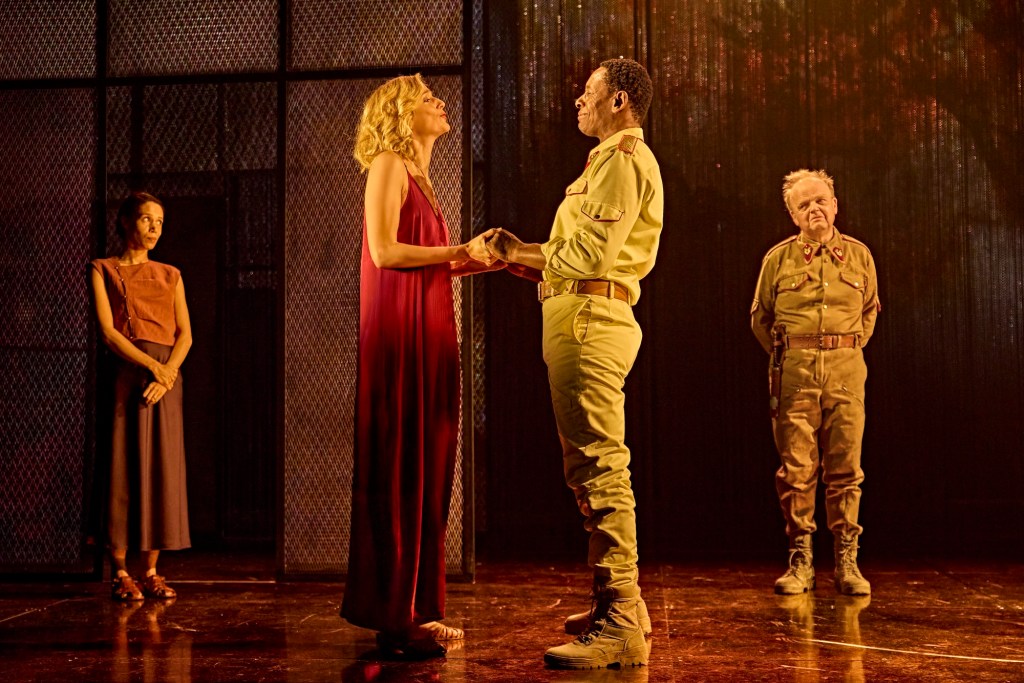
OTHELLO
by William Shakespeare
directed by Tom Morris
Theatre Royal Haymarket, London – until 17 January 2026
running time: 2 hours 45 minutes including interval
https://trh.co.uk/whatson/othello/
Raging passions and envy run through Shakespeare’s Othello like veins through the human body but that’s only fitfully apparent in this handsome West End mounting headed by David Harewood returning to the title role twenty eight years after playing it at the National. Harewood is, as expected, very fine, with natural gravitas and nobility, plus a voice that envelopes the language in a rich warmth that is a pleasure to listen to but never loses the meaning of it. He’s also such a good technician that he makes Othello’s descent into jealousy and mental disintegration plausible. If it’s not as moving as one might hope that is more due to other factors in Tom Morris’ production than the performance itself.
The modern dress staging (Ti Green’s costumes are pretty unflattering, borderline hideous though) is strong on storytelling and is an admirably swift, clear rendition of the text. It’s more workmanlike than inspired perhaps never drags, and has a genuinely innovative take on the tragedy’s doomed heroine, as played by Caitlin Fitzgerald.
This Desdemona is a mature patrician beauty who when required to soothe Othello to seems more like Othello‘s mother than his wife. She is initially formidable when standing her ground against her raging husband, then later admirably brave as she realises she’s staring down a dangerous, physically powerful man whose mental health has entirely broken down. Fitzgerald uses her own American accent, which gives the impression of Desdemona being as much an outsider as Othello himself, and speaks the verse superbly.
Toby Jones also has a masterful way with the language but it’s never clear what’s propelling this Iago towards destruction. The character is frequently portrayed as motivated by racism (which wouldn’t work in this interpretation as people of colour are integrated into the polyglot modern world of this production, plus his wife Emilia is Black here), or by unspoken love for Othello. This Iago just seems like a meddlesome imp, disempowered in multiple areas of his life, a mean-spirited manipulator for sure, but never truly chilling. There is perhaps a clue as to what powers him in a brief moment where he watches, intently and transfixed, as Fitzgerald‘s magnificent Desdemona kneels and prays in distress after a particularly nasty showdown with Othello. Is he in love with her or is he the type of sad little man who’s intimidated by the sort of strong woman that this Desdemona unusually is? His controlling behaviour towards his own wife is unpleasant to watch.
Ewan McGregor in the 2007 Donmar’s production gave us an Iago that was so affable on the surface that one could see how others were taken in by him, but Jones is quirkier than that. He’s a brilliant actor, capable of tremendous nuance and pleasing eccentricities, but he doesn’t strike me as a natural Iago, and it’s never entirely clear why he would have the ear of Harewood’s Othello.
Vinette Robinson is a terrific Emilia, a walking ball of understated anxiety and pragmatism that erupts distressingly (but dramatically satisfyingly) in the final act. Her howls of grief and screams of retribution at what Othello has done come from the depths of her soul. Equally, her crude, world weary assessment of men (“they are all but stomachs, and we all but food; to et us hungerly, and when they are full, they belch us”) seems to come from a place of bitter experience.
Elsewhere, Morris‘s production has an abundance of ideas, few of which seem fully formed, and so seldom coalesce into a satisfying whole. The Venetian scenes play out on a blank stage dressed with a series of gleaming frames that mirror the gilt gorgeousness of Haymarket’s auditorium while also suggesting a skeletal version of the elaborate ceilings in the Doge’s Palace. Then a series of images from exotic foliage to a full moon are beamed onto a stage-wide beaded curtain that looks as though it was bought as a job lot from the Jamie Lloyd Sunset Boulevard. The faces of principal characters are briefly projected huge at the back of scenes for no apparent reason, actors mime in slow motion upstage as others speak to the audience out front. Even more mystifyingly, lighting rigs fly and track on from the side for the final act as if to create a stage of the stage for Desdemona’s final reckoning. What’s that all about? Surveillance? The idea that Iago’s set-up for the tragedy turns everyone into play actors? It’s unclear. It’s not that the tone is inconsistent exactly, but nothing adds up.
PJ Harvey’s widely advertised musical contribution is unobtrusive to say the least, but Green’s set, Richard Howell’s lighting and Jon Nicholls’ sound design are all fine. Luke Treadaway is a decent Cassio, genuinely unhinged in drink, and there’s good support from Peter Guinness as Desdemona’s aggressively bereft father and Felix Hayes as the Duke of Venice, he and his church elder associates all wearing ID lanyards over their flowing scarlet robes. It’s interesting to note Rose Riley in the cast as a spirited Bianca: her luminous Desdemona was a highlight of the expressionistic 2023 Othello which cut the whole play down to 100 minutes and featured three Iagos.
This version isn’t as innovative as that, but it does give the tragedy its full dramatic weight. Essentially, it tells the story well while repackaging it as a semi-thriller; the nice Australian lady sitting next to me had never read or seen the play before but her gasps of shock and, at the end, her tears suggest that, for all my reservations, this Othello fundamentally works.
 ajhlovestheatre
Leave a comment