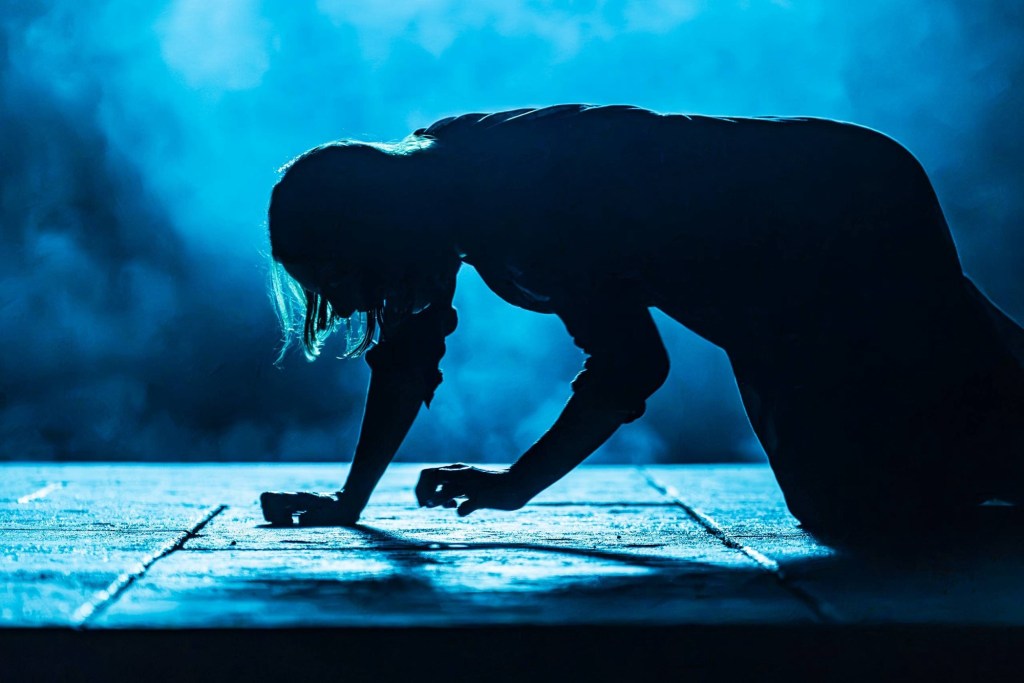
DESIRE UNDER THE ELMS
by Eugene O’Neill
directed by Ebenezer Bamgboye
Almeida Theatre, London – until 23 December 2026
running time: 2 hours 40 minutes including interval
https://almeida.co.uk/whats-on/desire-under-the-elms/
There were several times watching Ebenezer Bamgboye’s starkly powerful version of this 1924 Eugene O’Neill drama where I was reminded of Rebecca Frecknall’s career-defining staging of Tennessee Williams’ Summer And Smoke, which also played here at the Almeida. Both productions deconstruct not-quite top flight plays by revered American dramatists, finding in their stripped back, dream-like, music-soaked new aesthetics an elemental force and timelessness that proves shatteringly potent.
Another parallel between the two shows is that they both feature the kind of leading lady performances upon which reputations are built. Patsy Ferran’s Miss Alma in the Williams certainly turned the dial from a respected career to a starry one, and if there’s any justice Kelly Gough’s spellbinding, devastating turn as the spikily tragic Abbie in Desire Under The Elms will do the same for her.
In O’Neill’s American take on Euripides’ Ancient Greek tragedy Hippolytus, Gough plays Abbie Putnam (previously Phaedra) brought in as a trophy wife by grizzled, bullying farmer Ephraim Cabot (a splendid, complex Antony Byrne), who falls, with seismically tragic consequences, for her dispossessed stepson Eben (Zackary Momoh, electrifying). O’Neill had originally transplanted the spectacularly dysfunctional family triangle to New England but Bamgboye, despite stripping it of any period specifics (Camillia Dely’s costumes have a low-key hipsterish elegance), has moved the story again to the Deep South. That, and casting a Black actor as the furious yet vulnerable Eben, berating his hard-as-nails father for the way he abused and overworked his mother into an early grave, adds overtones of slavery. It’s not overdone but once you spot it, it casts everything in an intriguing new hue.
The trio of gifted actor-musicians who walk like somnambulists through and around the action like phantoms are also Black which gives the impression of Eben being more connected to the squabbled-over farmland than his white father and half-brothers. Singer Choolwe Laina Muntanga, as well as having a stunning voice used to thrilling effect throughout the show, also possesses a saturnine, commanding stage presence, as she represents at times not just one of the spirits but also Eben’s lost mother and the prostitute he dabbles with in the local town. Thomas Goodridge and Jamie Beamish contribute muscular, vivid impressions of Eben’s rough-hewn, downtrodden brothers.
Some people, with good reason, accuse Tennessee Williams’ work of being over-ripe, but O’Neill gives him a run for his money here. Desire Under The Elms is entirely gripping, especially in this production, but it has an overwrought, melodramatic quality that sometimes recalls soap opera, albeit with more poetic writing.
Bamgboye embraces the extremity rather than running away from it. There are multiple moments when he seems to be daring the audience not to laugh at the sheer, terrible enormity of what these flawed humans are going through, even heightening it with the use of animalistic, Frantic Assembly-style choreography (movement direction by Rose Ryan) that occasionally tips over into absurdity but mostly taps into the rich vein of theatricality running throughout the show.
The aforementioned lack of period specificity (Basia Bińkowska’s striking set is little more than a slate box in front of a mirror with a bucket suspended overhead) and ubiquitous musical score (superb work by XANA) lend the action and protagonists a fluid, mythic status that feels appropriate for a piece derived from Greek drama. The audience is on three sides of the stage which ups the immediacy considerable although Bamgboye’s preference for having characters walk round and round the playing area while raging or observing gets a bit repetitive.
If the ultimate impression of this enjoyably gruelling Desire is that it’s the work of a wildly talented director who hasn’t reached full maturity of discipline and imagination yet, Kelly Gough emerges from the inspired histrionic chaos as an actor at the very height of their power. In a performance devoid of vanity and fear, she conveys with forensic precision Abbie’s hardbitten exterior (when she talks about the roughness of her upbringing, we believe her) and volatility: watch how she toys with Eben like a cat tormenting a mouse, or the measured way she appraises Ephraim, at least until his abusive nature is turned on her. The detail and the laser sharp focus in her acting is astonishing, as is the erotic chemistry with Momoh’s terrific Eben, and the disturbing blurring of boundaries between lover and mother figure that emerges.
When things turn desperate, Gough goes into full cry Medea mode and she’s simply extraordinary. It’s not easy to make a character simultaneously pitiable and repellent, but Gough succeeds triumphantly. Incandescent and unforgettable, this is one of the performances of the year and surely one that will catapult Kelly Gough to the top of every decent casting director’s must-see leading lady lists.
Desire Under The Elms is no easy watch but it’s a fine, fiery night in the theatre, shot through with grim, raw humour and a sometimes wayward sense of invention. Engrossing, shocking and, finally, oddly moving.


Leave a Reply