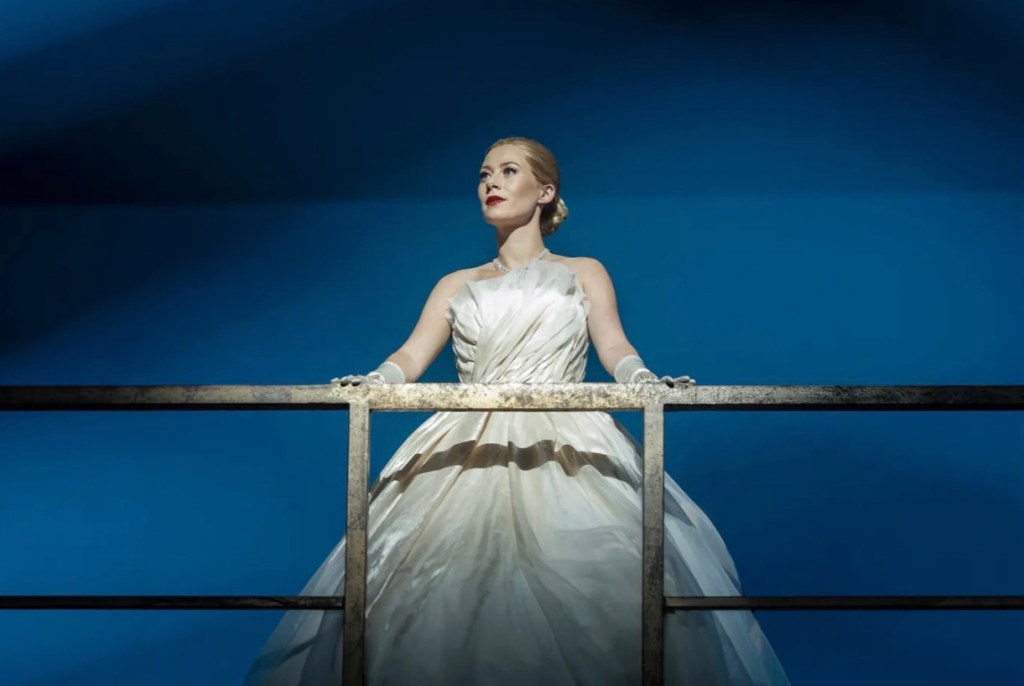
EVITA
Music by Andrew Lloyd Webber
Lyrics by Tim Rice
directed by Niclas Bendixen
Det Kongelige Teater at the Opera House Copenhagen, Denmark – until 20 December 2026
running time: 2 hours 20 minutes including interval
https://www.kglteater.dk/en/musical/2627/evita/
As it’s long been an established part of the musical theatre canon, it’s easy to forget that Evita was first billed, on the legendary ‘white album’, released several years before Harold Prince’s original staging saw the light of day, as an opera about the life of Eva Perón. So in that sense, Niclas Bendixen’s epic, Danish language production for Denmark’s National Theatre, and majestically ensconced at the Copenhagen Opera House, is a sort-of homecoming for this beloved work.
Bendixen, in tandem with the frequently jaw-dropping technical possibilities of a modern opera house’s vast stage (and, it would appear, the budget to match), has quite a few tricks up his sleeve, but nothing that is likely to horrify the most vociferous fans of Tim Rice and Andrew Lloyd Webber’s tuner. Indeed, this grandiose Evita may just be balm for the soul of those aficionados who actively loathed Jamie Lloyd’s sexed-up, paired-down reimagining, where storytelling played second fiddle to in-ya-face showmanship and aggressive modernity.
That’s before one even realises that the Royal Danish Orchestra, under the assured baton of either Joakim Hallin (alternating with Carlos Vázquez), is being let loose on the score. There are multiple moments here where the sheer wall of glorious sound coming at you (the orgasmic fervour of the opening Requiem after the singers reach their vocal climax, the orchestral swell following ‘Don’t Cry For Me Argentina’, the rich, full bloom of ‘Waltz For Eva and Che’ just before the former collapses) sends a chill up the spine and tears to the eyes. The soaring strings – not synthesisers, actual musical instruments – in the background of ‘High Flying Adored’, the crashing bombast of the dance break in ‘I’d Be Surprisingly Good For You’….all this is like heaven on earth for Evita fans…
The more upbeat elements of the score are fabulously served too (the production uses the more Latin orchestrations, and, as they should, the thunderous timpani and percussion on the ‘Buenos Aires’ threaten to blow the roof off) as are the stranger, more dissonant sections, which seem oddly well suited to a modern opera house. On the whole, this is possibly the most persuasive case for Evita being Andrew Lloyd Webber’s finest, most varied musical score, that I’ve ever heard “live”.
The sheer scale of Bendixen’s staging is thrilling – the opera house stage is enormous and he seems hell bent on using every inch of it, including above and below – but so are his more unusual choices. If you’re not an Evita obsessive you may want to skip the next five paragraphs, ditto if you have tickets for this production and want to be surprised. This version cuts the cinema prologue, going straight into Eva’s funeral, staged with cinematic flair but a bleak simplicity as the black clad, candle-carrying ensemble wander through the endless night-space lamenting. It also omits the coda where we learn the bizarre fate of her corpse.
The sometimes awkward gear change from the portentous classicism of the Requiem into the modern-ish, almost jaunty ‘Oh What A Circus’ is avoided by having Kenneth M Christensen’s Che begin the latter number entirely acapella, a mourner musing almost incredulously as he divests himself of his black garb. Evita herself first appears rising from beneath stage level at the rear of a cavernous space empty except for the mysterious female religious icon floating in a sun-like contraption overhead, a visual motif that comes back to haunt Eva later in the show.
The first section of ‘Buenos Aires’, almost up to the dance break, is clearly all in Eva’s head, a country dweller’s romanticised dream of big city life and how welcoming it’ll be, which adds to the tension when she tries to inveigle her way into society only to be firmly snubbed. ‘The Art Of The Possible’, the fiendishly clever number that delivers a potted impression of how unstable Argentine politics were, retains the musical chairs game created by Prince and his choreographer Larry Fuller, but adds a really nasty sting in the tail, indicating just how treacherous Julian Kellerman’s Juan Perón is capable of being. Similarly, during ‘A New Argentina’ this production stresses that Eva is entirely aware of the kickings the Peronista heavies are giving dissenters.
A criticism sometimes levelled at the show on stage is that it depicts a woman who was essentially a fascist dictator’s wife in a sympathetic light, but this version doesn’t sugarcoat how ruthless and amoral Eva is. Amusingly, in ‘Goodnight and Thank You’ she’s clearly bonking every Tom, Dick or Harry, not just men who can facilitate her social and professional rising. Her dismissal of Perón’s mistress (a sweet-voiced, heartbreaking Dafne Stilund Nielsen) is chilling, and the attraction to the man himself feels more transactional than I’ve ever seen it before.
Remarkably, Bendixen’s production does ultimately manage to elicit some sympathy for Eva despite everything we’ve seen. ‘You Must Love Me’ is sung like a plea by a vulnerable Eva, the only woman on stage in a sea of army officers (this being an opera-sized production, there are twice as many of them as we usually get) to an entirely impervious Juan. During the ‘Dice Are Rolling’ section where Perón lets slip that his wife is dying, Bendixen has a clearly sick and distressed Eva carrying around her white ball gown from the balcony scene as though it’s a comfort blanket. It’s a pathetic sight culminating in her clambering into the dress during the “and I shall have my people come to choose…” aria in a desperate bid to relive the glory days. It feels like an intimate snapshot, however fanciful, into something private and tragic.
The ‘Final Broadcast’ further ups the pity ante, with Eva lying on the floor like a broken doll with Che holding a microphone to her mouth as he whispers the words to her so that she can repeat them. There then follows probably the most stupendous version of the montage section that I’ve ever seen, the multi-level towers, full of watchful, accusatory ensemble members, of Benjamin la Cour’s staggering set design in constant motion as figures from Eva’s past return to confront her. It was cruel genius to have Perón’s discarded mistress return, now less victim and more avenging angel, to sing Eva’s section of ‘I’d Be Surprisingly Good For You’ directly into our bewildered anti-heroine’s face: Nielsen’s transformation is subtle but brutal.
The final lament when it comes is beautifully simple but hugely affecting, a prone Eva alone on a stage-wide platform that majestically levitates ever higher in a vast black void as the female religious icon from the opening looks impassively on.
This production fields two Evita’s, performing on alternate days and given equal billing (there are even separate editions of the poster with each in the white dress with the blonde swept back hair). I saw Sara Viktoria Bjerregaard (the other Eva is Cecilie Stenspil) and she’s terrific. Her voice is like silk shot with smoke, a plaintive, pretty instrument with a certain mellowness that belies the ease with which she negotiates this demanding score. As with Rachel Zegler, you’re never aware of the hard work but as with Elaine Paige, Patti LuPone and, to an extent, Elena Roger, there’s a certain rawness in the timbre that excites. The only disappointment is the decision to opt down in the usually roof-rattling sections of ‘A New Argentina’.
Bjerregaard convinces entirely as an ambitious schemer and has an unforced authority that makes it hard to take your eyes off her; it’s not a warm portrayal on any level, but then neither really was the way Eva was depicted in the Prince version. She’s truly haunting in the second half as the character’s health collapses. It’s a diva role, and we get a diva.
Christensen’s Che, costumed as the Everyman we have been used to seeing since the movie version, reads as more mature than usual but is sung with effortless panache. He acts the role with a fascinating combination of the laconic detachment familiar from more conventional interpretations, and an invested warmth that adds an extra layer of emotional connection. His critical analysis of Eva’s behaviour almost comes across as parental: disappointed, sometimes furious, the open antagonism between the two of them more highlighted than usual. Yet ultimately he seems the only figure on stage who actually cares about her. It’s a subtly unconventional take that works.
Kellerman’s Perón combines sleaze and weakness to memorably nasty effect, and Carsten Svendsen is very effective as a comically spineless womaniser Magaldi. The choral singing is everything you would hope.
Anja Vang Kragh’s costumes – opulent and gorgeous for Eva and the all white clad aristocrats, period specific for everyone else – scream quality, and there are so many of them….. Ulrik Gad’s sculptural, moody lighting design is another highlight, and the sound by Tim Høyer is admirably crisp and clear. Some people may miss the sheer overwhelming force of Adam Fisher’s work on the Palladium production, but hearing every delicate instrumentation and vocal harmony feels like a decent pay-off, and anyway this production is anything but quiet.
The set design by la Cour is a thing of wonder, simultaneously monumental and abstract, but capable of transformations that take the breath away. Technically, it’s astonishing: multiple levels rise and fall, sometimes simultaneously, towers the entire height of the stage revolve, travel and contract, revealing floors and staircases within, the enormous playing area is entirely empty one moment then in a blink of an eye is a whole bank of neon lit staircases. It’s a stunning spectacle but always with storytelling at its core, it never feels like empty extravagance.
So what doesn’t thrill? Well, perhaps inevitably there is a scarcity of authentic Latin heat, but then that was never a major factor in the acclaimed original. The balcony scene, although Bjerregaard’s ‘Don’t Cry For Me Argentina’ is gorgeous, is very straightforward. The scale and sound mean that it still impresses, but it is so static that it almost feels like something from an oratorio. That’s ironic given that this is a production that finds places to put choreography (supremely rousing if over-used work by Signe Fabricius) that sometimes feels like movement for the sake of movement. You can’t really count Fabian Aloise’s rightly award-winning work for Jamie Lloyd as that Evita is more arena spectacular than traditional stage musical.
Those are small niggles though in a soaring production that is likely to create new fans as well as surprising and delighting long term Evita enthusiasts. The flame is kept burning bright, yet strangely refreshed. A gleaming, memorable Evita, and an epic theatrical experience.


Leave a Reply