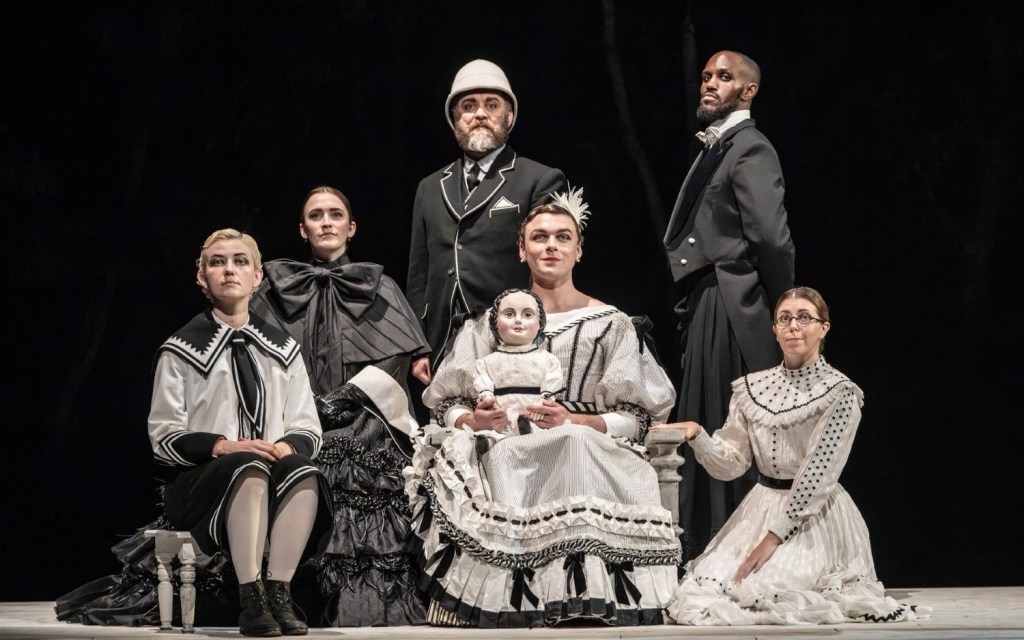
CLOUD 9
by Caryl Churchill
directed by Dominic Cooke
National Theatre/Lyttelton, London – until 13 January 2027
running time: 2 hours 45 minutes including interval
https://www.nationaltheatre.org.uk/productions/cloud-9/
If ever proof were needed that challenging, thought-provoking art and rollicking good fun are not mutually exclusive, Caryl Churchill’s rarely seen 1979 play Cloud 9 is that proof. Dominic Cooke’s glittering, flawlessly cast production for the National is probably the finest account of this epoch-making piece tackling feminism, sexuality, colonialism and gender identity that we are ever likely to see. It is fascinating to note how Churchill’s play is simultaneously stuck in a sort of 1970s time capsule while still speaking to us urgently and movingly right now.
The playful, fluid approach to gender and sexuality (male-presenting actors play women and little girls, female-presenting actors play little boys and men, sexual confusion -some joyful, some painful- abounds) feels less bracing and surprising in 2026, but the play’s highly original structure and Churchill’s keen, kind but clear-eyed perception of humanity still has the power to properly floor us. And oh boy is it funny.
Act one, set during Victorian times in a British colony in Africa, plays out like a cross between a satirical cartoon made flesh and a demented sex farce. Patriarch Clive (Sam Troughton delivering a masterclass in swivel-eyed, bloviating comic pomposity) is a raging snob, petty tyrant and hypocrite, ruling perpetually self-deprecating wife Betty (a witty, lavishly gowned Stuart Thompson) with a rod of iron while also having it off with local adventuress Mrs Saunders (Rebecca Humphries, an absolute riot).
Meanwhile son Edward (Ellen Robertson) wants to play with dolls and, more troublingly, also their preposterously macho house guest, explorer Harry Bagley (Tom Mothersdale) whom Betty also has designs on. On top of all this, governess Ellen (the brilliant Humphries again) is in lust with her female employer, as Betty’s starchy mother (Charlotte Ritchie) drains the joy out of every situation, and African manservant Joshua (Eloka Ivo) appears to be entirely submissive (“my skin is black but oh my soul is white”) but has revolutionary plans of his own.
It’s a bit Monty Python, and a bit French and Saunders in their heyday, superbly marshalled chaos that treads the fine line between truth and grotesquerie. While it’s laugh-out-loud hilarious, the undertow of disquiet under the absurdity of the constant toasts to Queen Victoria at the Christmas picnic, the resentful parlour games and frantic, furtive coupling, is impossible to ignore: why are the white men so awful, why do the women get such raw deals which they ongoingly self-perpetuate ….and what’s really going on with Joshua (a role played in the original production by a Caucasian actor, in an even more edgy comment on colonialism)?
Designer Miriam Buether sets it sumptuously on a glossy black stage under a lush canopy of trees, all placed inside a chocolate box-y proscenium arch with ornamental plaster and gilt surrounds and deep scarlet curtains. Costume designer Samuel Wyer’s work is equally gorgeous and multi-faceted. The characters look like something from a Merchant Ivory film but heightened somehow, more flamboyant.
The production goes on to deliver a theatrical volte face that matches the one built in to Churchill’s astonishing script. Cooke and the design team blow the stage apart, in much the way the radically progressive plays of Cloud 9’s 1970s ilk rent asunder the staid theatrical conventions that came before them. When we return from an extended interval, Buether’s traditional pros arch is literally in pieces, upended and scattered across the playing area, the house curtain lying unceremoniously across the front couple of rows of the stalls, the act one occupants of which are now milling about onstage. As a metaphor, it’s both neat and unsettling.
We are now in the 1970s but for Churchill’s dramatis personae only twenty five years has passed. Betty (now played by Robertson, whose transformation from the precocious but messed-up little boy she embodied in the first half takes the breath away) is a sprightly elderly lady, with a personal style clearly modelled on Elizabeth II in late middle age, who has finally left the horrific Clive. Her daughter Victoria – a ventriloquist’s doll in the first half – is now a bisexual feminist in an unhappy relationship and with a child of her own. Again, the excellent Ritchie is almost unrecognisable as is Humphries, marvellous as Lin, the spiky working class mum who’s attracted to her.
Mothersdale contributes another memorable portrait of appalling maleness as Victoria’s partner, the kind of man who considers himself such an ally to women that he’s writing a book all about the female experience, from the point of view of a woman. Yikes. Ivo plays the promiscuous, free-spirited lover of now grown up Edward (beautiful work from Thompson) and he nails the character’s emotional carelessness and priapic quest for adventure. He has a change of heart near the end that, though well acted, doesn’t feel fully earned, and is one of the few weaknesses in the writing.
The sight of bearded Sam Troughton as Cathy, Lin’s six year old whirlwind of a daughter, alice-band in hair, play dress smudged with paint, discovering the world around her with wide eyes and clenched fists, is worth the price of a ticket by itself. She’s wildly amusing of course but it’s also a meticulously observed piece of acting.
It’s a fabulous surprise in an evening full of them. I also never thought I’d be wiping away tears at an elderly woman’s monologue about masturbation and shame (delivered exquisitely by Robertson). There’s something touchingly naive about the depiction of adult Edward’s mulling over whether he wants to become a woman, but there’s never any doubt that Churchill is coming at her subjects with great compassion.
The inclusion of the Northern Ireland conflict in the second half inevitably resonates less in 2026 than it once did, but there’s an implicit suggestion that the British swapped one set of colonialism for another. More persuasive is the notion that compliance and acceptance in women can never be a positive way forward.
Cloud 9 is a big-hearted, big-mouthed crackerjack of a play that still resonates down the years, full of imagination and well-honed anger. It’s an essential part of modern theatre history but one that feels scintillatingly alive in this glorious production. It’s late in 2026, but the National has given us one of the productions of the year.


Leave a Reply