THE STANDARD OF LIVING
by James Graham
directed by Nicholas Hytner
Theatre Royal Haymarket, London – until 12 December 2026
running time: 2 hours 30 minutes including interval
The importance of the arts to the overall quality of life is an ongoing conversation between the moneyed and the creative, and it runs through James Graham’s new play like words through a stick of rock. Despite an oil smooth staging by Nicholas Hytner and a magnificent central star turn by Rory Kinnear, The Standard Of Living is an uneven, only intermittently focused piece, but it’s heart is undoubtedly in the right place.
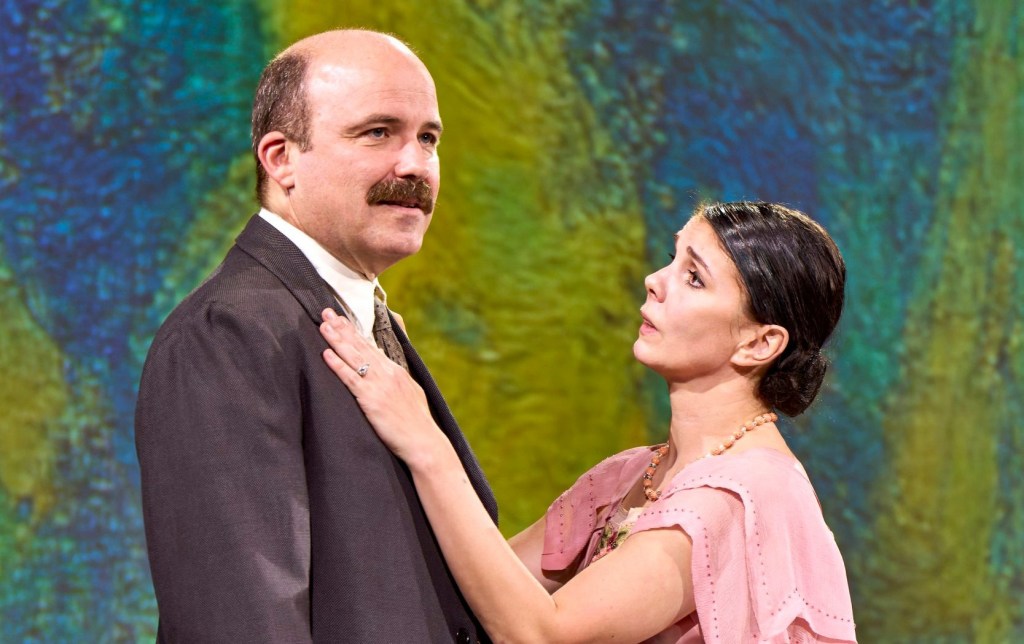
Kinnear plays John Maynard Keynes, the economist instrumental in establishing global financial stability while also bearing witness to some of the most extraordinary events of the last century and having one foot planted equally in the bohemian Bloomsbury Group. So, we get to meet such artistic luminaries as Virginia Woolf (Naomi Frederick), painters Vanessa Bell and Dora Carrington (Claire Price and Agatha Enecio respectively) and biographer Lytton Strachey (Pip Carter). More significantly, the play features both Keynes’ lover, painter Duncan Grant (Thomas Flynn in a beguiling West End debut) and wife, former ballerina Lydia Lopokova (played here, in a stroke of true luxury casting, by real-life Russian prima ballerina Natalia Osipova).
John Maynard Keynes’ ongoing preoccupation with the question of what makes “a good life” informs most aspects of a play that’s suitably heady, and frequently deliciously witty. Graham has form in making subjects that might seem theatrically intractable – such as the football World Cup (Dear England), the dubious morality of Fleet Street (Ink), the machinations of British politics during the troubled 1970s (This House) – into plays that dazzle with their bravura entertainment value as much as their rigorous intellect.
Ultimately though, The Standard Of Living feels more like a pageant of the great, the good and the downright batty through some of the seismic events of the early twentieth century rather than a satisfying, coherent piece of drama. When Graham writes about something that is really close to his heart (last year’s multi-award winning Punch, for instance, set in his hometown and dealing with community, consequences and healing) he is unmatchable, but this one feels like chilly, low-key Stoppard.
If the tendency to shuffle historical figures on and off stage with almost indecent haste, and an over-stuffed yet curiously shapeless structure that recalls Graham’s book for the middling Tammy Faye musical, means that The Standard Of Living is a play as conflicted as Keynes’ own loyalties, there’s still a lot to enjoy here. The dialogue frequently fizzes with bracing intellectual energy and naughty humour, and some of the acting is a source of genuine pleasure.
Osipova is a real treat as the tempestuous, tactless but loving Lydia, capturing both her diva tendencies and her staunch affection for her husband. Frederick suggests Virginia Woolf’s brilliance but also troubled brittleness, and Price beautifully delivers Vanessa Bell’s professional resentment yet personal warmth. A couple of the other performances have a tendency to broad strokes and questionable accents.
Kinnear really is remarkable, conveying Keynes’ brilliance but also his compassion, humour and his slight strangeness (note the vaguely prissy way he notes every male sexual conquest in a little book). He masterfully hints at an intellectual competitiveness within John, and his own surprise at his attraction to the fiery, abrasive Lydia is made wonderfully vivid. This is an immense performance, seldom grandstanding but full of truth and intelligence.
Hytner’s production, punctuated by bursts of recreated choreography for Osipova and a supporting cast of fine dancers, is an attractive synthesis of all the creative arts that so powered and spiritually enriched Keynes. Bob Crowley’s sliding panels set, inspired by Bell’s abstract canvases, also serves as a series of screens upon which paintings and period photographs are projected to sometimes dazzling effect. It’s striking how, as the evening progresses, the visual colour pallet, including Bruno Poet’s lighting, gradually drains of hue until we are looking at an almost entirely monochromatic stage, just as austerity engulfed Europe as it slid into two World Wars.
The Standard Of Living may lack the fire in its belly that ignites Graham’s finest work, but its themes are timely, and Kinnear’s performance soars over and above any shortcomings in the script. For all its flaws, this is a stylish piece of high quality theatre, and it’s hardly surprising that its limited West End season is virtually sold out.


Leave a Reply