MARTIN GUERRE
Book and lyrics by Alain Boublil
Book and music by Claude-Michel Schönberg
New lyrics by Annabel Mutale Reed
New lyrics and additional material by Paul Hodge
developed and directed by Matthew Warchus
The Old Vic, London – until 31 October 2026
running time: 90 minutes no interval
https://www.oldvictheatre.com/stage/martin-guerre/
Where Declan Donnellan’s original West End Martin Guerre (all three versions of it) at the Prince Edward was lush, expansive and, in the underrated final iteration with the replacement cast led by Jenna Russell, emotionally cathartic, Matthew Warchus’ bullet-point ninety minute revisal for the Old Vic is dour and dark. Billed as a semi-staged preview run (although I would argue that it’s way more fully realised than last season’s Broadway Chess, which was essentially a concert with choreo), this new look at Alain Boublil and Claude-Michel Schönberg’s “problem child” third musical (how do you follow Les Mis and Miss Saigon?!) strips it right back, with results that are by turn powerful then frustrating.
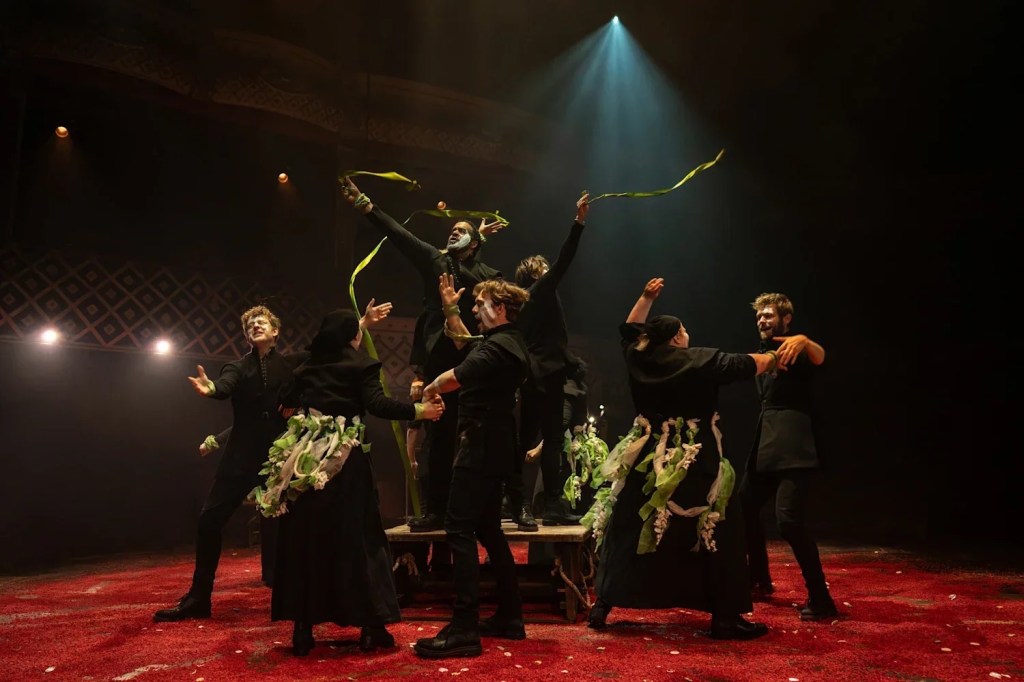
The medieval rural French village from which bullied, alienated Martin escapes to war, leaving new bride Bertrande high and dry, only to return a much changed man years later, is here a brutal place, plagued by land squabbles and drought. Warchus and his designer Rob Howell set the whole thing up as though it’s a satanic ritual, the company entering the circular playing space clad in black hooded robes and daubing their faces from a passed around bucket of paint (suggesting community perhaps? tribalism? collective guilt? it’s never clear) before emerging as individual figures in the grim tale. Although the mob’s treatment of Liv Andrusier’s grave, compelling Bertrande and Dan Hand’s young Martin is explicitly horrifying, the speed with which the show rattles through the story and the visual darkness that permeates the staging, sometimes making it difficult to distinguish who’s speaking or singing, makes it harder to connect with the characters.
Gone is the conflict between Catholics and Protestants, and also any light relief whatsoever. Bob Avian’s exhilarating, epic stomping dances are also gone, Lizzi Gee’s new work having a satisfyingly organic feel closer to movement than full-on choreography. The operatic scale and scope of the 1996 original (the opening of the first production which saw the sun coming up over the villagers toiling in the fields, the sound of a solo woodwind instrument giving way to full orchestral swell as the sun rose in the sky, remains one of the most beautiful starts to a musical I’ve ever seen) is replaced with a folky sensibility, which in some ways suits the unsophisticated setting and characters better.
Boublil and Schönberg’s score in its present form, with new lyrics by Annabel Mutale Read and Paul Hodge that are decent enough but hardly a significant improvement on those in the later versions of the original, is a hybrid of new and old material. It has less of a poppy edge than either Les Misérables or Saigon but it is frequently just as catchy. At its most melodic, it’s heart-stirring and gorgeous, and at other times it has a curious, elliptical quality closer perhaps to modern opera than musical theatre. In Tom Curran’s reduced orchestrations which intriguingly includes a lute but no keyboards, it sounds rustic and attractive though it seldom soars the way it can. The singing, technically excellent throughout, is more about dramatic expression than sounding pretty which feels appropriate for a musical where romanticism is eschewed in favour of trauma and starkness.
Andrusier is superb as Bertrande, vividly capturing her anger, her defiance but also her grace. As a childless woman abandoned by a husband she barely knew, she is treated abominably by her community; this new version leans into that but also beefs up her relationship with her conflicted mother (Caroline Sheen delivering fine, truthful work). Unfortunately though it also robs her of her agency by keeping her in the dark (as so much of the production literally is) over the fact that the ‘Martin’ returned from fighting is not the man she married. There was a heartstopping sequence in the original where the communal celebratory dancing stopped and a blindfolded Bertrande is ushered in to meet an also-blindfolded Martin (actually Arnaud Du Thil), and in that moment then the following duet it’s clear that she makes a conscious decision to maintain the deception. That gave her power and made their subsequent falling in love into something really urgent. For all the craft, fire and commitment in Andrusier’s performance, this Bertrande feels more like a victim than a heroine.
Shane O’Riordan brings warmth and gentle magnetism to Martin #2 but the genuine article is so thinly characterised that there is only so much Alex James-Hatton can do with him, although he does have a hugely impressive high tenor belt. Barney Wilkinson glowers effectively as villainous, aggrieved Guillaume driven by his equal obsessions over land and Bertrande, and Adam Pearce is ominously effective as a self-satisfied priest. Colin Ryan has some tender moments as the naive savant who also loves Bertrande but it’s interesting that this new Martin Guerre retains the idea of him constantly talking to a scarecrow he drags around with him, which was always one of the most head scratching aspects of the original.
Warchus’s mastery of the circular playing space is formidable and he is aided immeasurably by a beautiful, sculptural lighting design by Hugh Vanstone, Luca Panetta and Toby Ison. The face paint is a mixed blessing though, distractingly making some cast members look as though they are suffering from vitiligo, and the use of swirling flags and dry ice to denote battle and the passage of time is overdone. There’s also a flashback sequence, vaguely reminiscent of act two of Miss Saigon, but it doesn’t show us anything we haven’t already seen.
What really does work though is starting and ending the show at the same point, with all the interim scenes explaining why Bertrande is in despair and who the pleading hooded man being led away to execution actually is. It’s just a shame that, in trying to find the sweet spot between folk parable and bloated musical, so much emotional resonance and breadth of tone has been jettisoned. In fairness, this month long run at the Old Vic is billed as a “preview production” so it’s to be hoped that, as the work continues, Warchus and team can find a way of putting a little more meat onto these slightly undernourished bare bones. Musically though, Martin Guerre remains a rare treat.


Leave a Reply