FENCES
by August Wilson
directed by Daniel Bailey
Lyric Hammersmith Theatre, London – until 31 October 2026
running time: 3 hours including interval
https://lyric.co.uk/shows/august-wilsons-fences/
August Wilson’s great urban tragedy, number six and arguably the greatest in his cycle of ten plays about the Black American experience in all its glory and pain, gets a respectful but considered production by rising star director Daniel Bailey. This Fences is a joint venture between the Lyric Hammersmith, Leeds Playhouse, Manchester Home and Headlong, and is another fine example of world class drama far away from the bright lights and extortionate seat prices of the West End.
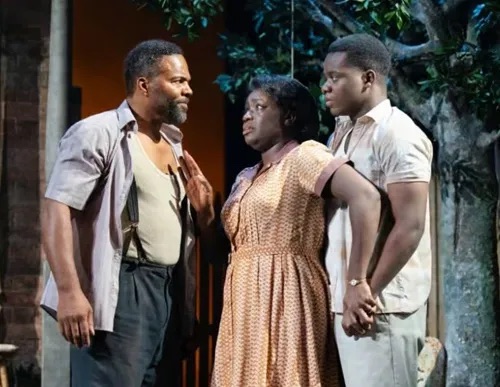
Fences won the Tony and the Pulitzer when it premiered in 1987 and it’s not hard to see why. It’s a magnificent play, albeit an imperfect one. It takes its sweet time (three hours including interval, but that’s ok, nobody goes to a Wilson drama for the brevity) but by allowing us to really live with and bed in with this working class Black Pittsburgh family in the 1950s, it’s ensured that when the emotional catharses come they hit hard. It has effortless breadth of scope but is full of telling detail and rich humanity. It also looks particularly striking in this version: Lily Arnold’s spinning house and dusty backyard set grounds the play most convincingly before being periodically plunged into a fanciful, neon-edged twilight by Jai Morjaria’s lighting design.
Ray Fearon, in what must surely be career highlight work, plays Troy Maxson, formerly a star of the baseball pitch in the Negro Leagues (by the time segregation in the sport ended he was past his prime) but now reduced to being a garbage collector, living for payday Friday. Fearon makes every aspect of this flawed, brilliantly drawn character (created onstage by James Earl Jones and subsequently played in a Broadway revival and immortalised on film by Denzel Washington) thoroughly convincing. He has the arrogance both of the sportsman who achieved a degree of celebrity and of the swaggering man of the house, providing for his wife and kids while assuming that he also has control of them, but also hints at the weariness and defensiveness of the former jailbird, and the sense that he is almost trapped as trapped in his workaday life as he was when incarcerated. Fearon invests Troy with irresistible charm and virility but he also gives us tantalising glimpses of uncertainty beneath the alpha male bravado, of the discomfiture that comes from the creeping realisation that, for some folks, you can try to do everything right but the great American Dream will always be just out of your grasp.
Realism and symbolism (Troy’s brain-damaged, trumpet-playing brother, beautifully played with a unique mixture of sweetness and danger by Simon-Anthony Rhoden, is called Gabriel, as in the Archangel….) sit slightly clumsily alongside each other in Wilson’s text. Wisely, director Bailey lets the play speak for itself, also placing particular emphasis on the music that underscores these people’s lives. Jazz and blues (superb contribution by Khalil Madovi) runs through and alongside the action, as if to console, enliven and just occasionally to taunt.
Madeline Appiah is wonderful as Rose, holding the Maxson house together even after the usual bonds of marriage have been cruelly shucked away. Viewed through a 2026 feminist prism, Troy’s betrayal of his wife might just be unforgivable (the expressions of disgust from the audience on opening night were as loud as anything on stage), his protestations and excuses actively diminishing him before our very eyes. Appiah and Fearon play it unflinchingly.
Similarly thrilling is the showdown between Troy and the son who would love to follow in his sporting footsteps. Josh Tedeku is heartbreakingly good in this role, and there’s further sublime work from Michael Ahomka-Lindsay as his half brother, and from Everal A Walsh, memorably grizzled as Troy’s great drinking buddy.
Fences is a tough play. Its length is challenging but so are truths it imparts about America, about race, about responsibility and about family. It’s worth the effort.


Leave a Reply