HAY FEVER
by Noël Coward
directed by Emily Burns
Wyndham’s Theatre, London – until 12 December 2026
running time: 2 hours including interval
It’s almost inconceivable that it’s only now that Christine Baranski is making her West End debut. With her willowy elegance and martini-dry wit, plus a sly, underlying hint of real naughtiness, she is, on paper at least, an ideal Noël Coward leading lady. She’s presumably the main raison d’être for this sumptuous if hardly revelatory revival (the sixth in London in thirty years) by Emily Burns of Coward’s crowd-pleasing ‘Comedy of Bad Manners’.
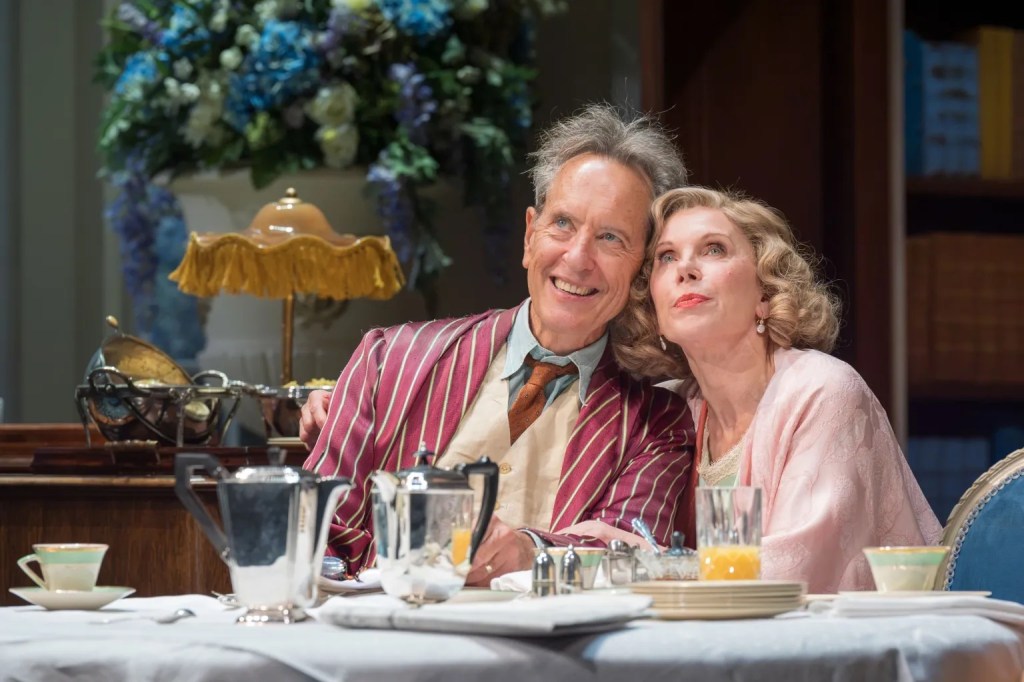
In Hay Fever, Baranski plays starry former stage actress Judith Bliss, blasting and sashaying through her idyllic rural retirement with the help of her eccentric novelist husband (Richard E Grant) and Simon and Sorrel (Will Close and Ophelia Lovibond), her equally histrionic grown-up children. It’s a peach of a role, ripe with opportunities for high camp self-dramatisation and comic excess.
The biggest surprise about Baranski’s performance is just how understated she is. Instead of the selfish yet irresistible grandstanding glamour-monsters many of her predecessors (Penelope Keith, Maria Aitken, Judi Dench, Lindsay Duncan, Diana Rigg, Felicity Kendal) have delivered, this Judith is more sweet and dotty, often archly funny but seldom lethal. Her voice is fascinating, ranging from the timbre of a breathy flute to the basso profondo of an aggrieved bullfrog whenever she’s especially outraged or offended. Her comic instincts are, as expected, sublime (she makes something gloriously off-kilter out of the line “David’s been a good husband to me, but he’s wearing a bit thin now”) and she’s incredibly lovable, maybe too much so.
Her accent sometimes verges on mid-Atlantic but that works perfectly well, since there’s nothing in the text to dictate that Judith should be native English, and anyway the character was inspired by the veteran American actress Laurette Taylor. But she’s just a bit too sane and nice to really satisfy. There should be an unhinged savagery lurking just underneath the actress’s grandeur and verbosity, and Baranski seldom lets us glimpse that. It probably doesn’t help that, in the role of vampish Myra, invited for the weekend by besotted Simon, Nancy Carroll possesses every single attribute required to be an absolutely outstanding Judith.
With a central performance that tends more to subtle rather than barnstorming, Hay Fever feels like much more of an ensemble piece, despite Baranski’s undeniable presence, and that ensemble is, on the whole, excellent. Carroll is sublime and so is Charles Edwards as another suitably appalled house guest. Grant is winningly strange and socially clueless as eccentric writer David. Lovibond and Close nail the volatility and self-absorption of the offspring, although the characterisations will feel very mainstream to anybody who caught Phoebe Waller-Bridge and Freddie Fox in the same roles in the 2012 Lindsay Duncan-led revival where the Bliss kids were hilariously reconceived as a pair of gawky, near-feral bohemians.
There’s excellent work from Ash Hunter as Judith’s hunky, eager-to-please guest Sandy, and from Lucy Karczewski, unrecognisable from her West End debut in last year’s Stereophonic, as a nervy, uptight flapper David is studying for research purposes. As often happens in Coward revivals of recent years, the ‘servant’ role comes close to stealing the show, and so it proves again here with Jo McInnes getting lugubrious comic mileage out of Judith’s former dresser and now housekeeper Clara, the kind of taciturnly judgemental but low level bonkers woman accustomed to huge swathes of her life in the backstage gloom.
As if to point up the theatricality of Judith’s moneyed existence, Frankie Bradshaw’s utterly gorgeous setting is an extension of the Wyndhams auditorium’s own decor, down to the powder blue wallpaper, golden cornices, twinkling chandelier, and the deep navy of the carpets. Her costumes are equally opulent and pleasing to the eye.
Director Burns gives Hay Fever to us straight. There’s no attempt to comment or recontextualise or, as in the aforementioned Howard Davies-directed 2012 production which presented the Bliss country pile as a wildly disarrayed, barely functioning house of artsy squalor, find any psychological depth. This is a solid, attractive staging, the kind of show you talk about for about fifteen minutes at dinner afterwards then barely remember the next day. It’s fun, and glamorous, and starry…and for many people that will be more than enough.


Leave a Reply