THE STORY
by Tracey Scott Wilson
directed by Clint Dyer
National Theatre/Olivier Theatre, London – until 24 October 2026
running time: 2 hours 20 minutes including interval
https://www.nationaltheatre.org.uk/productions/the-story/
It has only taken twenty three years for The Story, Tracey Scott Wilson’s hybrid of thriller and race-driven social realism, first seen at New York’s Public Theater, to cross the Atlantic. Watching Clint Dyer’s strident yet leaden UK premiere for the National, I’m not sure it was worth the wait.
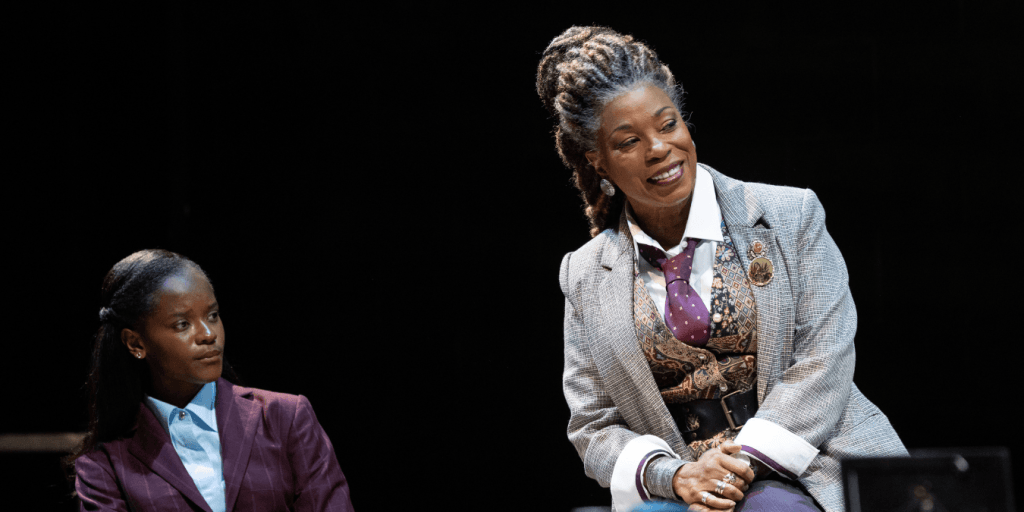
Partially inspired by the disgracing of Washington Post journalist Janet Cooke for fabricating an incendiary news story in the early 1980s, The Story centres on ambitious young Black writer Yvonne (Letitia Wright) determined to make her professional mark unencumbered by perceptions and prejudices related to her skin colour. She starts working at Vanguard, a fictional newspaper, under the watchful, not always approving, eyes of an uncompromising editor (Lorraine Touissant) whose fierceness belies a complicated history with the Civil Rights movement. A white schoolteacher is murdered in a predominantly Black neighbourhood, and Yvonne is all over the story, driven by an encounter with a random young woman named Latisha (Aliyah Odoffin), who appears to have one foot in the urban streets and the other in the more rarified world of advanced education (she speaks multiple languages).
Scott Wilson tells her story in short, sharp bursts, often having scenes happening concurrently on stage, lines and exchanges criss-crossing between different locations and time frames. It’s not confusing, but it starts to feel like a gimmick pretty early on, one that neither illuminates the plot nor ups the theatrical ante. It does however play havoc with the pace as it becomes awkwardly obvious that actors are waiting to pick up their cues from each other across the vast expanses of the Olivier stage, thereby lending an unhelpfully tentative air to a piece that should come at us like a train. Dyer punctuates these moments with staccato flashes courtesy of lighting designer Paul Anderson and sound designer Benjamin Grant, but it feels more like desperate attempts to enliven a plodding script rather than anything essential or exciting.
The thinly drawn characters seem more like mouthpieces than flesh-and-blood people, and the stiff, declamatory acting style doesn’t help. The performers appear to have mostly been directed to melodramatically bawl their lines facing front, barely connecting with each other. On the night I saw it, this bizarre delivery and the overwrought dialogue resulted in a couple of unfortunate moments which, though intended to be dramatic and serious, had sections of the audience roaring with unseemly laughter. The plot includes a major second act twist, but the storytelling is so muddy that the effect is more shrug-worthy than revelatory.
Wright, so good in last year’s Not Your Superwoman at the Bush, appears all at sea on a much larger stage, projecting little more than ongoing irritation for most of the evening, although she achieves a degree of power when Yvonne’s civilised mask slips. The chemistry between her and Wilf Scolding, otherwise excellent as her white, wealthy boyfriend, is non-existent. Toussaint fares better, and has undeniable stage presence, although there’s only so much anybody can do with a role whose main characteristic seems to be that she’s permanently in a bad mood. Ashley Thomas strikes the same relentless note as a scheming rival journalist, but Odoffin creates something intriguing and authentic out of the mysterious Latisha.
Schisms within the Black community, social mobility, and journalistic integrity should be fascinating subjects. Here though, they ultimately get flattened by flavourless writing and a staging apparently more concerned with flashy tricks than meaningful substance. The would-be-epic civil unrest final scene is strikingly staged, but cannot disguise that Scott Wilson’s script and the show as a whole ran out of steam long before this point.
Anna Fleischle’s angular, ugly scenic design, which looks conceived for the more traditional proscenium arch stage of the Lyttelton next door rather than the massive open circular space that the Olivier offers, sets the whole play in a school gymnasium. There’s no intelligible reason for this, other than that a couple of the flashback sequences take place in a deprived inner city school, and it just seems like another misfiring aspect of a production that can’t get out of its own way. I didn’t much care for the misconceived Sandra Oh Misanthrope earlier in the summer, but The Story brazenly steals that show’s crown as the National Theatre’s biggest dud of the year.


Leave a Reply