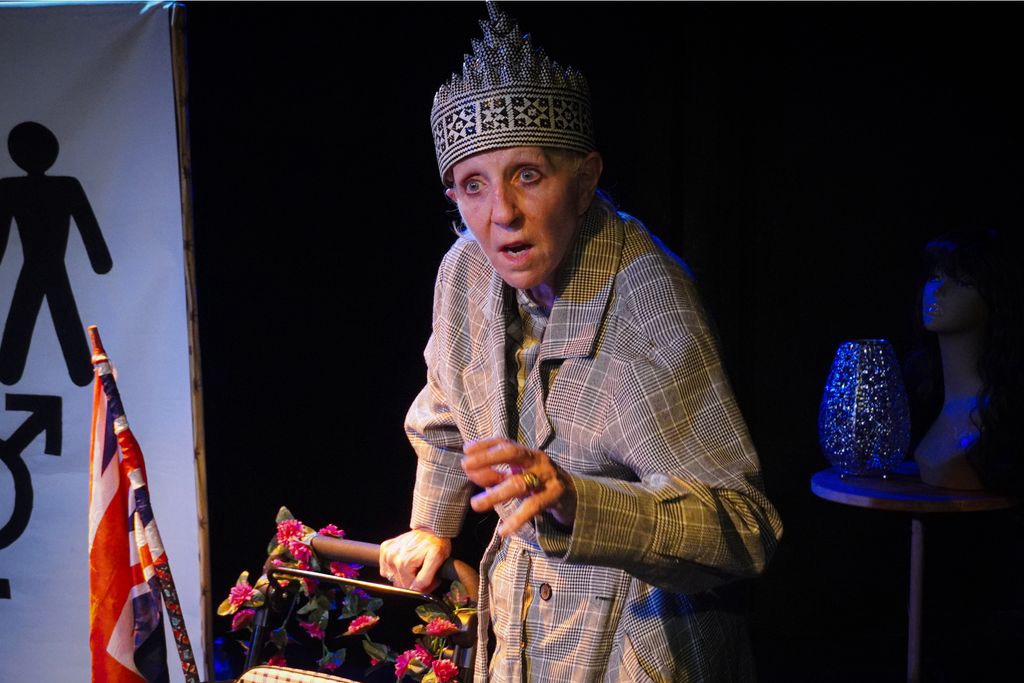
ANNIE WOBBLER (REVISITED)
by Arnold Wesker
adapted, directed and performed by Nichola McAuliffe
Finborough Theatre, London – until 26 September 2026
Running time: 75 minutes no interval
https://www.finboroughtheatre.co.uk/productions/annie-wobbler-revisited
The term “tour de force” gets bandied about with wearisome regularity and frequently some inaccuracy. However, if you want to see what a genuine tour de force looks like, head to the Finborough where award-winning actress and writer Nichola McAuliffe is resurrecting, after forty five years, a series of monologues created for her by that master of unflinching theatrical realism Arnold Wesker.
The women who comprise Annie Wobbler are variations on the theme of female identity and the masks people adopt, or are forced to wear, to deal with the world at large. In a performance of chameleonic brilliance and with the energy of a dervish, McAuliffe embodies recent graduate Anna, brimming with a relatable combination of self-doubt and bubbly confidence preparing for a hot date and dumbing down her natural intelligence so as not to intimidate the man she’s seeing.
Then she plays three versions of best-selling author Annabella, the first a genteelly whimsical Irish-accented boozer, the second a fiery, cougar-ish Scottish woman, and the last a sensitive, lonely upper crust matron. If it’s not clear why we are being treated to a trio of contrasting iterations, McAuliffe’s acting and the jagged elegance of Wesker’s language ensure that the confusion is entirely pleasurable.
The final, and most effective, creation is the eponymous Annie Wobbler, a wistful, garrulous homeless woman, pushing her pitiful cart of possessions around a mainline railway terminus, her fractured mind suspended somewhere between a rosily remembered past as a home help and a dislocating present, adrift in a cosmopolitan modern city she barely recognises. McAuliffe is devastatingly good; neither she nor Wesker patronise Annie, investing her with a bruised, busy dignity and, in her memories, a palpable joy. Annie drinks, not fastidiously, but with the practical, habitual manner of somebody who constantly needs to blunt the edges.
There are hints of unspecified past trauma (why did she never hold down a job longer than a certain period of time?) for Annie, and McAuliffe conveys a boatload of feeling and barely comprehended memory just by staring into space. She’s spiky too, but her barbed references to foreigners and Jewish people, though deliberately jarring, sound less like prejudice and more like somebody trying to make sense of an increasingly bewildering, unfamiliar world. When she refers to the need for herself to be rubbed out and started again, it tears at your heart. We might feel sadness for Annie Wobbler, even while marvelling at her indomitable spirit and ripe humour, but she never feels sorry for herself.
In the original production, Annie was costumed by designer Pamela Howard like a Dickensian crone, but this time around she wears a shiny hat vaguely resembling a crown, and that feels more appropriate: this damaged survivor is a queen of sorts, and, in this mighty performance, she haunts our imaginations. McAuliffe never lets her, or us, off the hook…and this is a performance which every drama student in London needs to see.
In all honesty, the attempts to bring Wesker’s gritty, witty text bang up-to-date feel a touch hamfisted. References to the internet and social media are just cosmetic, in a script that actually has a timeless quality: the constraints upon all three women depicted here haven’t, unfortunately, changed very much across nearly five decades. Having Annie Wobbler disport next to a station lavatory sign that includes the non-binary symbol seems more like lip service than anything else, but at least it doesn’t detract from the grim vitality of the writing or McAuliffe’s sensational performance.
Alex Jennings, James Naughtie and Peter Straker provide striking pre-recorded vocal turns as various men in the various Annie’s lives. Richard House’s lighting and Sebastian Frost’s sound are sharp and sensitive. Ultimately though, this is all about Ms McAuliffe, which is just how the late great Arnold would have wanted it. She’s a thrilling technician with heart, intelligence and, like her author, a deep understanding of flawed humanity, and she holds the audience in her outstretched hand. Do not miss her.


Leave a comment