A MONTH IN THE COUNTRY
by Brian Friel after Ivan Turgenev
directed by Lyndsey Turner
Donmar Warehouse, London – until 3 October 2026
running time: 2 hours 20 minutes including interval
Disappointment, ennui, romantic and erotic yearnings, half-truths that make the day-to-day living that bit more bearable…. all of these things are suffused like smoke though Turgenev’s mid-nineteenth century tragicomedy, revived at the Donmar in Brian Friel’s widely seen 1992 translation. Friel and Turgenev are a good match: A Month In The Country is full of the elegiac indolence and bitter humour that characterises much of the Irish master playwright’s output. It’s also similar to the work of Turgenev’s contemporary fellow countryman Chekhov, who Friel has also extensively adapted, although this never quite matches the depth and universality of the mighty Anton at his best.
Audiences longing to wallow in atmospherics and elegant savagery will find plenty to enjoy here, but anybody in search of something with a bit more oomph may find their patience tested. It’s all mood and no action. Director Lyndsey Turner has form at the Donmar with Friel, having directed several of his plays here including, a decade ago, a heart-stoppingly fine version of his Faith Healer that deserves to be the benchmark by which all future productions for a generation are measured.
This adaptation is exquisitely written and finds the sweet spot between stylishness and misery so essential to the original script. On a rural Russian estate, sundry malcontents pick away at their unexpressed feelings, guard or bemoan their social standings, and are presided over by landowner’s wife Nataya Petrovna (Sophie Okonedo) who assuages her chronic boredom by meddling in the lives of others.
One of several curious things about Turner’s production is that the actors, while individually fine, sometimes seem to be inhabiting different worlds from each other. Okonedo is brisk, mercurial and often very funny as scheming Natalya, even if her motivations and quicksilver mood changes aren’t always easy to comprehend.
Thomas Arnold is sensitive, touching and sincere as Arkady, her misused husband, while Patrick Gibson’s gauche, impassioned academic Belyayev and Rachelle Diedericks as the young woman falling for him both seem to be going for a modern realism that gives a jolt of electricity to the proceedings but isn’t mirrored elsewhere.
Daniel Rigby is manically humorous but undeniably effective as a self-serving local doctor while Alastair Petrie plays Rakitin, Natalya’s most ardent admirer, as so low energy that he almost disappears before our very eyes. Amanda Wilkin, all gawky physicality and staring eyes, works hard as a rebellious, snuff-addicted lady’s companion but it comes across as more of a comic turn than a fully realised characterisation, while Jessica Brindle and Jonathan Livingstone paint the lusty servants in similarly broad strokes.
They’re as nothing though compared to the bumbling, mispronouncing German interloper Herr Schaaf, played by Mark Hadfield like something from a 1970s sitcom. The most satisfying performance, by quite a long margin, comes from Susan Brown, utterly perfect as Arkady’s soignée but no-nonsense mother. The scene where she lets on a seismic family secret to her flailing son is beautifully handled. Michael Hodgson finds real pathos in a socially awkward local landowner reduced to being a pawn in other smarter people’s games.
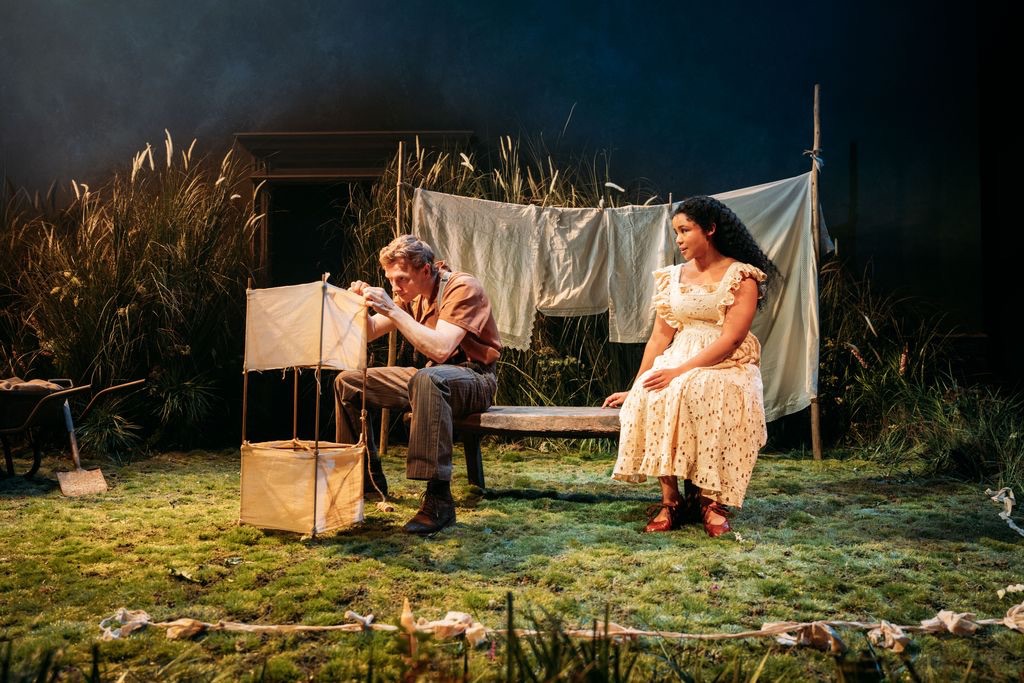
Turner and designer Leslie Travers have updated the time period, possibly by about a century, but not distractingly so. Visually this Month In The Country is a feast of rich autumnal hues (Tim Lutkin’s lighting is particularly evocative) in rueful harmony with the melancholy inner lives of the characters. Travers’ set ingeniously marries the opulence of Arkady Islayev’s house with the verdant landscape of the country estate surrounding it (drawing room furniture is placed directly onto the green lawn, a horizontal cascade of reeds and florals frame a grand arch leading to other interior locations).
It all looks lovely, and it would perhaps be churlish in a play like this one to complain that there isn’t much in the way of pace, but much of the blocking is pedestrian and the constant raising and lowering of leaf-covered walls to indicate passage of time and scene breaks is rather awkward. The decision to occasionally have Natalya and Rakitin’s inner thoughts booming over the sound system for them to respond to, is an odd one, awkwardly straddling comedy and melodrama; it’s also inconsistent, as though it had been floated during the rehearsal process then neither fully abandoned nor properly explored.
For all these reservations, there is much to savour here. It’s handsomely mounted, and most cast members get moments to shine, albeit seldom in tandem with each other. A quality piece of theatre for sure, but not one that suggests Turgenev’s work has anything startlingly relevant to offer modern audiences. This may not feel like a whole month in the country, but it sure felt longer than just over two hours.


Leave a Reply