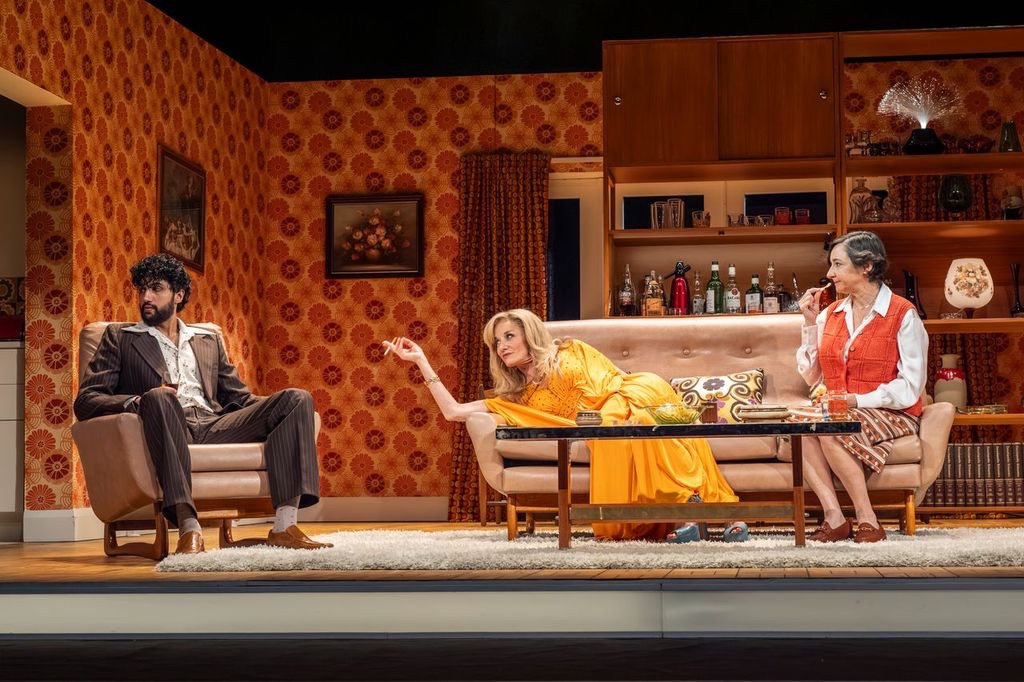
ABIGAIL’S PARTY
by Mike Leigh
directed by Nadia Fall
Harold Pinter Theatre, London – until 19 September 2026
running time: 2 hours including interval
https://www.haroldpintertheatre.co.uk/shows/abigails-party
“We’re not here to hold conversations, we’re here to enjoy ourselves” – yes Mike Leigh’s Beverly Moss, that mid-1970s gorgon of upward social mobility, suburban marital warfare and aggressively over-the-top home entertaining, is back. This time she’s in the magnetic glamazon form of Tamzin Outhwaite who may just be delivering career-best work in Nadia Fall’s extravagantly kitschy but ultimately dramatically potent revival.
Abigail’s Party, with its excessive drinking, quips about rape, cheesy pineapple festive snacks, and Demis Roussos references, feels as though it’s locked in a time capsule harking back to the decade that taste forgot. It defies updating and, honestly, if this production wasn’t quite as good as it is, one might be tempted to wonder what relevance it has to today.
Wisely, Fall allows the script to speak for itself while subtly injecting it with a couple of new emphases that make the characters read slightly differently. The most obvious one is in making the younger neighbours, over-eager nurse Angela and taciturn former footballer Tony (Lauren Patel and Omar Malik), into an Asian couple. As far as I can tell, not a line of dialogue has been changed, but their heritage adds an extra comic piquancy to Angela’s complaint that they never have curry because Tony can’t stand it. More significantly, it lends a new unease to the section where Laurence (Kevin Bishop), Beverly’s increasingly desperate estate agent husband, questions older local resident Sue (Pandora Colin) as to whether she has noticed any significant changes in the area. Bishop, brilliant, lards Laurence’s low level racism with real covert nastiness, spitting out the word “cosmopolitan” like it’s poison.
Initially, it looks like production the might be on the verge of overdoing the 1970s garishness, especially at the first reveal of Peter McKintosh’s busy, retina-bruising living room set. Remember, when this play was first done in 1977 it was a contemporary piece, nailing the foibles and pretensions of the newly moneyed lower middle classes of the time, not a big ole camp fest. Despite a few overly broad strokes, Fall’s version swiftly hits its comic and dramatic strides most pleasingly.
Beverly, especially as played here, could be seen as a precursor to the shallow, wealthy TOWIE vulgarians who’ve achieved celebrity status in the last couple of decades. Outhwaite, astonishingly, succeeds in banishing all memories of Alison Steadman’s vivid, borderline grotesque original creation, giving us a Beverly in love with the sound of her own voice, relentlessly self-dramatising but with an edge of sour unhappiness that becomes more and more strident as the gin starts to flow. She’s a suburban diva who sees her lavishly appointed living room as her own personal stage, with anybody else who comes into her orbit as mere bit part players. Her lascivious objectification of hunky Tony is hilariously done, but it’s clearly in reaction to a deeply unsatisfying intimate relationship with the hapless Laurence. It’s a multi-layered performance, laugh-out-loud funny but never at the expense of some sort of manic truth, and she’s strangely endearing in her lack of empathy and self-awareness. It’s a performance that straddles the divide between barnstorming and brutal reality, with a side-order of spite and camp fabulousness. It’s impossible to take your eyes off this combination of fishwife and suburban queen as she delivers the excruciating banalities in Leigh’s endlessly quotable script with majestic aplomb and total conviction.
Patel’s Angela, pushing a bit hard for the humour at first but eventually becoming hugely endearing, and Malik convince as a couple whose mutual communication is permanently running on empty. Intriguingly and crucially, they achieve, in the play’s harrowing final minutes, the feat of showing us why this pair really do work well together, despite all the odds. Colin, in the least rewarding role as divorcee Sue whose daughter’s unruly gathering down the street gives the play its title, is squirmingly awkward perfection.
This really is Outhwaite’s show, and she’s so sensational she’s not even upstaged by her wig (at least one assumes it’s a wig) which looks like a cross between a blonde Barbarella-era Jane Fonda and The Wizard of Oz’s Cowardly Lion. Judging from the ecstatic audience reaction, there’s still plenty of life in this 1970s throwback of a play, and it’s hard to imagine a better revival than this one. Other people behaving appallingly are so seldom this much fun.


Leave a Reply