MIDNIGHT AT THE NEVER GET
Book, music and lyrics by Mark Sonnenblick
directed by David Cromer
Menier Chocolate Factory, London – until 12 September 2026
running time: 100 minutes including interval
https://www.menierchocolatefactory.com/tickets/midnight-at-the-never-get/
Midnight At The Never Get, the crafty, compelling off-Broadway tuner receiving its UK premiere at the Menier, features one of the cruellest and most powerful coups de théâtre I’ve witnessed in quite some time. It adds an extra layer to an already rich cake that marbles together the easy charm of late night cabaret, the trauma of being gay in a time and place (early to mid 20th century in the USA) where it wasn’t legal, and an exploration of the unreliability of memory and the lies that we tell about ourselves. I’m not going to reveal here what the surprise is, but suffice it to say that it lends an extraordinary emotional punch to the conclusion of David Cromer’s richly enjoyable production, and explains why the cast list in the programme doesn’t include the character names.
The show also marks the London theatrical debut of Broadway’s Ben Platt, and he’s giving a performance that equals if not surpasses his original Evan Hansen and his more recent turn as Leo Frank in the Main Stem revival of Parade. Platt plays Trevor Copeland, a night club singer in 1960s looking back with a combination of regret, bitterness but predominantly joy at his romantic and professional partnership with songwriter and musician Arthur Brightman (Gregor Milne, absolutely wonderful).
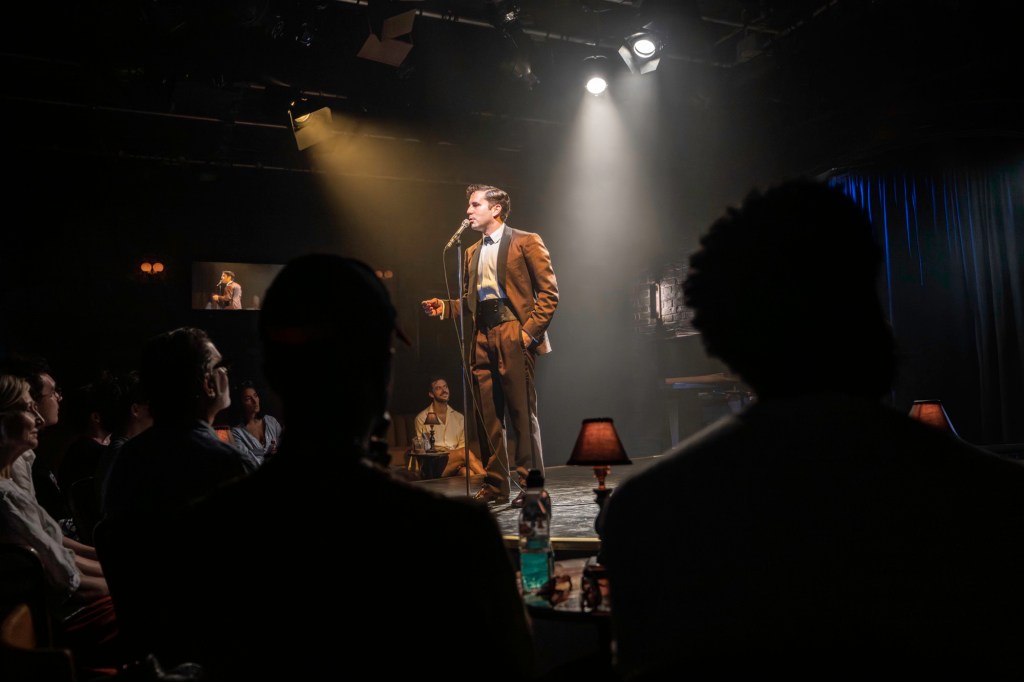
The Never Get of the title is the name of the divey underground cabaret club in Greenwich Village where Copeland and Brightman perform their set of elegant lounge/easy listening songs with a gay twist, the underlying threat of NYPD raids a constant. Award-winning designer Scott Pask has had a field day turning the Menier’s entire auditorium into an intimate, atmospheric night club, a thrust stage fronting a curtained bandstand, dining tables and chairs in the central section, grimy mirrors and plush banquettes punctuated by tiny drinks shelves with lamps all around the sides. All that’s missing is the sound of a cocktail shaker and the tug of smoke. The utterly gorgeous lighting is by Heather Gilbert. Visually, it’s all so redolent of nocturnal old school New York that it’s quite the shock to emerge out into still partially sunlit Borough. Frankly, the technical elements (punchy, precise sound by Paul Groothuis, elegant costuming by Jonathan Lipman and attractive, full-blooded orchestrations by Andrew Resnick) are such that the production would be worth seeing, even if the piece wasn’t as good as it is (and it really is good).
In Mark Sonnenblick’s script, the contrast between bouncy, charming Trevor and watchful, volatile Arthur is vividly rendered, and Platt and Milne have such palpable chemistry that they genuinely convince as a couple, whether bickering or executing Lynne Page’s charmingly airy, loose-limbed choreography. Sonnenblick also created the score, a collection of swinging numbers and haunting ballads that would not disgrace Cole Porter or Bobby Darin. There’s a biting, rueful wit to a song like ‘Boy In Blue’ performed with mic-swinging aplomb by Platt as a cheeky semi-erotic ode to the cops who would arrest Copeland and Brightman simply for existing, while others, such as the bluesy ballads ‘When It’s Spring Again’ or ‘The Mercy of Love’ clutch at the heartstrings with their intimations of romances conducted in the shadows.
Cromer’s masterly staging strikes a perfect balance between escapism and the harsh realities of leading lives under constant low level threat. The concept of the whole thing being a night club act with Trevor and Arthur’s relationships being played out in flashback feels bracingly original, even if the storytelling could sometimes be a little clearer. The creeping realisation that Platt’s brilliantly fleshed-out Copeland, his down-home Idaho roots and sense of wonder often just perceptible under his New York showbiz brio, may be a less-than-reliable narrator is effectively managed. So are the tragic, yet self-serving compromises Brightman needs to make to fully realise his professional potential.
Perhaps controversially, I find Platt a stronger actor than singer. His truthful, quirky choices and ability to turn on a dime from cocky showmanship to sinking so far into himself as to become almost invisible are fascinating to behold, and his emotional availability is devastating. His singing voice is a superb, wide-ranging instrument but with just a touch too much vibrato in the ringing higher register for my taste. That’s nitpicking really though: this is a tremendous performance, and London is so lucky to have him, especially to see this level of work at such close quarters.
Milne complements him perfectly, in a magnificent, multi-layered turn that’s as dramatically true as it is musically impressive. West End veteran Barry James contributes an invaluable, haunting cameo.
This is very special indeed. A classy, highly original piece of musical theatre that’s as entertaining as it is ultimately heartbreaking. I suspect the Menier Chocolate Factory has a massive, and deserved, hit on its hands. Get yourself to The Never Get.


Leave a Reply