ARCADIA
by Tom Stoppard
directed by Carrie Cracknell
Duke of York’s Theatre (soon to be Tom Stoppard Theatre!), London – until 12 September 2026
running time: 3 hours including interval
Claimed by some to be Tom Stoppard’s masterpiece, Arcadia has now been entrancing and perplexing theatregoers for over thirty years. Buoyed up by generally stellar reviews and the recent death of the playwright, Carrie Cracknell’s in-the-round staging sold out at the Old Vic and now arrives in the West End, substantially recast, at the Duke of York’s, a venue soon to be renamed for Stoppard. That’s a fitting tribute, given the writer’s outstanding long term contribution to British theatre, plus his legitimate connection to this particular playhouse. His Artist Descending A Staircase played here in the 1990s, as did the transfer of his 2006 Rock’n’Roll from the Royal Court, while a starry earlier revival of Arcadia was a success on this stage in 2009.
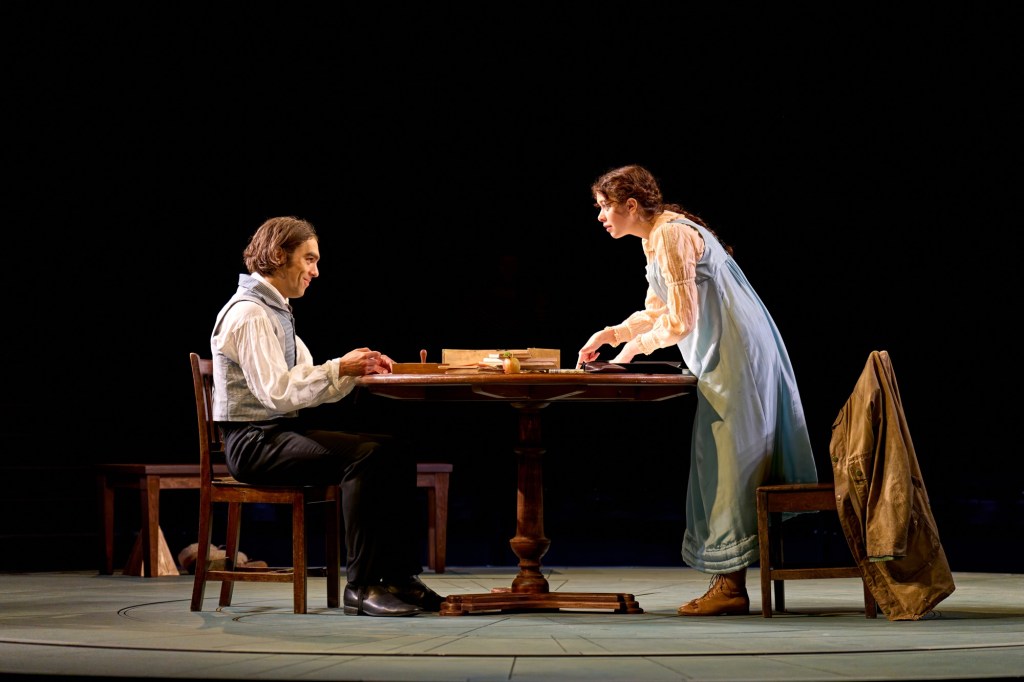
The word Arcadia in classical literature and mythology suggests a rural idyll, where humans and nature co-exist in tranquil harmony. Stoppard’s Arcadia is set in an English equivalent thereof, the fictional Derbyshire country house Sidley Park, across two time periods. In 1809, sixteen year old Thomasina Coverly (a sublime Isis Hainsworth) studies mathematics with tutor Septimus Hodge (Seamus Dillane, wry, charming and non-threateningly priapic) while her mother Lady Croom is having the extensive grounds remodelled by a gardener (“Culpability Noakes!”) who has quite different ideas about how the finished product should look.
Then in the present day, academics Hannah Jarvis and Bernard Nightingale (Nikki Amuka-Bird and Oliver Chris, both new to the cast but inhabiting their roles with ferocious intellectual glee) are working on opposing works about the history of Sidley Park. He’s obsessed with a possible duel fought in the house involving poet Lord Byron while she is concentrating on the identity of the hermit who had inhabited the hermitage on the house grounds, while the present day Coverly family members, still in residence, regard them both with varying degrees of amusement and exasperation.
One of the delights of Stoppard’s text is how the sections set in the past inform the ones set in the present. As Jarvis and Nightingale theorise and pontificate, we in the audience are often one step ahead of them, a conceit which becomes heartbreaking towards the play’s end when you realise the fate of probably the most lovable character. The tension between intellect and emotion thrums constantly throughout the play, as does the mind-boggling antagonisms between chaos and order, the past and the present, science and literature.
It is a lot to take in on one viewing, and Cracknell’s production, playing out on concentric circular revolves under a pair of giant interconnecting neon hoops and a canopy of lights suggesting the celestial infinity of the cosmos (striking designs by Alex Eales and Guy Hoare respectively), isn’t always as clear as it might be in helping elucidate this challenging piece. Although beautiful to look at, the abstract visual approach sometimes makes the play even more confusing than it already is, especially when both time frames are occupying the limited space. Trevor Nunn’s original National Theatre staging and David Leveaux’s first revival were more literal and, honestly, more engaging.
Some of the performances are terrific. Amuka-Bird’s Hannah is a particular highlight, the isolation of the bookish academic tempered with a wicked sense of humour and generous-spirited warmth; it’s a flawless, selfless, beautifully realised performance. Chris is similarly inspired as egotistical Bernard, a sort of intellectual rock star in his own head, a maddening, charismatic but possibly lethal combination of spoilt child and brilliant scholar. These fine actors find an erotic charge between the two that no other pairing I’ve seen in these roles has quite managed since Felicity Kendal and Bill Nighy in the original production, and it adds a welcome heat to a play that, for all its brilliance, can seem chilly and remote. I now long to see this pair as Annie and Henry in Stoppard’s own The Real Thing.
Angus Cooper is absolutely spot on as a modern day Coverly, an Oxbridge academic who may or may not have a bit of a crush on Hannah (understandable); he nails the character’s innate niceness and a genuine sensitivity under the relaxed intelligence. I was less keen on this production’s treatment of Lady Croom (usually Yolanda Kettle, but played on second press night by understudy Peta Cornish).
As written, she’s one of the funniest women in Stoppard, a baroque, sexy, whip-smart eccentric, a contrast to the dry directness of Hannah, and entirely plausible as the mother of a self-possessed teenage intellectual like Thomasina. Harriet Walter at the National, Julie Legrand in the West End transfer and Nancy Carroll in the last revival had tremendous fun with her, and the erudite campery sat entertainingly alongside the mind-expanding rigours of the rest of the play. In this iteration she mostly comes across as severe and uptight, not the fault of Cornish who tackles the language head on and has notable presence, but the costuming and direction seem calculated to rob this usually irresistible character of most of her joy.
The soon-to-be Stoppard Theatre is fairly intimate and there are moments when the actors seem to be mic’d for a much larger venue, which takes a few minutes at the top of each act to get used to. It’s perhaps to be expected that a late twentieth century piece that plays around with time will become dated. So it proves (slightly) with Arcadia where the notion that decades of misinformation surrounding a classical poet would make front page news in the tabloid press seems positively quaint. Running at an unfashionable three hours including interval, it’s also a challenge for some attention spans.
For all that, Arcadia retains its power to dazzle as it fuses humanity and curiosity with science and mathematics, and dialogue that’s laugh-out-loud funny and with a rich, empathetic understanding of what makes humans tick. It’s a remarkable work, and one that anybody with a genuine interest in modern English language plays needs to see at least once. One has to hope that the theatre’s change of name happens fully before the end of the run, as having a Stoppard play at the Stoppard would be as wonderful as Arcadia is in its most persuasive moments.


Leave a Reply