REDCLIFFE
Book, music and lyrics by Jordan Luke Gage
directed by Paul Foster
Southwark Playhouse – Borough, London – until 4 July 2026
running time: 2 hours 30 minutes including interval
https://southwarkplayhouse.co.uk/productions/redcliffe/
A solo creative doing the book, music and lyrics for a musical can result in clarity and cohesion of vision (look at Willy Russell and Blood Brothers or Rupert Holmes with The Mystery of Edwin Drood, and Richard O’Brien’s inspirational weirdness for The Rocky Horror Show) or, conversely, a right old mess that suffers because nobody puts the brakes on when necessary (anybody remember Mike Batt’s The Hunting of the Snark or an off-West End abomination by Daniel Abineri entitled Money To Burn which closed between matinee and evening performance during the week of its press night in 2003? No? Good for you….) It’s wonderful to report then that Redcliffe, the new tuner by West End leading man Jordan Luke Gage (& Juliet, Heathers, Bonnie and Clyde, Titanique), belongs most definitely in the former category. This is the most enjoyable, and most emotionally resonant, new British musical since The Curious Case of Benjamin Button, and deserves to achieve a similar sort of extended life after this initial Southwark Playhouse season.
What matters about Redcliffe is not that it’s perfect (it isn’t: some of the storytelling needs clarifying, it could lose a song or two and the dialogues between its 18th century setting and the present day would benefit from some finessing) but rather that it has ambition, massive heart, characters we genuinely care about, and some really terrific tunes. It’s also about something real and urgent, being inspired by the true story of Bristolian William Critchard and Londoner Richard Arnold, lovers executed in 1753 for “the detestable crime of buggery”.
It explores, with authentic feeling and some wit, the historical attitudes to homosexuality and the gulf between the cruelty and suspicion gay people were treated with back in the day and the progressive attitudes of the present, while also noting that in some quarters of the world not much has changed. If it’s more of a lament than a celebration, it impressively mixes together a human interest story, pockets of joy, some romance, and a whole lot of heartbreak.
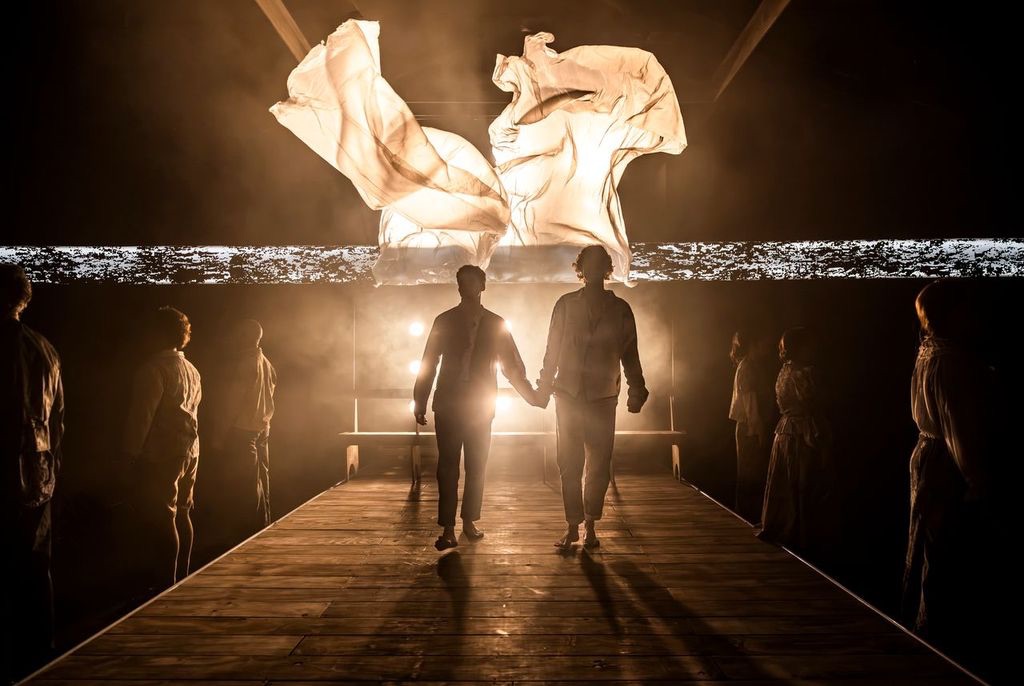
Director Paul Foster has fashioned the material into an entrancing theatrical experience, combining intimacy and epic sweep, the gear changes between raucous pub numbers (de rigeur apparently for any musical with a period working class setting, from The Beggars Opera through Oliver! to Les Mis), church chorales, family recriminations, erotically charged sequences between the two men, and scenes of heartbreaking suffering, are brilliantly managed. The action swirls rhapsodically over Andrew Exeter’s timbered apron stage, an atmospheric space of benches, boxes and endless possibilities, stunningly lit by Matt Hockley, before coming to rest in individual scenes ranging from the euphoric to the harrowing. It’s not always easy to see where Foster’s work ends and Emma Woods’ musical staging begins, and I mean that as the highest compliment. It’s a collaborative process and a whole late-1700s West Country maritime world is created with elegance and economy.
It looks absolutely beautiful, with a timelessness that matches Gage’s frequently gorgeous music which marries together Spring Awakening-style theatrical rock, folk and classical strings (Katy Richardson’s band and the orchestrations of Ben Tomalin and Ben Ferguson are just wonderful). Martin Hanly’s costumes display a similar historical duality, classically cut and contemporary clothing side-by-side, partially faded and with the imprint of other styles, patterns and ages simultaneously visible. It’s a sartorial equivalent of time seeping through and leaving its indelible imprint on individuals across the years; it’s tremendously effective, and another example of the detail which makes this such a staging to savour.
Perhaps surprisingly, it’s the upbeat and comic numbers that work best, although the choral sections have a surging, haunting quality that thrills the blood. The ballads are memorable and well-crafted but some have a slightly tendency toward the generic. That said, there’s nothing generic about ‘Hurricane’, the epic solo -an aria really- Gage has created for William’s mother. It’s an absolute journey, as Ma Critchard goes from denial to acceptance then defiant allyship, and it requires full throttle vocals and textured, vivid acting; it gets all that and more in a stupendous, white-hot performance by Rebecca Lock that is incontrovertibly the stuff of which theatregoers indellible memories are made. Even if the rest of the show wasn’t as good as it is, this number would be worth the ticket price alone. Absolutely remarkable.
Gage plays William with a deeply touching sweetness and sincerity, his performance only becoming showy when he gets to unleash the higher levels of his stratospheric tenor. He’s superb. Opposite him Daniel Krikler makes something truly haunting out of Richard, in a tender, nuanced portrayal that combines gravitas, kindness and sheer unmistakable sex appeal.
If the male leads impress with their restraint and subtlety, the principal women are more obviously sensational. It takes a special generosity of spirit to write a show which you’re starring in and then give the greatest role to somebody else, but that’s what Gage does here. The Critchley matriarch is a glorious creation, a funny, smart, determined woman with credible quirks, innate intelligence and a complex trajectory in terms of her understanding and personal growth that will likely resonate with any parent with a child outside what is considered the norm. It’s the most demanding and interesting Mother role in a musical since Ragtime and Lock inhabits every note, breath, shade and beat of her: astonishing. Jess Douglas Welsh, in a sympathetic, vivid, altogether wonderful London stage debut, is deeply moving as William’s younger sister Abigail, who also goes on a hell of a journey. Good luck with trying to hold back the tears in the second act when Abigail is trying to sell her hand-stitched kerchiefs for pennies so that she can make up the visiting fee to see her brother in prison; Douglas Welsh will break your heart.
The luxury casting includes golden-voiced Adrian Hansel, superb as the drunken publican who precipitates William and Richard’s tragedy, Melissa Jacques doubling up as a disapproving neighbour and authoritative judge, Steven Serlin’s snarlingly nasty prison guard and Joseph Peacock as the potential suitor Abigail understandably outgrows. The singing throughout is magnificent.
William and Richard’s journey from wariness to declarations of undying love is done a little too swiftly perhaps, but Gage displays an unexpected gift for pithy, humorous dialogue. The shadow of executions of local men accused of homosexuality falling over the initial scenes of cosy domesticity at Christmas is well done though, as is the suggestion from the outset of William’s slight ‘otherness’ even in the context of a family who adores him. There’s a heartstopping moment at the very end when the company drop their Bristolian accents (Redcliffe is an area of that Avon city) and address us with their own voices, to drop some interesting, and shameful, statistics about persecution of gay people in the world we live in right now. It’s an ingenious way of turning a richly enjoyable, rattling good yarn with a strong score into something much more timely and important. Alistair Penman’s refreshingly clear sound design ensures we catch every word.
This is a triumph for Jordan Luke Gage but it’s not a solo achievement; everyone here is working at the top of their game. When Redcliffe soars, it really soars.


Leave a Reply