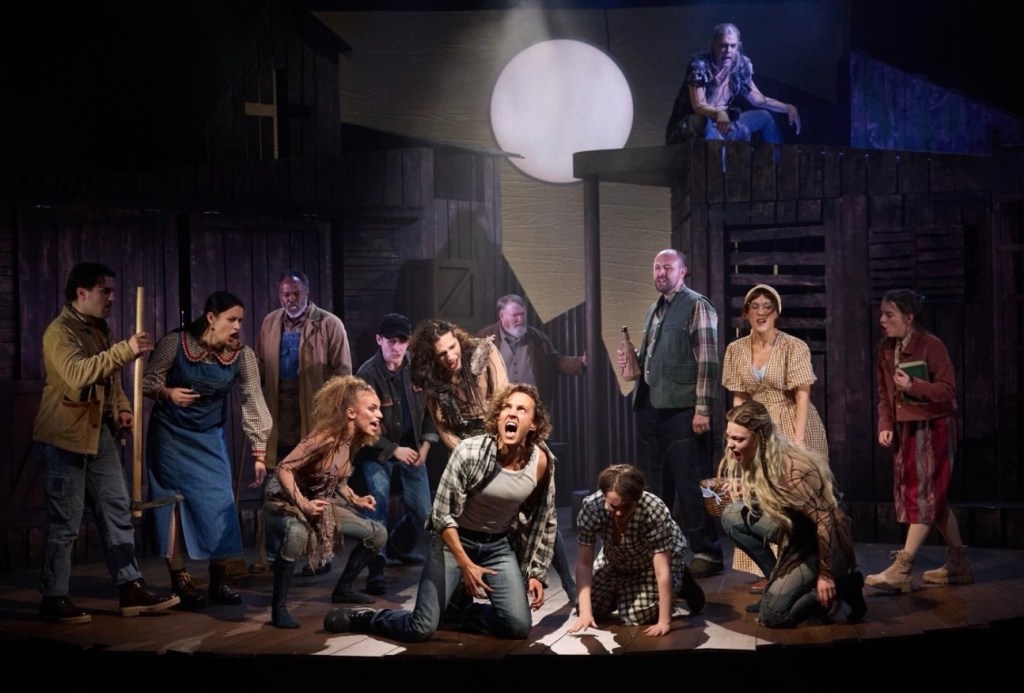
DARK OF THE MOON
Book by Jonathan Prince
Music and lyrics by Lindy Robbins, Dave Bassett and Steve Robson
based on a play by Howard D Richardson and William Berney
directed by Georgie Rankcom
Charing Cross Theatre, London – until 8 August 2026
running time: 2 hours 30 minutes including interval
https://www.charingcrosstheatre.co.uk/
It would be nice while watching Dark Of The Moon, jaw dropped in disbelief, to reflect that it’s been a while since we’ve seen an objectively terrible musical on the London stage. But of course we’ve only just had the UK premiere of Korean zombie apocalypse farrago The Last Man over in Southwark. Now, as if to prove that lightning can in fact strike twice, there’s this overwrought yet undernourished effort, blending folklore, portentousness and high camp to frequently hysterical effect. In fairness, this is rather more fun, largely due to the talent involved but also because, like numerous other so-bad-they’re-nearly-good musicals (the original Carrie, Out Of The Blue, Which Witch), quasi-operatic ambition is tethered to a misconceived idea that apparently nobody on the creative team thought to halt, or at least question.
Inspired by a 1940s play and with a score written by a trio of Grammy nominated songwriters (Lindy Robbins, Dave Bassett and Steve Robson), it’s a fanciful tale of rustic Appalachian mountain folk and a coven of witches, aka Conjur people, who exist all around them but are mostly invisible to mortals. In a Little Mermaid-esque twist, one of the Conjur people, John the Witch Boy (yes really, played by Bat Out Of Hell’s Glenn Adamson, all goof, curls and soaring rock tenor) falls for human Barbara Allen (Lauren Jones, a genuine talent who, after starring in Rebecca, Scissorhandz and now this, really deserves a break) and opts to lose his supernatural powers to spend his life with her.
It’s a supremely silly concept, but in all fairness no more so than the plot of Golden Age musicals such as Brigadoon or Finian’s Rainbow which were more or less contemporary to the original play this is based on. Where Dark Of The Moon really snaps the tether is in its execution. Rather like the Back To The Future musical which was effectively two scores for the price of one (the 1950s versus the 1980s) so this has the Appalachian villagers singing Blue Grass-inspired numbers (all the voices are superb) juxtaposed with a driving rock sound for the witches, heavy on drums and wailing guitars. Sometimes the two discrete styles fuse together, with cacophonous results. Generally though, this sets up the duality of the two worlds quite successfully even if Georgie Rankcom’s unfocused production – prone to aimlessly shuffling characters on and off to deliver the brief scenes in Jonathan Prince’s tortuous book, rather than maintaining any unity of style – seems unsure of how seriously any of this is supposed to be taken.
Considering religious fervour, miscarriage and a potential lynching are involved, one would assume it’s not intended to be a barrel of laughs but the tone is all over the place. Josie Benson, whose skyscraping, power-packed vocals are authentically thrilling, looks to be having a huge amount of campy fun as the vengeful witchy queen, or Conjur Woman as she’s titled here, while Gary Turner as her more muted cohort plays it relatively straight.
Then there’s the trio of witches -Al Knott, Jordan Broatch, Apolilly Szwarc, all done up like sexy vampires and gyrating their socks off- who form a sort-of malevolent Greek chorus. Rankcom and choreographer Jane McMurtrie has them jerking, writhing, slithering and hissing (yes, actually hissing) at each other as though in perpetual audition for some demonic reinterpretation of Cats. Lighting designer Jonathan Chan has had the decent idea of illuminating them in a pallid ghost light, in contrast to the more robust, naturalistic colours washing over the humans, but unfortunately the stage at Charing Cross is so small, especially when crowded with Libby Todd’s obtrusively busy wooded set, that the different light states bleed all over each other, sometimes making it a challenge to work out who’s undead and who’s alive.
Adamson is no actor, with an emotional range that barely extends beyond overjoyed, bewildered or mildly inconvenienced but does well by the considerable demands of the score, while Jones works hard to bring a bit of depth and fire to the underwritten Barbara (who Witch Boy repeatedly and irritatingly calls by her full name of Barbara Allen, presumably lest he thinks he’s addressing Babs Windsor…or Streisand). She’s very appealing, with a cracking voice, and one longs to see her getting to grips with stronger material.
The lyrics throughout are at best undistinguished but musically the show is pretty interesting. There are far too many songs (a dozen in each act!) but they are strong on melody and the exhilaration factor, and it would be remiss of me not to tell you that the audience went wild at the end of some of the real bangers. Realistically, I could see several of these songs ending up on my ‘guilty pleasures’ Spotify playlist. Dillon Kondor’s orchestrations, a hybrid of ultra-loud rock’n’roll band and fiddle-led folksiness, are a real treat, bridging the gap between enchanting and face-melting.
It’s just a shame that most of the book scenes are flat as a pancake and, for all the drama inherent with the story (including a subplot similar to that of Oklahoma! whereby a slightly sinister local – in this case Samuel Murray’s overly youthful Marvin – is obsessed with our heroine), little ever seems at stake. By the time the townspeople go full pitchfork wielding mob on the gormless Wolf Boy we are deep into Disneys Beauty And The Beast territory but without the budget, and I was longing to get out of the theatre.
Maybe this will appeal to musical goers who miss the uncomplicated rock bombast of shows like We Will Rock You and Bat Out Of Hell, or fans of line-dancing (these Appalachians are all over that), but honestly it is hard to see this finding an audience, beyond collectors of you-had-to-be-there-to-believe-it theatrical eccentricity. It’s ultimately more exhausting than exhilarating.


Leave a comment