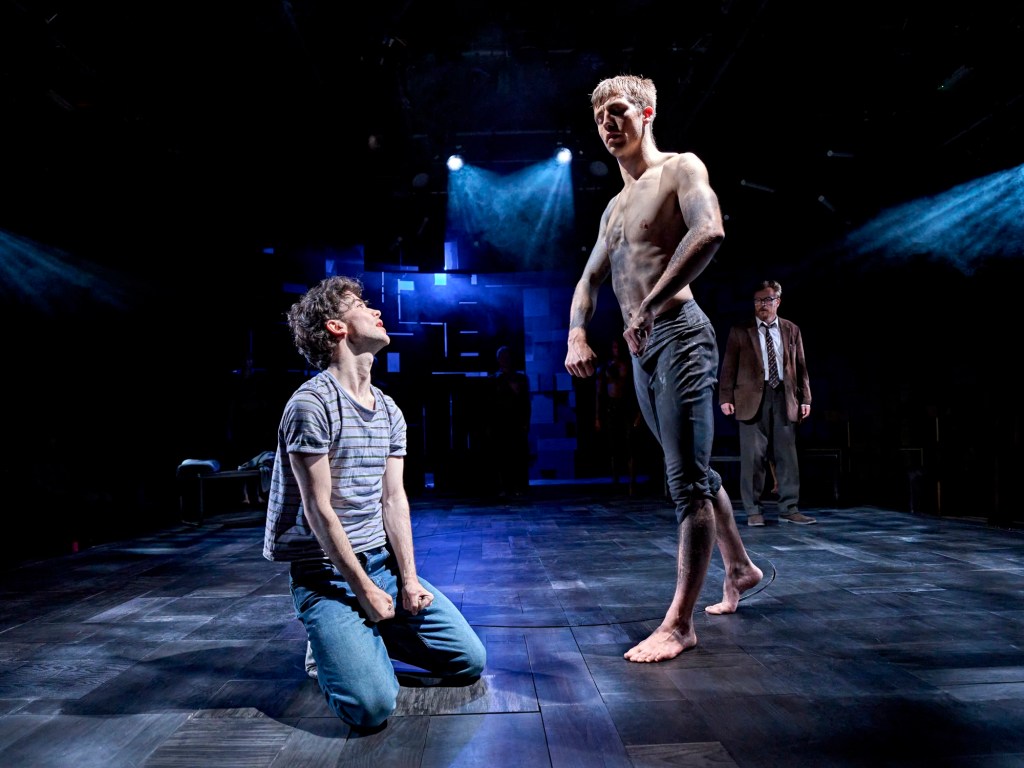
EQUUS
by Peter Shaffer
directed by Lindsay Posner
Menier Chocolate Factory, London – until 4 July 2026
Theatre Royal Bath – 14 to 25 July 2026
running time: 2 hours 40 minutes including interval
https://www.menierchocolatefactory.com/tickets/equus/
https://www.theatreroyal.org.uk/events/equus/
Pitched half way between ritual and psychological thriller, Peter Shaffer’s Equus, which premiered at the National in 1973 before enjoying West End and Broadway transfers, as well as major revivals including the 2007 one which played both sides of the Atlantic and saw Daniel Radcliffe make his adult theatrical debut, plus a film version, has lost surprisingly little of its power to shock and stimulate. Seeing this superb new production by Lindsay Posner for Menier Chocolate Factory and Theatre Royal Bath with searing leading performances from Toby Stephens and Noah Valentine, it’s not difficult to see this astonishing play’s enduring appeal.
Valentine gives a sensational, star-making performance as deeply disturbed teenager Alan Strang, who blinds a stable full of horses while in the throws of (literally) naked hysteria, opposite Stephens as Dr Dysart, the equally troubled psychologist trying to help him. Although attitudes to mental health and psychological treatment has altered drastically in the 50+ years since the play (which is actually inspired by a horrifying real incident) was written, Shaffer’s literate but potent script still works it’s dark magic. A second act scene set in a porn cinema further dates the play but once you’ve strapped in for the ride, you’ll be too gripped to care.
Equus mixes up psychological insight, repression, religious fervour (Alan both worships and fetishes horses), and sexual awakening, with classical mythology (Dysart is fascinated by the ancient Greeks and traces a direct line between his own obsessions and the cult-like devotion of Alan to the horses, and by extension the equine pagan god that gives the play its title). Amongst all the blood-letting and soul-searching, there’s a mordant wit to the writing that helps make the horrors a bit more bearable, if not exactly palatable.
Less monumental than Thea Sharrock’s 2007 revival with Radcliffe and the late Richard Griffiths and less flashy than Ned Bennett’s stunning 2019 version at Stratford East, Posner’s take is, initially at least, more conversational, lower key. Actors watch and contribute from the front row of the audience, and the six young men playing the horses don’t have the huge equine masks favoured by earlier productions. Instead they sit, bare-faced, bare-chested and earth-spattered, at the back observing the humans like silent judges. When they move (stunning choreography by James Cousens), their collective strength, grace and gravitas makes you catch your breath.
The homoeroticism is dialled up to 11: the opening image sees Strang, and Ed Mitchell as Nugget, the principal horse, embracing like lovers; outstanding intimacy coordination work by Clare Foster. So to is the fusion of animal and human, more keenly realised than in any other production I’ve seen, with the result that when the story reaches its terrible, inexorable climax, it carries an authentic emotional punch amongst all the furious distress and as the technical elements ramp up to a heart-pounding crescendo.
Stephens is delivering career highlight work as the child psychiatrist whose personal life is far from satisfactory and is haunted by the idea that ‘healing’ can also mean robbing an individual of all their passion. He makes Shaffer’s lengthy, muscular speeches – arias almost – sound spontaneous and natural, and makes vivid Dysart’s agitation and internal conflict; it’s a tremendous performance that captures every note and layer of this complex man. When he leans into a witticism, his slightly nasal, back-of-the-throat delivery sometimes unexpectedly recalls his late mother, but his triumph here is entirely his own.
The role of Alan requires full throttle commitment for the play to really work, and Valentine – vulnerable, fearless, frightened and frightening – fully delivers. In a flawless supporting cast, Emma Cunniffe is heartbreaking as his mother, torn apart by her jaggedly conflicted feelings about her son, and Bella Aubin radiates goodness, mischief and strength as the stable worker who almost helps Alan to a normal-ish life. Amanda Abbington is magnificent as the sensitive, kindly barrister who brings Strang into Dysart’s orbit.
Some of Shaffer’s writing is a little over-ripe, indeed there are moments where he could almost be daring us to laugh inappropriately, but it is irresistibly theatrical and Posner has such a sure hand with this material that it never tips over into the risible. Paul Pyant’s lighting washing moodily over Paul Farnsworth’s abstract but forbidding set and Adam Cork’s omnipresent compositions and sound design, add to the shattering overall impact of a production that reeks of quality but isn’t afraid to go for some really big swings in a relatively small space.
For all the intermittent flamboyance of the staging and the massive emotions and passions that are given full rein throughout Equus, it’s the final image of not one but two broken humans hoping for healing and forgiveness that finally haunts and hurts here. This is a thrilling piece of theatre and one that gilds the reputation of one of the most original and ambitious plays from the latter half of the twentieth century.


Leave a Reply