AN IDEAL HUSBAND
by Oscar Wilde
directed by Nicholai La Barrie
Lyric Hammersmith Theatre, London – until 6 June 2026
Bristol Old Vic, Bristol – 10 to 20 June 2026
running time: 2 hours 35 minutes including interval
https://lyric.co.uk/shows/an-ideal-husband/
https://bristololdvic.org.uk/whats-on/an-ideal-husband
First produced in 1895, Oscar Wilde’s An Ideal Husband is marginally less notorious than its better known sister play The Importance of Being Earnest but is still trotted out periodically by theatres nationwide, and has enjoyed regular West End revivals – the last was in 2018 – as well as six film adaptations. It’s tempting to see it as a trusty old theatrical war horse, smart enough to stimulate the intelligentsia and accessible enough to please the masses. However, director Nicholai La Barrie, in this altogether splendid new production for the Lyric Hammersmith and Bristol Old Vic, has refashioned it into something that feels current, sexy and wickedly enjoyable, while still remaining true to the essence and scintillating wit of Wilde’s original text.
You know this isn’t going to be a typical Ideal Husband when, at the outset, the lights come up on society grand dames Lady Markby (Suzette Llewellyn) and Countess of Basildon (Nimmy March) and they’re raucous, fabulous Black women, gloriously bedecked in vibrantly coloured Afro-Caribbean garb, off-their-faces on spliff and whatever’s in the hip flasks they’re carrying. They’re gossiping furiously about the London ‘scene’, one of them in a slurred RP and the other with a broad Jamaican accent.
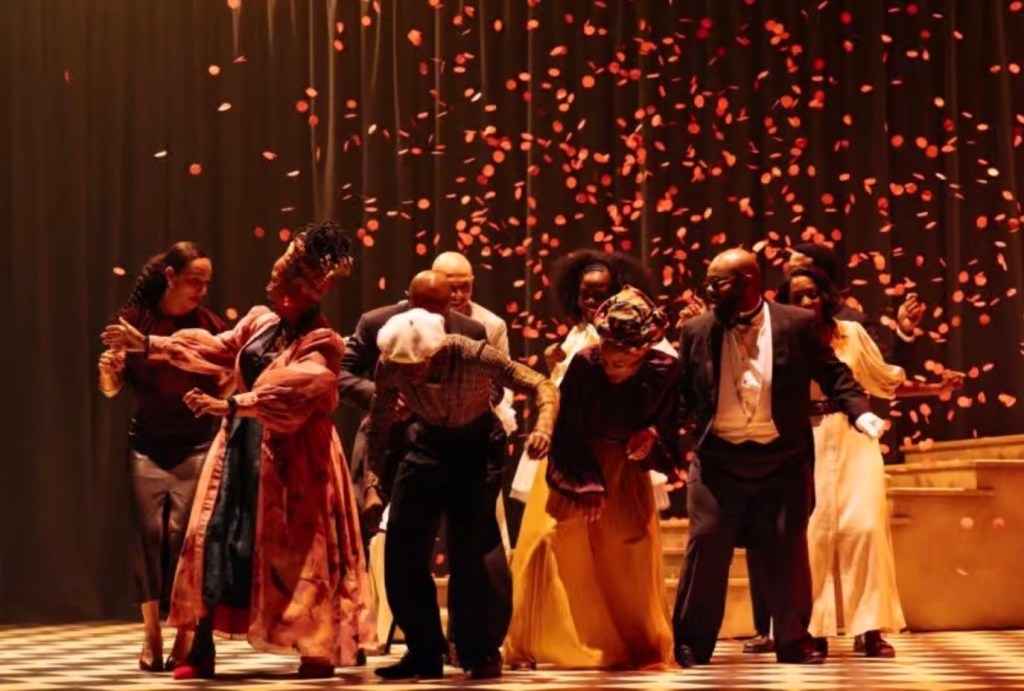
It’s as unexpected as it’s irresistibly funny, but La Barrie and team are only getting started. The whole cast, first revealed en masse doing the Electric Slide to the Cameo floorfiller ‘Candy’ at a party in the home of Sir Robert and Lady Gertrude Chiltern, is Black. This contemporary, culturally shifted spin places a different emphasis on Wilde’s text which, although contemporised with references to things like Hello magazine, Soho House and Obama, is still delivered pretty much intact. The accents are a mixture of posh, urban street, Caribbean and, for the blackmailing adventuress Laura Cheveley (Aurora Perrineau), a mid-Atlantic drawl which tracks given that this glamorous schemer has been living in Washington DC.
This new approach inevitably democratises the societal hierarchies in the original text but replaces them with a milieu where image and surface are still important (Tiwa Lade’s delightfully flippant, gorgeously attired Mabel Chiltern just screams influencer culture, while Jamael Westman’s über-camp Goring looks perpetually red carpet ready). Yet the human feelings underneath the witticisms and peacocking still register potently.
Some of the embellishments are delicious: note the way the Chilterns are constantly chirruping “we appreciate you, Mason” to their flouncing, increasingly stroppy manservant (Emmanuel Akwafo, hilarious) every time they issue an order, or how one of Lord Goring’s middle names is now Mohammed….. Look out for the bottle of hot sauce that appears as Lady Markby empties her handbag while holding forth on some topic or another, or the moment one woman accuses another of looking “ashy”. These are all mere details but collectively they point to a refreshing reappraisal of the play that pulls it into a different dimension while retaining its essence. It also opens up what could be perceived as stuffy, white elitist theatre to a whole new audience, and it does it with great style.
The idea of past misdemeanours impacting on current success and respectability is just as relevant now as it was when Wilde wrote An Ideal Husband, as is the tension between outward image and what goes on behind closed doors (“public and private life are different things. They have different laws, and move on different lines”). For all the rollicking comedy and party vibes, La Barrie gives full measure to the more serious aspects of the text. The breakdown in the Chiltern marriage is conveyed with potent force, and played with truth and emotional clarity by Chiké Okonkwo as a a suave, charming Sir Robert and Tamara Lawrance, who gets exactly right the mixture of warmth and unswerving righteousness of Lady Gertrude (or ‘G-G’ as she’s affectionately rechristened here).
Lord Goring, surely a proxy for Wilde himself, is a gift of a role and Westman, in an absolute treat of a performance, embodies him with a dazzling combination of benign flamboyance and genuine warmth, with intriguing hints of a desolate loneliness beneath all the flighty outrageousness. The only downside of having him so clearly and joyfully queer is that his last act romantic pairing off with Mabel doesn’t quite make sense. A solution might have been to swap the gender of the latter character but then we would have been denied Lade’s sparkling take on the role.
Jeff Alexander is a total delight as the Earl of Caversham, Goring’s increasingly exasperated father, his Jamaican accent adding wonderful colours and rhythms to the Wildean language, and Llewellyn matches him as the loquacious Lady Markby. In amongst this company of experienced theatre actors, Perrineau, whose credits are all on screen, initially seems a trifle stiff as the glamorous chancer Cheveley, but she has a distinctive, formidable stage presence and looks like a million bucks (which the character probably stole). She also rises dramatically to the occasion when Laura is cornered or angered. I suspect this is a performance that will grow and round out as the run progresses.
As yet, La Barrie’s staging hasn’t quite figured out how to make the third act lurch into farcical territory, with people concealed in anterooms and notes being exchanged into the wrong hands, all of apiece with the rest of the play. Despite that though, this is a sparky, richly enjoyable reinvention, hilarious yet engrossing and far closer to the spirit and intention of Wilde than was the garish, hyper-sexualised Earnest recently perpetrated by the National. Rajha Shakiry’s sets, but especially her costumes, have a pleasing opulence and slightly outlandish chic. I wish Zeynep Kepekli’s lighting design was a bit brighter though.
Sending the audience out dancing to Soul II Soul’s ‘Get A Life’ isn’t what you’d expect from a play written in the nineteenth century, but then this is a show full of lovely surprises.


Leave a comment