THE BOY WHO HARNESSED THE WIND
Book and lyrics by Richy Hughes
Music and lyrics by Tim Sutton
based on the book by William Kamkwamba and Bryan Mealer
directed by Lynette Linton
@sohoplace, London – until 18 July 2026
running time: 2 hours 45 minutes
https://boyharnessedwindmusical.com
A new musical from the Royal Shakespeare Company feels like an event (look at Les Misérables and Matilda, heck even Carrie is legendary, albeit for the wrong reasons) so the arrival of The Boy Who Harnessed The Wind in London after an initial Stratford season was warmly anticipated. That it’s based on an inspirational true story which subsequently inspired a best-selling memoir and acclaimed film, and is directed by the brilliant and versatile Lynette Linton only further ups the ante. In practise though, Richy Hughes and Tim Sutton’s amiable, chaotic tuner is a bit of a disappointment. Its heart is surely in the right place but it mostly remains resolutely earthbound just when you’re longing for it to soar.
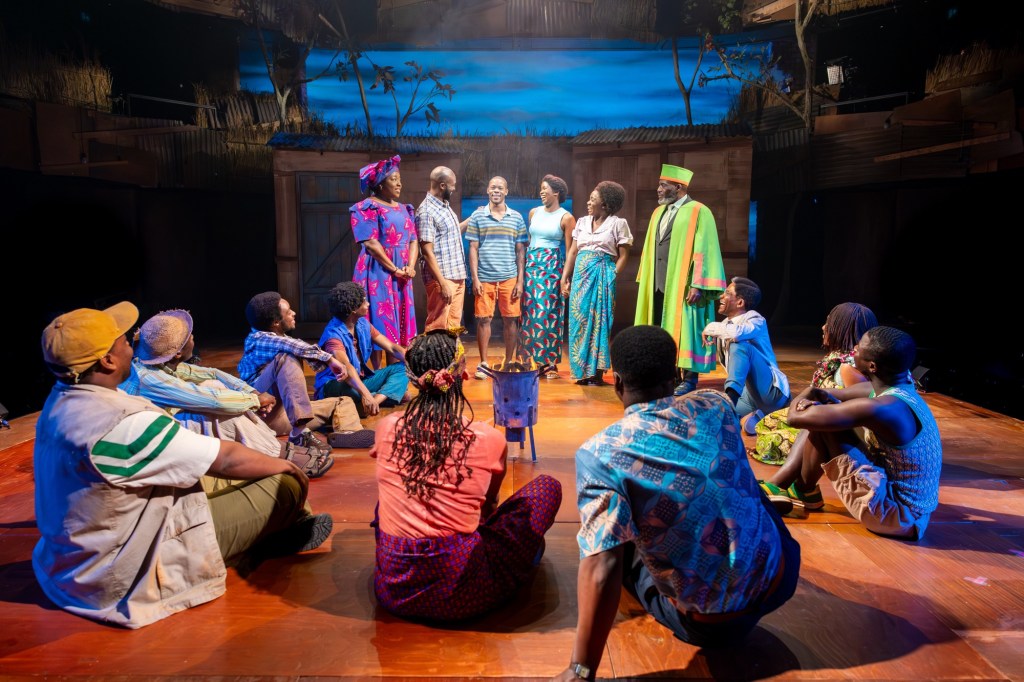
Not that there isn’t a lot here to like. For starters, the story of how William Kamkwamba as a school age child found a way to create electricity and water from wind power thereby rescuing his region of Malawi from hunger and desperation is one of those lightning-in-a-bottle tales of possibilities and just how extraordinary humans can be, that quicken the pulse and dampen the eyes. Then there’s the world-building achieved by Linton and her long term design partner Frankie Bradshaw, turning the sohoplace auditorium into a rural African village teeming with life and joy: as we enter the theatre, the cast are everywhere, greeting the audience, getting people to dance, shaking hands, baskets on top of heads, portable stereos pressed to ears. It’s an instant good mood creator but it feels rooted in reality, not Disneyfied.
Within the cast there’s a plethora of talent and, crucially, they feel like a genuine community, with a pleasingly diverse selection of ages and body types. As costumed by Bradshaw and wigged-up by Cynthia De La Rosa (another regular Linton collaborator), they seem like real people, not a glossed-up ‘musical theatre’ facsimile of what this village’s inhabitants would look like, and that’s pretty disarming. Furthermore, they swap between roles with such swiftness and dexterity that it’s quite a surprise at the curtain call to realise that the company is about half the size that you thought it was.
Alistair Nwachukwu plays William with an appealing mixture of youthful idealism and hard headedness, although the script doesn’t give him an awful lot to work with, beyond innocence and dogged determination. The characters of his disdainful older sister Annie and the school teacher she is not-so-secretly in love with, are similarly thinly drawn, but Tsemaye Bob-Egbe and Owen Chaponda give spirited readings of their roles. Bob-Egbe delivers a powerful lamenting solo in the second half that threatens to rip the roof of the theatre.
By contrast, the roles of the Kamkwamba parents, superbly played by Sifiso Mazibuko and Madeline Appiah, are much better fleshed out. Mazibuko also gets, in the lilting, soaring ‘This I Know’, the best number in the score, a powerful aria of acceptance and taking stock, also one of the few times when the music and lyrics really take wing.
Elsewhere Tim Sutton’s tunes tend to be pleasant but pedestrian, although the sheer power of Choolwe Laina Muntanga’s vocals as a personification of the wind that William tames is really something special. Hers is one of the few voices that manage to blast through the frustratingly raw sound design which has a tendency to flatten all aural impact, rendering it almost impossible to make out or enjoy the harmonies and much of the lyrics.
Few of the songs advance the action and the lack of underscoring adds to the sense of this being a stop-start play with songs rather than a fully integrated musical. The simplistic, plodding book by Richy Hughes doesn’t help. Having the villagers as storytellers, a device that works wonderfully well in the far superior Once On This Island, is perfectly fine but here they are mostly stating the obvious as scene after scene shuffles by with very little dramatic momentum.
Themes like parent vs child confrontation, forbidden love, corrupt authoritarianism, possible total extinction should at the very least raise the theatrical temperature but seldom do. The unjust death of the village chief (McCallam Connell) should be searing but somehow isn’t, and it feels as though there are too many plot strands and characters to concentrate on. Visually and dramatically, the show too often feels unfocused, and there are a number of different performance styles – from Helena Pipe’s nicely naturalistic school librarian who takes William under her wing, to the portentous, to the bizarrely camp (Idriss Kargbo’s histrionic best friend and Newton Matthews as an inappropriately over-the-top headmaster) – that simply don’t cohere.
All that aside, the climactic building of the makeshift windmill to generate power from the wind is beautifully done, as is a balletic sequence (choreography by Shelley Maxwell) where death, characterised as a hungry hyena, stalls the village gaining more and more followers. The puppetry of the stray dog that William adopts (or is it the other way round?!) is also exquisite (designed by Nick Barnes, performed by Yana Penrose) if almost identical to what we saw earlier this year in the Harold Fry musical at the Haymarket, though it concludes with a tragic gut punch that’ll bring a tear to the eye of any dog lover.
Having footage at the end of the real Kamkwamba, shining and articulate, in a Ted Talk interview broadcast is authentically moving but also counterproductive as it threatens to render slightly synthetic much of the emotion earlier in the show. The Boy Who Harnessed The Wind on stage honours Kamkwamba’s astonishing story and legacy, and has moments of real wonder, but it only fitfully justifies why this remarkable tale needed to be a musical.


Leave a Reply