1536
by Ava Pickett
directed by Lyndsey Turner
Ambassadors Theatre, London – until 1 August 2026
running time: 1 hour 50 minutes no interval
Harnessed and honed female rage is one of the most potent forces on earth; there’s a lot of female rage in Ava Pickett’s incandescent debut play, as well as a ton of passion, hilarity and messy, relatable human feeling. Already deservedly an award winner, Lyndsey Turner’s enthralling production now transfers into the West End after last year’s sold out Almeida run. 1536 is the sort of play that wakes you up, shakes you up, and leaves you reeling with shock, exhilaration and, if you’re paying attention, white-hot anger. If you didn’t see it in Islington, now’s your chance, and if you were lucky enough to catch it there, go again: it’s possibly even better now.
Interestingly, 1536 was premiering here in London just as Kimberly Belflower’s equally acclaimed John Proctor Is The Villain was taking New York by storm, and the plays share a similar DNA, wit, vitality….and fury. If you’ve only seen one of them and loved it, chances are you’ll enjoy the other. For me, 1536 is marginally the better play but, really, they’re both essential viewing for young women and anybody who cares about them.
Pickett’s script is set in Tudor England but feels bang up-to-date: 1536 was the year Anne Boleyn, Henry VIII’s second wife, was beheaded, allegedly for adultery although in retrospect the claims seem spurious. The play imagines a trio of young women from rural 16th century Essex fascinated by, and commenting on, a Royal crisis that, on the surface, would only appear to have a tangential effect on their day-to-day lives. As with the narrative of history itself, the information these women receive is controlled by men, with the result that it takes a tremendous leap of faith and imagination for them to think outside the male-centric box they’ve been locked into.
The dialogue Pickett gives them is in a contemporary, frequently expletive-strewn idiom crackling with urgency and raucous humour, or at least it is until the action of the play puts levity out of their reach. After that point, it just breaks your heart. What’s extraordinary is that these characters never sound like mouthpieces. Far from it, these are recognisable flesh-and-blood humans who switch allegiances, keep secrets and have each other’s backs even when it’s actively painful to do so, and 1536 persuasively makes the case that witty, smart women were just as present in times gone by but that their lives were straitjacketed and stifled by the patriarchy.
The women’s observations on the plight of Anne Boleyn, reports from London being drip-fed through periodically, also feel like a comment on the way news and scandal are shaped by biased mass media in the modern age. The nearest this gets to cliché is that the central trio initially sound like archetypal ‘Essex girls’, which is quite deliberate and delicious. It turns out though that Pickett is on about something far deeper and more dramatic but it’s not fair to give away too much as the play becomes proper edge-of-your-seat stuff as accusations whirl, paranoia boils up, confidences are broke, and violence explodes.
“Has it always been like this? Will it always be like this?” asks Siena Kelly’s bewildered, not-yet-defeated Anna, the working class, sexually liberated young woman whose freedom and intelligence is under fire in a world controlled by self-serving men. Kelly was superb at the Almeida last year but has since found new colours and depths in this wild but kind woman, and is now delivering electrifying work.
Also returning is Liv Hill as Jane, the most impressionable and (on the surface at least) vulnerable of the three women. Hill finds pathos in her naivety but also a volcanic anger and gut-wrenching pain as her far-from-happy domestic circumstances implode. When she screams at the more worldly wise, sexually confident Anna “a man looks at you, and you call it fucking power” it’s like a cry of agony but it’s also terrifying as one realises the chasm widening between these former friends.
Tanya Reynolds plays Mariella, the local midwife and the most level-headed of the trio but nursing a profound, not-unreciprocated love for a married local landowner (George Kemp, excellent). Reynolds is magnetic, extraordinary, combining laconic humour with deep wells of sadness, as she’s pulled in multiple directions at once. She lets you see this woman thinking and feeling; her strength is galvanising, her pain palpable, it’s a stunning performance.
The domestic catalyst for these women’s lives imploding is Oliver Johnstone’s Richard, toxically entangled in their lives in unexpected ways but also strangely lost. Johnstone charts his journey from priapic befuddlement to swaggering nastiness with more clarity and assurance than his predecessor, and makes compelling and vivid the contradictions at play within this flawed man who ultimately, dismayingly, chooses the darker path.
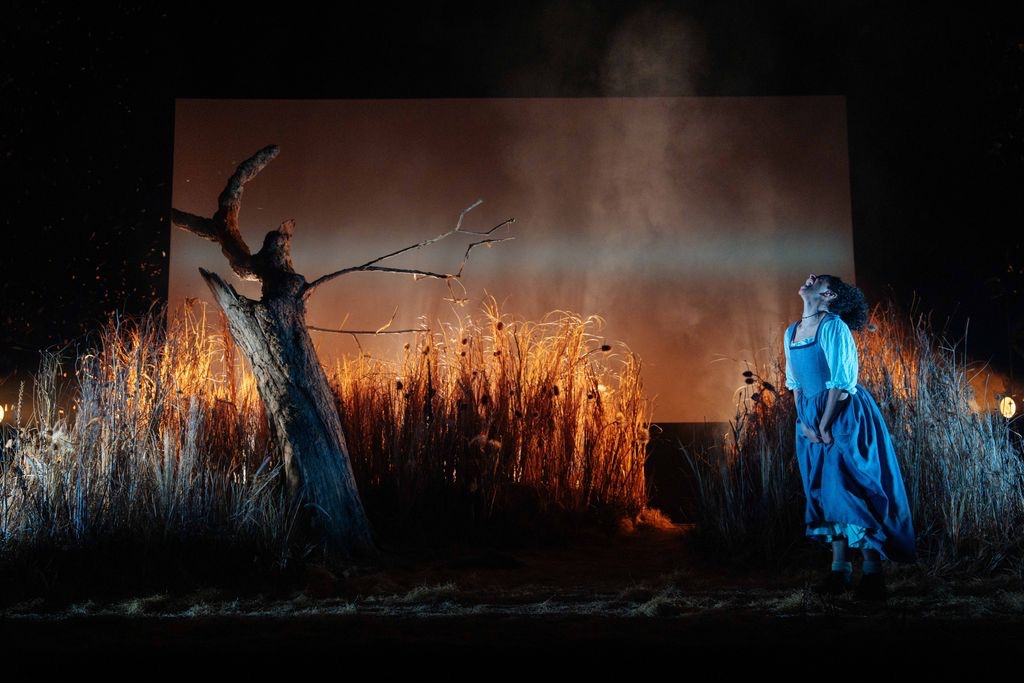
Turner’s direction remains an exemplary piece of stagecraft but now feels sharper, punchier. It’s entirely, engagingly naturalistic, until it isn’t. Jack Knowles’ lighting conveys rural exteriors, then suddenly bathes Max Jones’s attractively bucolic set – all grass and flower bushels and a picturesque tree – in acidic yellow or deep sanguine red. Will Stuart’s compositions and Tingying Dong’s sound add an invaluable thrum of unease, punctuated by shards of distressing shock. None of this feels unnecessarily flashy though, every creative working fully in service of the text.
There’s a line near the very end which encapsulates so much of what 1536 is about: as one of her best friends vows, yet again, to stifle her own desires and happiness to get by in a brutalised, male dominated world and to “be good”, Anna asks, in frustration, “how you can be good when they keep changing the definition of what that is?”
1536 at the very least defines what a truly terrific play is. It’s a historical piece that speaks to the present day with a rare urgency. It’s in the process of being adapted for television by the BBC, but you really need to see this in the theatre, where it dazzles and bruises with its relevance and grim vitality. Shattering and unforgettable.


Leave a comment