DEATH OF A SALESMAN
by Arthur Miller
directed by Joe Mantello
Winter Garden Theatre, London – until 9 August 2026
running time: 2 hours 50 minutes including interval
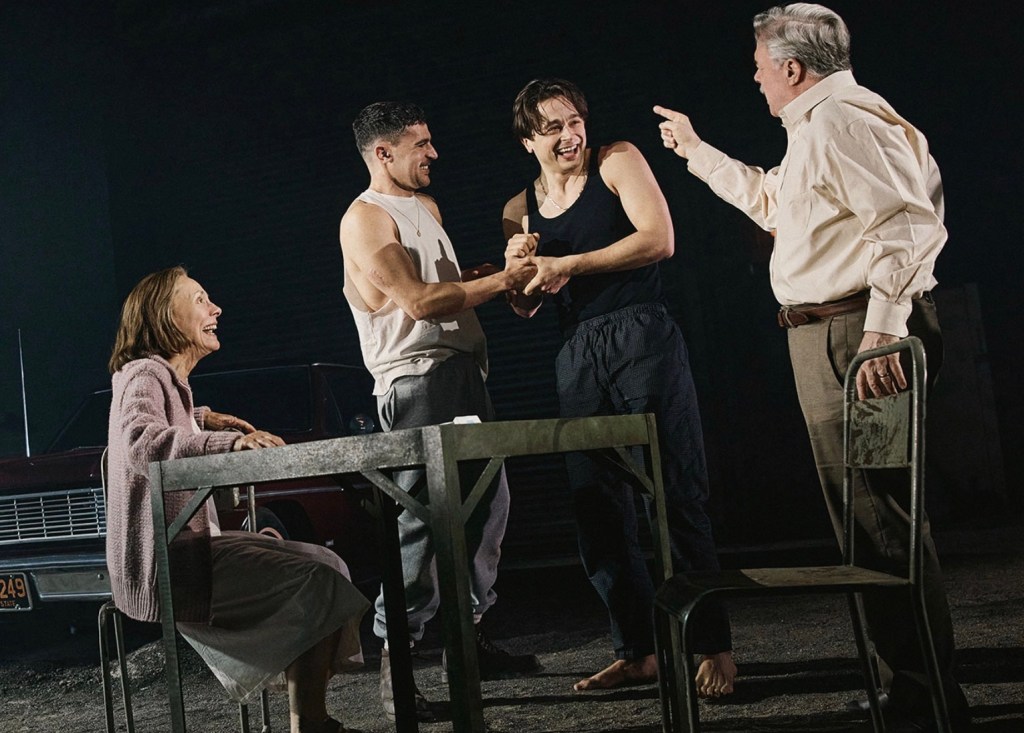
On paper, a sombre dramatic warhorse of the American theatre where there’s seldom more than four people in any one scene, headlined by an actor known more for comic and musical roles, on the stage of one of the most cavernous houses on Broadway, isn’t necessarily an appealing proposition. In practice, Joe Mantello’s production of the Arthur Miller classic Death Of A Salesman, starring Nathan Lane as Willy Loman, with the incandescent Laurie Metcalf as his long-suffering wife and hot (in every sense) young TV stars Christopher Abbott and Ben Ahlers as their sons, is an utter triumph, and a major flare up the behind of a moribund season on the Great White Way.
Less a revival and more a radical reappraisal on a par with what Stephen Daldry did to An Inspector Calls or Ivo van Hove did to Miller’s own A View From The Bridge and recently in London All My Sons, Mantello’s version frees Salesman from naturalistic trappings and takes us into the failing mind of Loman, the ageing salesman whose ability to make a living is running out as fast as his grip on sanity. Chloe Lamford’s set is a giant garage, dominated by forbidding pillars, dusty window panes, an ominous-looking metal door and the car Willy travelled around in to hawk his wares.
That car in itself is interesting and a clue to the unusual approach this staging takes: it’s a 1960s Chevy while the play originates from 1949, it’s also not the car Willy describes for himself. This isn’t sloppiness on the production’s part, it’s a specific choice that marks the fluidity of time and the unreliability of Willy as a guide through it….and it proves far more than just a gimmick. Anachronisms abound but never proclaim themselves – in a kitchen scene Linda Loman produces a modern milk carton from the fridge, Willy’s entrepreneurial brother Ben (Jonathan Cake) sports 1970s fashions, Willy’s exasperated employer Howard (John Drea) carries a plastic coffee cup straight out of a contemporary Starbucks or Tim Hortons – to collectively create a picture of a world where chronological time has no meaning: literally timeless in fact.
Just as memory is a jumble where the mind can juxtapose a recalled moment from decades ago with something that happened just last week, so this production picks up and runs with the concept of every aspect of Loman’s flawed, diminished life closing in on him at once. The focus and pacing are sheer perfection and every technical aspect (Jack Knowles’ moody lighting, Mikaal Sulaiman’s dream-like, unsettling sound, the Tony-nominated score by Caroline Shaw, Rudy Mance’s unobtrusively clever costuming) is on board the same train to cathartic oblivion.
Mantello’s staging is also infused with blink-and-you’ll-miss-it magic that feels entirely appropriate to the overall vision: a golden pocket watch disappears into thin air, figures emerge from, or disappear into, the omnipresent car as naturally as though they’re walking into another room. The theatricality is all, but never at the expense of Miller’s towering text, a life’s hopes, jealousies, betrayals, disappointments and kindnesses etched in acid, poetry and, just occasionally, full-on belly laughs. At a time when it seems more and more Americans are concerned about making enough money to even put food on the table, the play has an unwelcome relevance that adds to the overall urgency.
Any doubts I had about Lane, usually a brilliant clown with an edge of fascinating aggression and a true treasure of the American theatre, taking on Willy Loman were dispelled within about two minutes of him taking the stage. He completely disappears into the role, creating a figure whose brokenness is patched over with a certain arrogance. Lane finds the joy in him, or at least the echoes of it, and also the bewildered pain of somebody who can’t quite grasp that he is no longer at the height of his powers. His outbursts of impotent rage are horrible, but essential, to watch, and there’s a telling, pitiful moment where, having advised his son not to pick up a dropped object during a job interview as it would suggest lack of status, Willy does just that when Howard’s coffee cup lid falls on the floor as this battered salesman is pleading for his livelihood. It’s an unforgettable moment in a performance full of them.
Opposite him and entirely matching him, Laurie Metcalf finds new colours, of genuine affection, soul-sucking grief but also of surprising viciousness, in Linda that take the breath away. There’s not a single note of this indomitable, faithful, multi-layered woman that Metcalf doesn’t express. She even makes the moments when Miller allows himself to lapse into purple prosed-sentimentality (“he’s only a little boat looking for a harbour”) feel completely organic. Two mind-blowing performances in one Broadway season (the other was in last fall’s Little Bear Ridge Road) is great going by anybody’s standards: Metcalf is the real deal, although we already knew that.
Ben Ahlers, in a sensational Broadway debut, also gives womanising younger son Happy a texture and magnetism I’ve never seen before. If Christopher Abbott as older, and preferred, son Biff doesn’t make as much impression at first, that’s of apiece with the idea of a young man lost even to himself, but he galvanises into a heart stopping final confrontation both with his broken dad and his own tortured psyche that leaves the audience open-mouthed in shock. In an unusual move, this version employs a pair of excellent younger actors (Jake Termine and Joaquin Consuelos) to play the younger versions of the brothers, which adds to the overall tension.
Such is the quality of the production, every single role feels inhabited fully and convincingly. There’s beautiful work from K Todd Freeman as the concerned but realistic neighbour who tries to throw flailing Loman a lifeline (having an African American actor play this role casts a fascinating, terrible pall over Willy’s line “I just can’t work for you”) and from Michael Benjamin Washington as his kind, measured son. Tasha Lawrence is a vivid and compelling as the blousy mistress Loman finds on the road, and the aforementioned Drea (previously so good with Metcalf in Little Bear Ridge Road) invests dismissive boss Wagner with a knotty, dynamic mixture of irritation, self assurance and low level guilt. There’s not a single false note in any of the acting.
This Death Of A Salesman, which unsurprisingly has more Tony nominations (nine) than any other play this season, uses “attention must be paid”, Linda’s desperate cry when speaking of her tormented husband to her bewildered sons, as it’s advertising tagline. Audiences lucky enough to experience this embarrassment of riches are not just paying attention, they are pinned to the back of their seats, sobbing in grief and shock. It really does feel like seeing this masterpiece for the very first time. Absolutely stunning.


Leave a comment