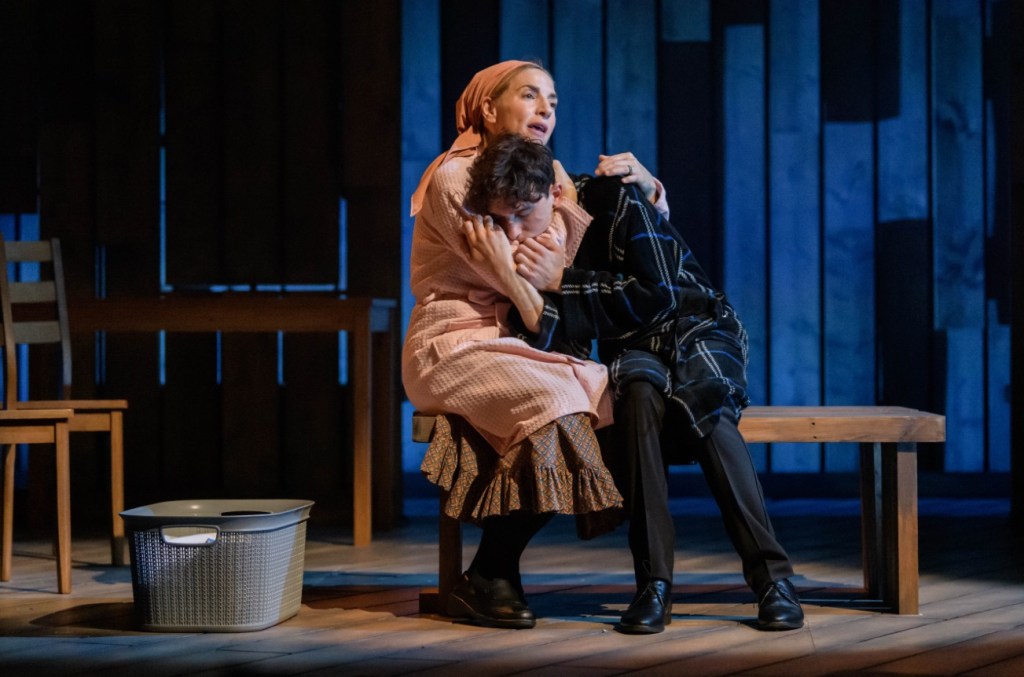
FAYGELE
by Shimmy Braun
directed by Hannah Chissick
Marylebone Theatre, London – until 31 May 2025
running time: 90 minutes no interval
https://www.marylebonetheatre.com/productions/faygele
There’s nothing remotely enjoyable about writing a negative review of a play that the author has clearly poured their heart and soul into, but here we are. In a touching programme note for Faygele, the gay Jewish drama at Marylebone directed by Hannah Chissick, playwright Shimmy Braun describes the text as “my baby…deeply personal” before briefly describing his own journey from married Orthodox Jew with four children to out gay man, So, there’s clearly a lot here at stake.
Thankfully Braun’s life path has turned out differently from that of poor Ari Freed, his eighteen year old protagonist, rejected for his sexuality in his early teens by his father, and whose post-suicide funeral is returned to at intervals throughout the ninety minute duration. We also see his Bar Mitzvah and various scenes in the family home, with Ari himself (Ilan Galkoff) commenting directly to us from a dimension somewhere between life and death, which has the unfortunate effect of making Faygele feel more like a radio play than a stage property, an impression reinforced somewhat by Chissick’s stilted, static production.
Galkoff, a tremendously likeable and talented young actor, gives a creditable account of a role that requires him to go from sullen to shouty with little in between, apart from one clumsily written sequence where the bewildered youth attempts to seduce Sammy, an older man who’s trying his best to guide him (Yiftak Mizrahi, delivering beautiful work). A consistent feature of the play is that conflicts are set up -between Ari and his parents, between the parents themselves, between the Rabbi (a warm and charismatic Andrew Paul) trying to help the family despite the constraints his faith puts upon him around the subject of homosexuality and the parents, between Sammy and almost everybody- that should be emotionally and theatrically potent but are scuppered by undistinguished, obvious writing and a lack of psychological depth.
The result is that everybody sounds like a bunch of viewpoints strung together rather than real people, which inevitably robs the play of much of its feeling, despite the raw emotionalism of the subject matter. This is especially true of Ari’s parents (Ben Caplan and Clara Francis, fine actors both) whose relationship is depicted as a series of subterfuges and screaming rows, but they are too sketchily drawn for their arguments to feel especially urgent. Caplan starkly depicts Freed’s inability to comprehend his son’s otherness while Francis, a lovely, instinctive actress, finds the pain in the conflict between love for her child and obeisance to her husband. These are very good performances, but with stronger writing and direction they could be great.
On press night, Chissick’s production didn’t seem quite ready, with some fudged lighting and sound cues, and a couple of instances of actors stumbling over their lines. That should all improve with a few more shows under everyone’s belt, but there’s not a lot that can be done about a script that, while it undoubtedly has its heart in the right place, feels unfocused and dramatically inert. I would rather have had part of the comparatively brief running time used to give us more information about the characters than the interminable and pointless enactment of a Jewish fable about a turkey that is staged with little flair or enthusiasm.
Any head of steam that Braun does manage to build up is dissipated by unnecessarily lengthy scene changes as the cast shift the furniture about on David Shields’s dark, woody, non-specific set. One area where the show is successful in conveying the sense of an entire community of people living in a modern American city yet being quite separate from it. It is almost a shock when talk of cellphones and the internet is first introduced. The recurring motif in the direction seems to be placing the actors in isolation, hands clasped in anguish, and staring at the floor: it must doesn’t make for very interesting theatre.
The fault is in the writing. During the funeral, the Rabbi talks about Ari being too good for this world, and that the people left behind him didn’t deserve him, but there’s very little in the script to support that, beyond the fact that his dad was a massive bully and a hypocrite. It’s a desperately sad story but it isn’t fleshed out enough to make us really feel that sadness. It should break your heart and, despite the efforts of an excellent cast, it just doesn’t.
There is a play stirring, tragic and thought-provoking to be written about the antiquated attitude to sexuality within Orthodox Judaism, and the human fallout from archaic traditions, but Faygele (the title is a Yiddish word meaning “little bird”, also employed as derogatory slang for gay or effeminate men) isn’t it. Maybe Braun is too close to his subject matter, but right now Faygele needs a dramaturg, more complexity, and a snappier production.

 ajhlovestheatre
Leave a reply to Alex Webber Cancel reply