THE HUMAN BODY
by Lucy Kirkwood
directed by Michael Longhurst and Ann Yee
Donmar Warehouse, London – until 13 April 2024
https://www.donmarwarehouse.com
Lucy Kirkwood certainly doesn’t shy away from tackling huge themes in her plays. Her 2013 Olivier winner Chimerica looked at the fractious relationship between the USA and China, The Children (2016) dealt with a post-apocalyptic way of living and in 2017 her National Theatre hit Mosquitoes spun a story of sisters through an examination of experimental physics. Now, with her richly enjoyable new play The Human Body she takes on the birth of the NHS. It’s slightly ironic that this should be premiering at the Donmar just as Nye, the National’s stage life of NHS founder Aneurin Bevan, is previewing on the other side of the river. It’s a lengthy but rewarding evening.
Once again Kirkwood explores an ambitious subject through the relatable experiences of regular people caught up in something bigger than they are, in this case the marital disenchantment of one Iris Elcock, a tireless post war middle aged wife and mother who is also a GP and an aspiring MP. Countless present day women will identify when she confides to a friend that she feels that on a daily basis she’s doing a hundred little things but not getting any of them right. She’s a superb, strong, multi-layered creation. In a performance of outstanding delicacy and truth, Keeley Hawes invests her with a credible combination of crisp efficiency and reassuring warmth, but brilliantly suggests passion and melancholy beneath the elegant surface.
That passion comes to the fore when she holds forth on the importance of health care for all (the play may be set in the late 1940s but it’s relevance to today is occasionally breathtaking) with the forceful conviction of a zealot. By contrast, the hurt and humiliation when she’s rejected by her war veteran husband, also a doctor (superb Tom Goodman-Hill, in one of numerous roles) is palpable. Hawes makes kind compelling, and fuses it seamlessly with the intriguing spikiness, born of frustration and stiff upper lipped despair, that Kirkwood has given Iris at certain moments in the script. She is a magnetic lynchpin for the sprawling but fascinating drama surrounding her.
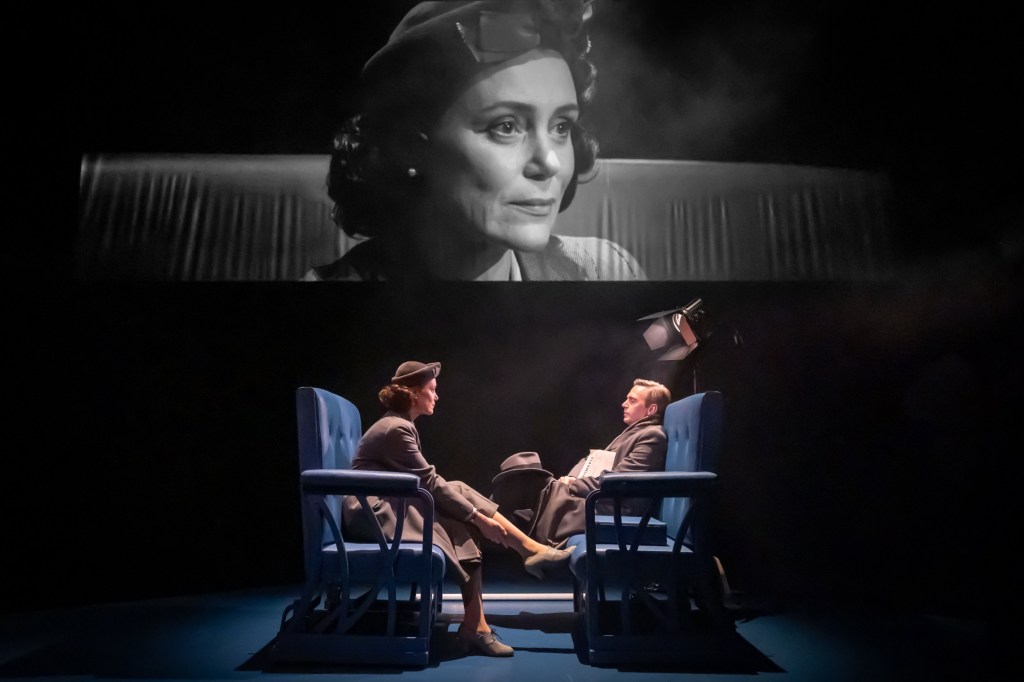
That drama doesn’t just stop with Iris’s marital misery and political ambitions, nor the impending inauguration of the NHS, all of which is handled with commendable flair and urgency. Kirkwood also manufactures for Iris an illicit romance, with a film star, played with an insouciant, grizzled charm by Jack Davenport, who she meets by chance on a train and unlocks in her “the rapture of living”, as he puts it. The parallels with Noël Coward’s Brief Encounter, which is referenced in the script, are inescapable then further underlined by the use of black-and-white live filming.
Simultaneously viewing actors live on stage, and in real time on a big screen above them is very much having a theatrical resurgence right now (my first memory of a version of it is from the opening Requiem sequence of Hal Prince’s original Evita staging). Nathan Amzi and Joe Ransom’s work here is no less impressive and sophisticated than what they were recently awarded for in the Jamie Lloyd Sunset Boulevard but whether it really adds anything in this instance is a question. Certainly it underlines the relationship to the aforementioned Noël Coward screen saga of middle aged romance on trains, and it allows us to appreciate finesse and subtlety in the performances, particularly from Hawes and Davenport both of whom have luminous screen as well as stage presences, but it doesn’t necessarily enhance the play itself, except on a superficial but admittedly exciting level.
The acting throughout is wonderful, walking the fine line of appealing to modern audiences, while at the same time capturing the clipped understatement that characterises the way people spoke and behaved in the middle of the last century, or at least as we today perceive them. Hawes and Davenport couldn’t be better, but the range and skill of the other three actors who play umpteen other roles apiece (this is effectively an epic play done on a minuscule scale) is astonishing. Goodman-Hill, Siobhàn Redmond and Pearl Mackie are effectively doing an acting marathon every night here, and they never hit a false note as a series of colleagues, rivals, patients and relatives. Tremendous work.
There’s an invaluable contribution too from the hardworking stage crew, essential yet unobtrusive, who are part of the action of Michael Longhurst and Ann Yee’s busy but oil smooth staging, fully visible as they hand props to actors and shift furniture and lights on Fly Davis’s bare, perpetually revolving stage. Technically brilliant as the production is, it never clarifies whether some of the storytelling clichés (amongst others, a posh frock reveal, sudden lengthy speeches that spring from nowhere like arias and feel inorganic, and a moment of discovery of infidelity that could have come straight out of a hackneyed romance) are weaknesses in the script or a deliberate homage to B-movies of yore. The muted palette of Davis’s design and Joshua Pharo’s lighting would suggest the latter. The contrasts between middle and working classes is portrayed effectively if without much subtlety.
Where the play is most successful is that it makes you care deeply about its flawed but ultimately admirable heroine and the things that she cares about. The last couple of minutes, which I won’t spoil here, may well have you reaching for hankies, and Hawes is heartrending but never sentimental. Kirkwood has made an angry play but also an articulate and deeply humane one. I wasn’t fully convinced by the golden age of cinema redux approach perhaps but the majority of the writing is very fine, and there’s no denying that this is a grand, engrossing time in the theatre.


Leave a Reply