SUNSET BOULEVARD
Music by Andrew Lloyd Webber
Book and Lyrics by Don Black and Christopher Hampton
Based upon the film by Billy Wilder
Directed by Jamie Lloyd for the Jamie Lloyd Company
Savoy Theatre, London – until 6 January 2024
https://sunsetboulevardwestend.com
For the second time this month the West End has seen the opening of a musical production that will be talked about for decades. But where Cameron Mackintosh’s ravishing tribute revue Stephen Sondheim’s Old Friends feels like a warm hug from a best mate, Jamie Lloyd’s technically breathtaking reinvention of Sunset Boulevard, starring an incandescent Nicole Scherzinger, is the theatrical equivalent of having a bucket of icy water thrown over you.
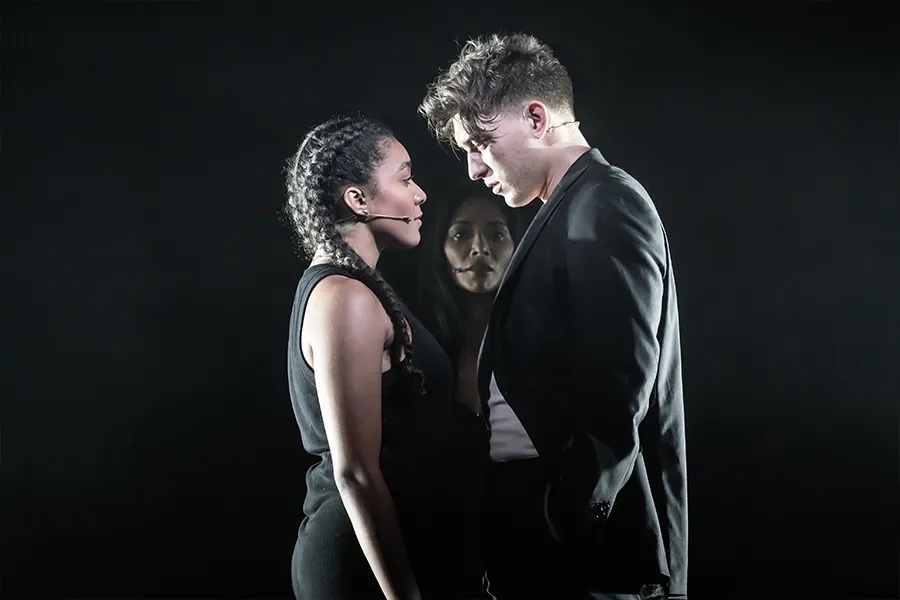
This might be retitled Deconstructed Boulevard as it simultaneously refocuses and comments upon both the 1993 Andrew Lloyd Webber musical and the Billy Wilder film classic, with live filming (brilliant, game changing work by Nathan Amzi and Joe Ransom) an essential part of the experience, and an elegant, brutally spare visual aesthetic in an almost exclusively black and grey colour pallet. The most obvious comparison is to the multimedia work of European auteur Ivo van Hove: the meta staging of the title number is particularly reminiscent of an outdoor filmed section of his National and Broadway smash Network from a few years back, but Lloyd and team go bigger and even more remarkable here.
The overall effect is of watching a beautiful nightmare unfold. The figures move in dreamlike slow motion through blasts of dry ice then suddenly, stunningly break into Fabian Aloise’s dynamic, jagged choreography. It’d be anachronistic if they’d been dressed in the 1950s fashions of the original but here it looks appropriate given that everybody is attired as though they’d ramraided an All Saints store. Meanwhile, a giant, stage-filling screen pivots, tilts, raises….and turns out to be the only set (design by Soutra Gilmour) that we get. Somnambulistic characters only occasionally address each other directly, mostly delivering their lines out front.
This is especially true of Scherzinger’s Norma Desmond – less a faded film star and more a free-floating, sensuous wraith, equal parts attitude and neediness – who often seems the only person onstage aware of the encircling cameras, and plays up to them or to “my people in the dark” (specifically, us in the audience) as though the adoration of fame and fandom is the oxygen upon which her life depends, which it just might. This version feels less about a reclusive actress deludedly trying to reclaim her stardom and more the pressure on women in the public eye to stay relevant and desirable in a world where, increasingly, youth and surface are all. Tellingly, a lot of the references to old time film stars in Christopher Hampton and Don Black’s script and lyrics have been excised.
Instead of inheriting the gowns and jewels of previous Normas, Scherzinger’s is bare footed, raven locks tumbling free, her bone slender dancers body clad only in a sheer black shift. She’s still gorgeous, astoundingly so, even when juxtaposed in unforgiving close-up with Hannah Yun Chamberlain’s ghostly, athletic youthful iteration of the character. Vocally, she’s exhilarating, going seamlessly from gently breathy to full out diva belting, and observe the way she physicalises the big numbers ‘With One Look’ and ‘As If We Never Said Goodbye’, pleading yet imperious, it’s impossible to take your eyes off her.
She’s also irrepressibly camp, but not in the Grande Dame manner of LuPone, Close, Buckley, or Elaine Paige (the only Norma from the original production to bear a resemblance to Gloria Swanson in the movie): this Norma is all finger-snapping, eyebrow-arching, pouting-to-camera “yassss kweeen” camp, and it works brilliantly. Some of her asides and moues to camera are as hilarious as they’re provocative, and she has an irresistible eccentricity tempered with a fragility that tears at the heart. She’s weird and self obsessed, but it’s impossible not to like her. The descent into madness (which includes an unsettling, rollickingly unhinged dance section courtesy of Mr Aloise, featuring multiple Norma’s) is more painful to watch than that of any other actress I’ve seen in the role, and Scherzinger finds an animalistic, elemental rawness that stuns. Her Norma exists at the axis between iconic and vulnerable, and she’s unforgettable. This is a career redefining performance from an artist at the very height of her powers.
Opposite her as struggling writer Joe Gillis, Tom Francis catapults himself into the top bracket of young West End leading men. He’s sexy yet tormented, and detached, with a wariness behind the eyes that suggests a deep-rooted hurt, despite his comparative youthfulness. It’s a tremendously nuanced take, abetted by the (literally) in-yer-face camera work, and his singing has an agreeably gritty edge. He’s magnificent.
David Thaxton’s devoted Max is another performance that completely remints a familiar role, and benefits from the detail afforded by playing straight to camera. He’s a saturnine, powerful presence with a palpable sense of longing and pain, that can suddenly, disturbingly flip into snarling aggression when he perceives a slight upon his beloved star. Thaxton’s voice has never sounded finer, and he pulls out money notes that make you hold onto the arms of your seat and gasp. Grace Hodgett Young as Betty is appealingly direct, with an intriguing steely edge, a palpably ambitious young woman rather than an idealistic neophyte: she’s a wonderful find, and a perfect foil to the streetwise lost boy of Francis’s multi-layered Joe.
The ensemble is outstanding, a glorious cacophony of fine individual voices that collectively thrill the blood when they coalesce. Aloise has them hurling themselves about, tumbling, rolling, posing, like an organic whole from which soloists periodically extract themselves to powerful effect: it’s visceral, striking work, sublimely theatrical in amongst all the cinematic high tech.
There are moments when the cool, stark style of Lloyd’s overall concept works against the lushness of Lloyd Webber’s music (which has never sounded better, by the way, not even in the bigger orchestrated Coliseum version of 2016) but that also creates a tension that gets closer to the dark acidic heart of Wilder’s legendary movie than Trevor Nunn’s lavishly literal original production ever did. This Sunset is expressionistic and demands that we use our imaginations, and Lloyd has a stronger handle on this material than he did on Evita in his bold but occasionally bewildering 2019 Regents Park staging. It’s playful too, sometimes perversely so, as when we are shown a Jamie Lloyd Company mug, Pussycat Dolls photos and a cut out of ALW in the live streamed backstage sections. I’m not sure that really adds anything to our perception of the show, but it’s a lot of fun.
Musically, it remains a sometimes overblown fusion of surging, soaring melodies and operatic dissonances, pitched somewhere between pop opera and Hollywood film score. It still doesn’t quite hang together but, packaged up in Lloyd Webber and David Cullen’s fine orchestrations, with a crystal clear sound design by Adam Fisher that gives the bombast full measure but never sacrifices intelligibility to volume, it registers mightily here. Hampton and Black’s partially revised, generally impressive lyrics are very well served, and Jack Knowles’s sophisticated, thriller noir-ish lighting is undeniably classy.
Inevitably there will be fans who mourn the loss of the grand staircase, the frocks (the turban!) and the dead monkey, but what’s in their place is so exciting and inventive, it’s pretty much impossible to resist rising to your feet and bellowing superlatives. This astonishing onyx-black production and its mesmerising leading lady really have, to quote one of the songs, “found new ways to dream”. Shatteringly good.

 ajhlovestheatre
Leave a reply to Andrew Walters Cancel reply