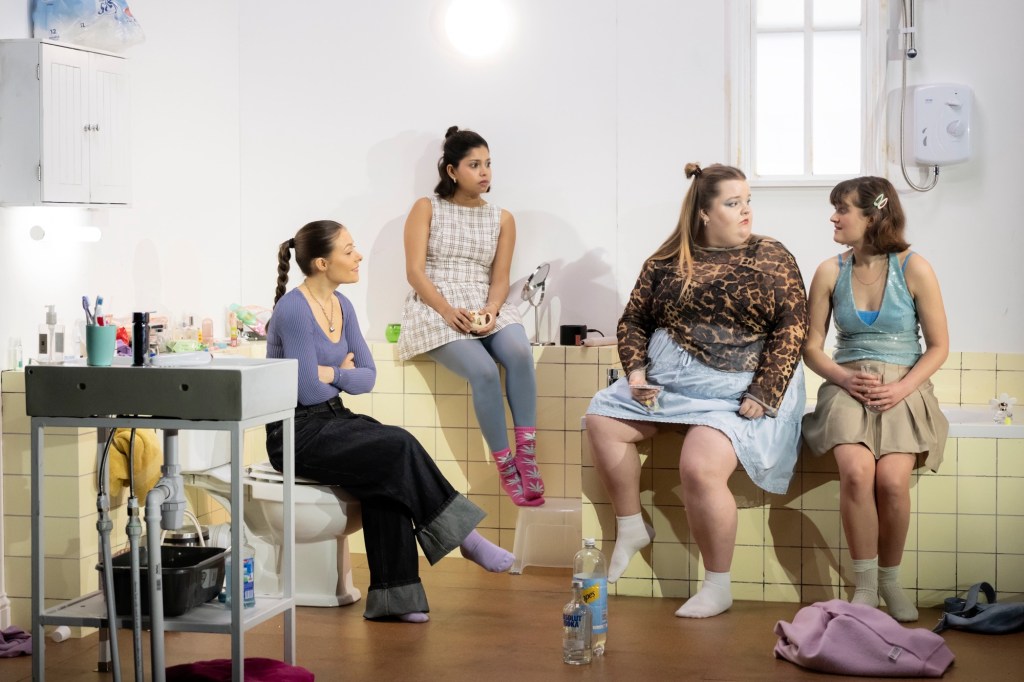
“It is a massive thing. I can literally feel it… It’s so heavy I feel like I’m wiping the floor with it… I’m surprised I can even walk with it.” That’s hyper-anxious sixteen year old Phoebe talking about her own virginity in Miriam Battye’s outrageously entertaining but thoughtful new play. The Virgins centres on a group of teenage girls preparing for a night out where the aim of “pick one boy each to pull…then come home and eat chicken dippers” takes a more extreme turn when an older, more sexually experienced young woman turns up, all knowing sass and attitude, and the race is on for full scale loss of virginity.
At first it feels like a modern day answer to Willy Russell’s Stags And Hens, the girls primping and preening in the bathroom while just across the hall a pair of boys play computer games and engage in half-hearted banter. The detailed, mostly realistic set and entirely plausible costumes are by Rosie Elnile.
Battye’s writing for these kids is eye-wateringly accurate and deliciously funny. The dialogue bounces off the stage with a rare vitality and relatability, and the playwright’s affection for these stroppy, clueless, lovable youngsters is palpable. Jaz Woodock-Stewart’s sparky, supremely well cast production, punctuated by blasts of bombastic classical music in witty counterpoint to the lower brow concerns of the characters, matches the potty-mouthed dynamism of the text.
Every member of the youthful acting company is outstanding, mining the script for every scrap of humour but never playing it for the laughs which, goodness knows, are coming thick and fast anyway. Anushka Chakravarti and Ragevan Vasan fully convince as siblings whose mutual loathing is probably only on the surface, and Ella Bruccoleri finds so many layers and colours to quirky, independent-minded Jess. Zoë Armer suggests with real pathos the trauma and hurt hiding just under the surface of apparently confident, slightly older Anya, and Alec Boaden raises diffident coolness to an art form as a bemused lad also with hidden depths. Molly Hewitt-Richards is a neurotic delight as uncertain Phoebe (“I’ve done a test run and I know if I have three single vodka lemonades on no dinner I’ll be fun and not vulnerable”).
Aside from the copious belly laughs, The Virgins has a genuine gravitas as it touches on peer pressure, sexual violence, the objectification of young women and the bewilderment of young men. It’s a compelling mix but the lurches into serious territory, though essential to the play as a whole, could be refined somewhat. A mutual masturbation scene should be awkward, as should the closing moments where two youngsters start to have sex but are impelled to use the physical and indeed aural language learnt from exposure to porn. But a reflective speech for Boaden’s Mel where he talks, almost accusingly, about his disillusionment with the opposite sex, although terrifically well played, feels shoe-horned in and a tad ponderous.
The Virgins is still a tremendously accomplished piece of writing though, a rollicking good time with very sharp fangs and moments of authentic pathos. It should be required viewing for mid- to late-teenagers, but probably not with their parents. The embarrassment, y’know…. Enthusiastically recommended.
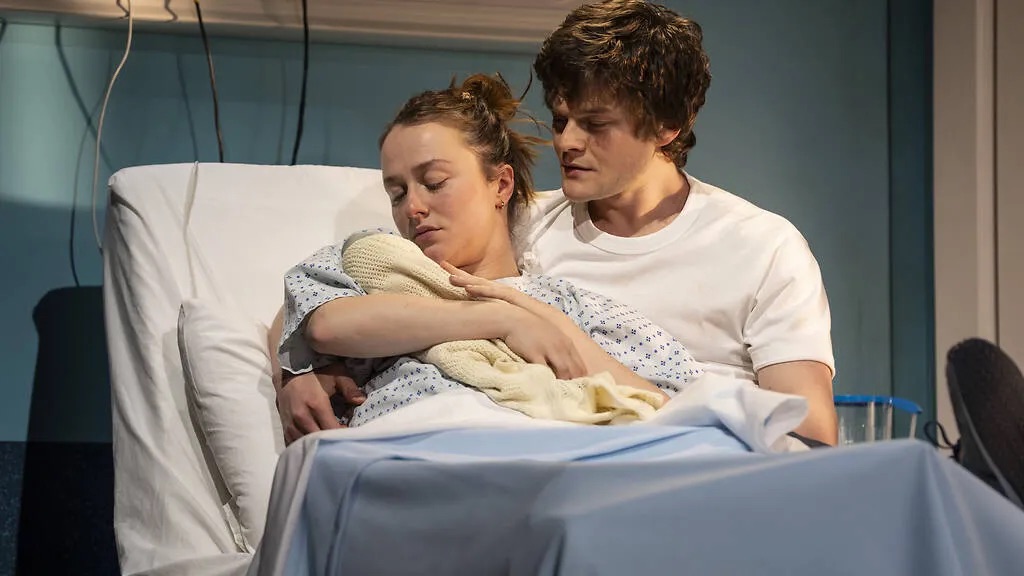
It’s awfully early in 2026 to be proclaiming that something is the play of the year, but any other new piece of writing, central performances and overall production in the next ten months will really have to be going it some (technical term) to match this no-holds-barred stunner. Luke Norris is a very good actor, but on the basis of his script for Guess How Much I Love You?, premiering on the Royal Court’s main stage in a shattering production by Jeremy Herrin, he’s a truly great playwright.
He writes naturalistic dialogue that pulses with raw emotion, crackles with wit that sometimes winds you with its stark cruelty, and reveals painful truths about the characters speaking it, even when they don’t necessarily realise how much they’re giving away. Rosie Sheehy and Robert Aramayo play a young couple expecting a baby whose lives are transformed when their twenty week scan reveals an irregularity in the foetus. There’s a bleak poetry to the writing too: “can you close the curtains please? The sun doesn’t make any sense” said by one of the characters in the depths of their sadness, is a line that will stay with me for a long time.
Guess How Much I Love You? deals with the emotional and spiritual fallout from such a devastating discovery. Sounds harrowing? Well, yes it is, inevitably….but it’s also deeply, bloodily humane, surprising, darkly humorous, suffused with love, pain, and masterful visual and verbal storytelling that takes the breath away with its dexterity and invention. Theatrical alchemy happens when writer, cast, director and creative team are all singing from the same tear-stained hymn sheet, and that, thrillingly, is what’s happening here.
It’s not fair to give away what happens beyond the first scene which finds the young couple in a hospital’s ultrasound room awaiting their consultant’s return, killing time by playing an increasingly spiky and exasperated game of Twenty Questions. It’s the perfect introduction and set-up for a riveting rollercoaster of compassion, trauma and cold hard truth, best experienced by the audience when, like the principal characters, they don’t know what’s coming next. There’s nothing cheap or sensationalist about Norris’ or Herrin’s work though, but part of the play’s raison d’être is to examine, unflinchingly, how humans absorb and rebound from, the unthinkable.
Sheehy’s extraordinary ability to access an almost unfathomable well of deep feeling has seldom, if ever, been as persuasively demonstrated as it is here. Whether screaming blue murder with the vehemence of a thousand furies, masking her agony with scabrous sarcasm, or her face slack with despair, she is unforgettable. Aramayo matches her every step of the way, as the young man at her side even as she’s pushing him away. He makes his grief vivid and heart-stopping, and manages the not inconsiderable feat of portraying a thoroughly good human but ensuring that he is also utterly fascinating.
There’s beautiful, sensitive work from Lena Kaur as a NHS midwife (“imagine this but it bankrupts you” says Sheehy’s character at one point). Herrin’s staging is brilliantly modulated, giving full rein to every beat, detail and colour in the text, and goes at a hell of a pace. The lengthy breaks between scenes isn’t just to change Grace Smart’s realistic sets, it’s to give the audience a chance to decompress. Smart’s sets are interesting, they look like actual rooms but claustrophobically hemmed in somehow, as though to visually represent the grim choices facing the couple, until, that is, the very last one when the playing space expands and you can feel the audience members around you allowing themselves to breathe.
Anybody thinking about seeing this remarkable piece of theatre should check the trigger warnings on the website. If you’ve been through some of the experiences depicted here, it may be too distressing to bear. Alternatively, it may provide authentic catharsis, as great art can do: and this IS great art. I am still reeling.
Frantic Assembly’s signature blend of thought and feeling expressed through ecstatic, expansive movement melds with Anna Jordan’s beautifully observed tragicomedy charting the highs and lows of a relationship in Lost Atoms. If it sometimes feels that the choreographed sections in Scott Graham’s visually arresting, beautifully performed production feel more grafted onto the text than arising organically out of it, it’s impossible not to admire the skill and indeed to feel the feels.
Robbie (Joe Layton) and Jess (Hannah Sinclair Robinson) look back on their stormy but frequently heartwarming relationship from coffee shop meet-cute through joyful sex, awkward in-law introductions, insecurities, potential parenthood to trauma and regret. Jordan writes her characters, flawed and relatable as they are, with an abundance of affection and has them express themselves in language terse, humorous and natural, shot through with devastating shards of cruelty when the emotional stakes become high.
Robbie and Jess seem to be recalling their past from some sort of liminal space – Simisola Majekodunmi’s lighting snaps back and forth between sepulchral pallor and warm realism – so as to comment on the unreliability of memory (they frequently contradict each other) and, quite movingly, to imagine potential futures for each other, but not necessarily together. The shadow of Nick Payne’s Constellations sometimes seems to hang over Lost Atoms although, textually at least, this is a less ambitious affair.
The chemistry between Layton and Sinclair Robinson – him cautious, grief-tinged but touchingly open-hearted, her fearlessly running at life with healthy doses of sunshine and attitude – is quite something to behold. Whether cradling each other in a stunning “bed ballet” viewed from above, confiding things they’ve told no one else, or bickering with the passion of people who really matter to each other, they entirely convince, and it’s impossible not to care about them, even at their most insufferable. The tenderness takes your breath away…and so does the brutality. Jordan gently upends traditional romantic notions by casting the go-getting Jess rather than the more reticent Robbie as the dominant force in the relationship. “You’re my knight in shining armour” he points out wryly, and, for all his insecurity and issues, when things go asunder, for a number of reasons, she is the prime mover.
Layton and Sinclair Robinson, as athletic as they are riveting to watch and truthful, are so good that they almost divert attention from the script’s second act meanderings into soap opera territory, although a joint trauma, which I won’t spoil here, is sensitively handled. It’s also a little long: what could have been a punchy ninety to a hundred minutes is bloated into nearly two and a half hours including interval, and it might verge on the interminable without such cracking performances and the considerable pleasures of Graham’s bravura staging.
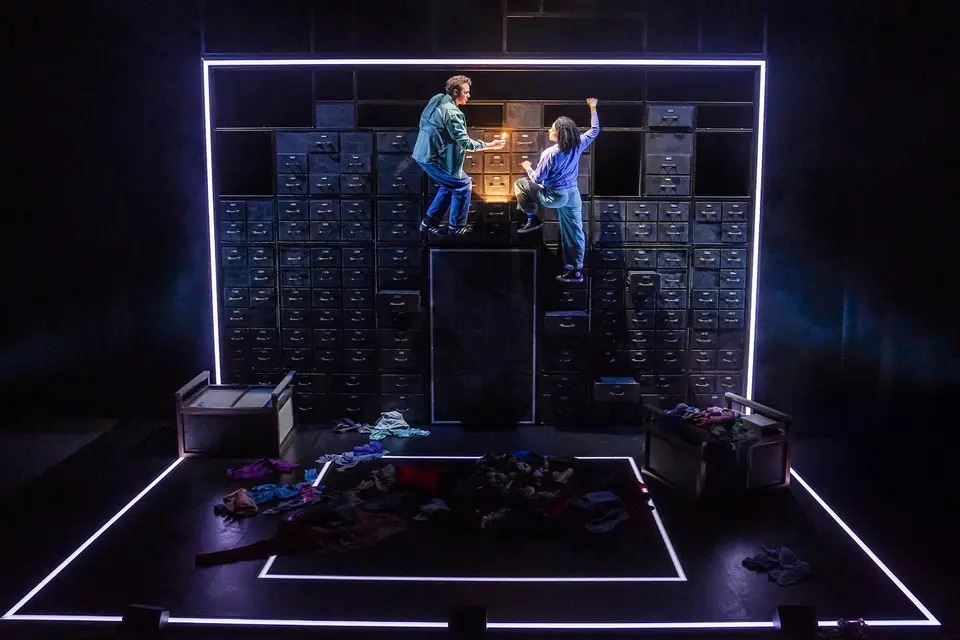
Apparently unimpeded by gravity or indeed vertigo, the actors bounce, glide, clamber and ricochet all over Andrzej Goulding’s neon-edged, multilevel set of dozens of drawers that can pop open to reveal props or become steps and platforms, while also evoking a cityscape at night. It’s exhilarating to watch and occasionally very affecting as the airborne movement conveys the heady euphoria of new-found love before devolving into the treachery and danger when that connection is under threat.
Intriguing, engaging and ultimately frustratingly elliptical, Lost Atoms doesn’t fully satisfy as a play, although it has some wonderful things in it. See it for the astonishing performances, Jordan’s unerring grasp of how real people talk, and the uniqueness of Frantic Assembly’s vision and house style.
You can’t accuse the Almeida’s outgoing artistic director Rupert Goold (he leaves in the autumn to take up the reins at the Old Vic from Matthew Warchus) of resting on his laurels. His 2013 musical version of Bret Easton Ellis’ gory, controversial novel American Psycho was an absolute smash hit (well ok, not on Broadway where it tanked after less than three months) but it was the hottest ticket in London town during the original run starring a ripped, wittily unreadable Matt Smith. Surely it must have been tempting to repeat the winning formula but this 2026 iteration is no carbon copy of the first version, despite using the same creative team.
The musical has been streamlined, brought into sharper focus and almost completely restaged. There are new songs (including the belting, haunting opener ‘Selling Out’ created for the New York production), sequences and scenes reordered and characters reconsidered. It’s still defiantly, pleasingly weird though, like a waking nightmare unfolding in a sea of neon, chrome, brick and glass where humanity is in short supply but ego, image and cheap thrills are in abundance.
Is it actually better than before? Not necessarily, but it remains a chilling and thrilling night out, one that captures the unique atmosphere of paranoia, icy cynicism and flamboyant consumerism of the 1980s. Duncan Sheik’s synth-heavy, mordantly melodic songs, more minor than major key, are so irresistibly redolent of the period that somebody unfamiliar with late twentieth century pop might have a hard time working out where the score ends and the actual chart hits of the time begin: Human League’s ‘Don’t You Want Me’, Phil Collins’ ‘In The Air Tonight’ and New Order’s ‘True Faith’ are all included.
2026’s Patrick Bateman, the designer label-obsessed, emotionally disconnected Wall Street banker who may or may not be a serial killer, is Arty Froushan in a tremendously accomplished musical theatre debut. He imbues Bateman with an edgy charm, and a wide-eyed, almost child-like watchfulness that troubles far more than his urban playboy swagger. Unlike his predecessors in the role (including Benjamin Walker on Broadway and Christian Bale in the 2000 film), Froushan suggests that Bateman never quite feels ‘enough’, that he is somehow at sea in the world of wealth and privilege his financial position has put him in. When, at the beginning, he describes his well-appointed apartment, he feels less smug and more eager to impress. When his chic downstairs neighbour laughs at him for hanging an expensive painting upside down, his reaction is fear of exposure as much as fury. He makes vivid and all too credible the gulf between Bateman’s slightly withdrawn social stance as a privileged but perpetual outsider, and the simmering mania that periodically boils over with a mixture of glee and total abandon. He looks older than the 27 years that the text repeatedly reminds us he is, but this really is a terrific central turn.
Between Froushan’s performance and the revised staging, which replaces fake stage blood (the original was awash with it) with scarlet fabrics, lighting and video effects, it seems more clear this time around that Bateman’s graphic murder fantasies are just that, not actual events. Roberto Aguirre-Sacasa’s book is a skilful distillation of the original novel, managing to evoke real horror and revulsion while seldom becoming a hard watch, and it’s often bleakly hilarious.
This time around, the chasm between satirising the snobbish shallowness of extreme wealth (“I will not have an odd number at my dinner table, Patrick! This isn’t Brooklyn!”) and the fratty, misogynistic bants of the corporate financial bros, and the little bits of genuine feeling on display, feels more pronounced. That does lead to a certain unevenness but it also, tellingly, throws the humanity of the victims into sharper relief: it’s impossible not to be moved by Joseph Mydell’s homeless man, sobbing pitifully over the bank note Bateman has tossed down in front of him, or not to feel pity for the sex workers (Hannah Yun Chamberlain and Millie Mayhew, both hugely effective) who are reduced to twitching cadavers. Yep, as ‘dark’ musicals go, this one is right up there with Sweeney Todd.
In theatricalising a story as gory as this one, there is inevitably a degree of artifice required that is perhaps best served by the distance lent by a proscenium arch; the original version had that, but this one doesn’t. Es Devlin’s set is a sleek black runway extended into the Almeida stalls and ending in a forbidding-looking tunnel that suggests a railway arch but also the urban-chic downtown nightclubs where Patrick and his cohorts go on their coke-fuelled binges. It’s very striking, especially as excitingly lit by Jon Clark and enhanced by Finn Ross’ sophisticated video floor, but it paints the staging into a bit of a corner, with actors constantly masking each other, and repetitive scene changes (things rise up through the floor ad infinitum). It’s only possible to really take in Lynne Page’s dynamic, unsettling choreography if you’re front centre in the circle, but equally if you’re up there you miss the immediacy of having performers centimetres away from you in the stalls. Still, it’s a glossily attractive eyeful, and Katrina Lindsay’s elegant (even when ripped to shreds) costumes evoke the 1980s without sending them up.
There are some great voices in the cast but this isn’t a score that requires steel-lunged belting, and it’s the acting choices that really impress here. Emily Barber and Tanisha Spring bring a brittle glamour and surreal humour to, respectively, Bateman’s moneyed girlfriend and her best mate (who he’s also sleeping with, of course). Anastasia Martin, wonderful, and looking uncannily like a young Dianne Wiest, is the steady, decent heart of the piece as the secretary in love with Patrick and possibly the only person capable of helping him. Kim Ismay is a deadpan hoot as his soignée, heavily medicated mother and the incredulous Russian dry cleaner charged with removing bloodstains. There’s superb work from Daniel Bravo, smooth as silk as Bateman’s professional nemesis, and Olly Higginson, splendidly obnoxious as the cockiest of his colleagues, also providing a bang-on impersonation of Patrick’s idol, one Donald J Trump. Zheng Xi Yong is cute and appropriately bonkers as a lost soul in thrall to Bateman.
Thunderous, poisonous, and just occasionally a little ponderous, this is a musical that refuses to play by the rules. There are brief moments, usually involving dance beats and Page’s barnstorming yet macabre choreography (the glam rock-adjacent ‘Killing Spree’ which sees our anti-hero, mic in one hand, knife or shotgun in the other, slaughter the entire company, is a prime example), where it capitulates, almost, to traditional musical theatre exhilaration. For the most part though, American Psycho is a piece that invites us to meet it on its own terms, and, perhaps surprisingly, it works. Something this nasty and cynical has no business being so much damn fun.
The dual legacy of music and stories handed down through centuries, traversing centuries, lifestyles, oceans and continents, is at the heart of Finn Anderson and Tania Azevedo’s engrossing, female-centric musical. Ballad Lines feels at once intimate and epic, and equal parts Celtic and American. It’s also possibly the best sung show in town right now.
One certainly can’t accuse songwriter and co-author Anderson and director/co-author Azevedo of lack of ambition. In less than two and a half hours, they examine how traditional songs get passed from person to person, all around the world, and the resulting cross fertilisation of cultures. Equally, the show, previously known as A Mother’s Song in an earlier iteration, considers how women’s bodies are commodified and controlled, across three different time frames but centring on one extended family.
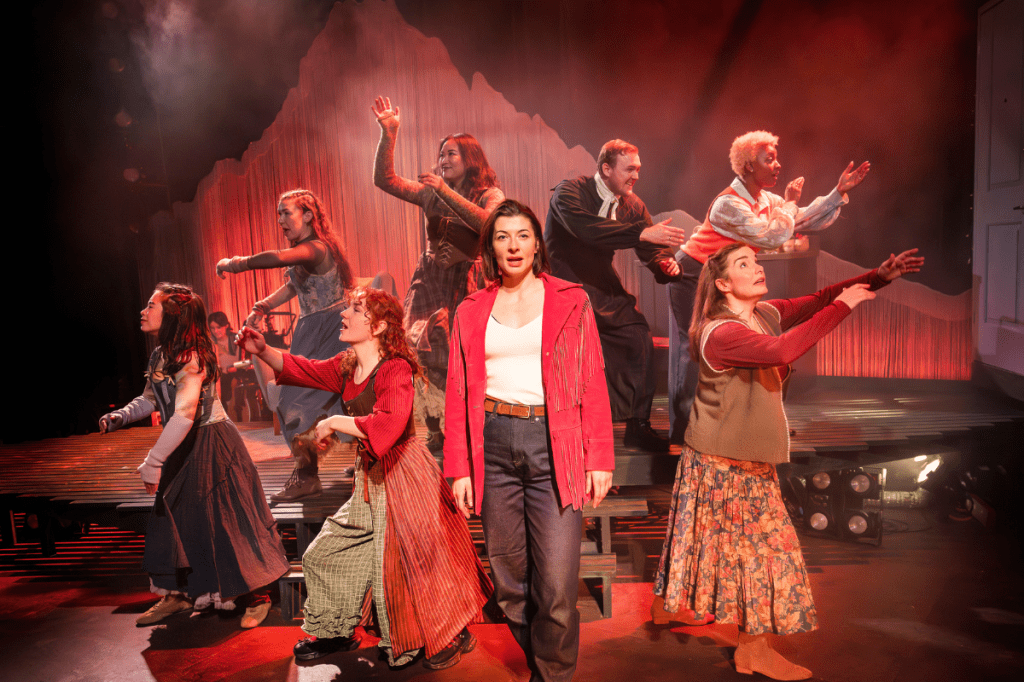
There’s 17th century Scottish ministers wife Cait (a luminous Kirsty Findlay), unwillingly pregnant and defying social norms, then, a hundred years later, her free-spirited descendent Jean (Yna Tresvalles) unexpectedly pregnant at fifteen and compelled to make the long journey to start a new life in America. In the present day, Sarah (Frances McNamee), the distant offspring of these woman, moving into a new apartment in New York with her girlfriend Alix, is floored when she listens to a series of tapes from her deceased aunt (golden voiced Rebecca Trehearn) recounting family stories and reciting folk songs carried half way across the world by her female forebearers.
There is a degree of contrivance in the way the three timelines interweave but the sheer potency of the music and the truth of most of the performances ensure that it never devolves into schlocky sentimentality. The score (played gloriously by a four-strong all-female band, and sung by the cast like their lives are depending upon it, which, in the context of the story, is frequently true) is folk made vibrantly theatrical. It’s easy to make comparisons with Once, Come From Away and Benjamin Button, and indeed the music, lyrical yet thrillingly rhythmic, does punch you straight in the heart in a similar way, but Ballad Lines seldom feels derivative.
The show isn’t perfect: the second half unsatisfactorily resolves a conflict between Sarah and Alix (Sydney Sainté, utterly wonderful) over them having their own child, that blows up too quickly and results in a schism in their relationship that is dealt with too perfunctorily to be fully credible. The sole male in the cast, Ally Kennard, is a capable and likeable triple threat but feels fundamentally miscast. He is a warm, almost cuddly presence but doesn’t feel rough or alpha male enough as to be a physical threat to Findlay’s desperate Cait.
Still, the sense of generations of women’s joys, struggles, traumas and triumphs being channelled through drums, fiddles, guitars and roof-raising vocal harmonies is palpable and powerful. At the centre of it all as the conduit for all the memories, traditions and issues is Sarah, and McNamee is remarkable. She invests this conflicted young woman with a credible, all too human combination of fragility and edge. In all honesty, she’s sometimes better than the script which just occasionally veers into daytime soap territory. As her ancestor, Findlay – heartbreaking – finds a similar balance of softness and steel, while Tresvalles is all passionate determination as fiery but lovable Jean. All of the vocal performances will make the hairs on the back of your neck stand up.
T K Hay’s simple but ingenious set manages to simultaneously suggest Sarah and Alix’s New York apartment, the Appalachian mountains and the ship that carried Sarah’s ancestors across the Atlantic. Tinovimanashe Sibanda’s stomping and keening choreography, although sometimes hemmed in by the limited space, is rousing and hypnotic. The lighting by Simon Wilkinson is suitably atmospheric and helpful in delineating locales and while the sheer wall of sound (design by Andrew Johnson) frequently thrills the blood, there are lengthy sections where the lyrics are indecipherable.
The flaws in Ballad Lines are fairly minor, and as that music and those voices surge through the house, it’s impossible not to get swept up in the raw emotion and melodic brilliance. If the spoken material isn’t quite realising its full potential as yet, this is undeniably a cracking night in the theatre already, and could end up being a real world beater. I’ve already got the studio cast album playing on repeat.
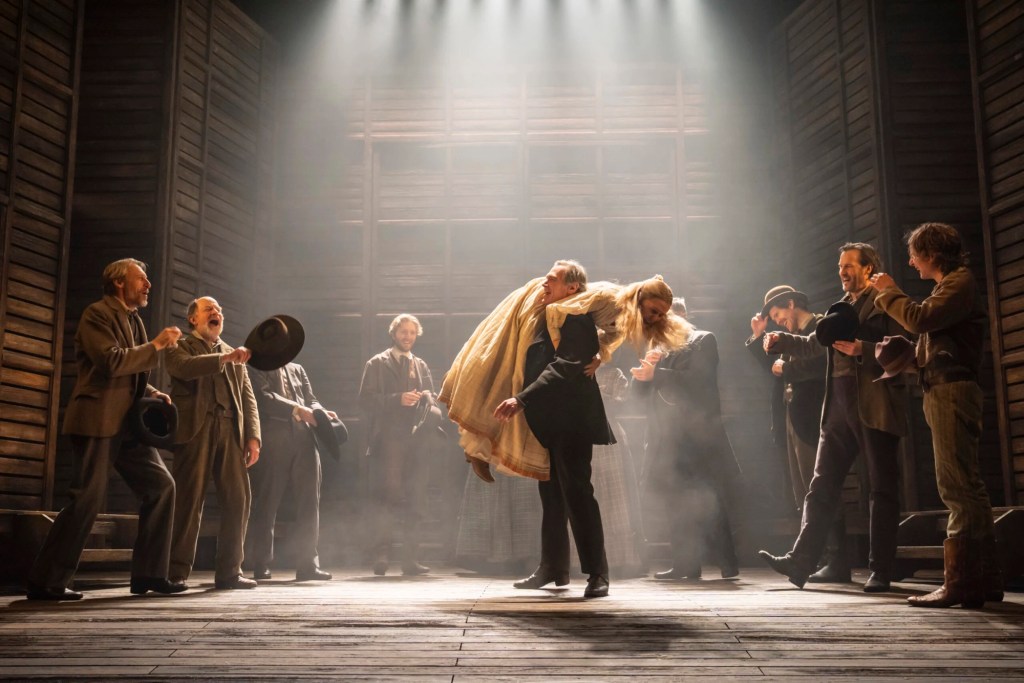
The original 1952 movie is such a classic of the Western genre, with its sense of blazing, unforgiving sunlight and wide open, barely habitable plains, that it might seem foolhardy to attempt a stage version of it. Although Thea Sharrock’s production immediately immerses you in the world of High Noon, I spent the first twenty minutes or so wondering what was the point of turning this story into a play, despite the obvious stagecraft employed. Playwright Eric Roth and director Sharrock won me over though, turning this tale of lawlessness and self-sacrifice into a sonorous, atmospheric thriller that winningly conveys the claustrophobia as well as the community of a small township where life is equally informed by the ongoing threat of violence as fear of God Almighty.
Tim Hatley’s slatted wooden set and period costumes and especially Neil Austin’s stunning, evocative lighting are instrumental in the production’s success. So is Chris Egan’s rather gorgeous music, heavily referencing the rock of Bruce Springsteen as well as the bluesy twang of classic Western soundtracks, of which there is so much that one almost wishes they’d gone the whole hog and given us High Noon – The Musical. Courtesy of choreographer Lizzi Gee, there’s line dancing, a bit of a hoedown and, perhaps unnecessarily, a smattering of interpretive dance, culminating in death by gunfire, which unfortunately drew a few inappropriate titters from the front stalls on the night I attended.
There’s no unwelcome laughter at the magnificent central performances however, which consistently sell this sometimes overwrought script for rather more than one suspects it might really be worth. In an exquisitely textured and detailed turn, Billy Crudup is very different from Gary Cooper in the movie, but no less effective. He makes town marshall Will Kane, choosing between leaving with his strong-willed, pacifist new bride Amy (Denise Gough) or staying to face the newly released murderous criminal he helped put away who’s returning to wreak vengeance, into a fully rounded figure, heroic but plagued by doubt.
Gough delivers beautiful, powerful work as Amy, torn between her principles and her devotion to Kane, a modern woman in a world ill-equipped to cater to her. She sings frequently (and wonderfully) but it feels less like breaking into song, more an incantation, an expression of feeling when prose is inadequate.
Rosa Salazar impressively nails the stoic pragmatism and dormant passion of discontented saloon owner Helen Ramirez, and Billy Howle, all glower, swagger and nerves, is wonderful as Harvey Pell, Kane’s hot-headed youthful deputy. Some of the supporting performances, though nicely energised, tend to broad, generalised strokes but, in fairness, the Western milieu is a tricky one for British actors to capture.
Roth’s script and Sharrock’s fluid staging lack the propulsion of true stage drama – you’re frequently aware that this is based on a screenplay – but the tension ratchets up effectively as the clock suspended above the stage ticks inexorably towards the fateful midday when the train carrying Kane’s nemesis is due to arrive. High Noon finds modern day relevance in its depiction of the power of community and, especially in Amy’s case, the realisation that sometimes one’s most noble principles may have to be compromised for the greater good. A line of dialogue about the temerity of expecting to trust the people you voted for provokes ironic laughter.
This is an attractive, genre-blurring piece of theatre. It’s not essential viewing perhaps but Crudup and Gough are such a dynamic central pairing that High Noon ultimately packs quite a punch.
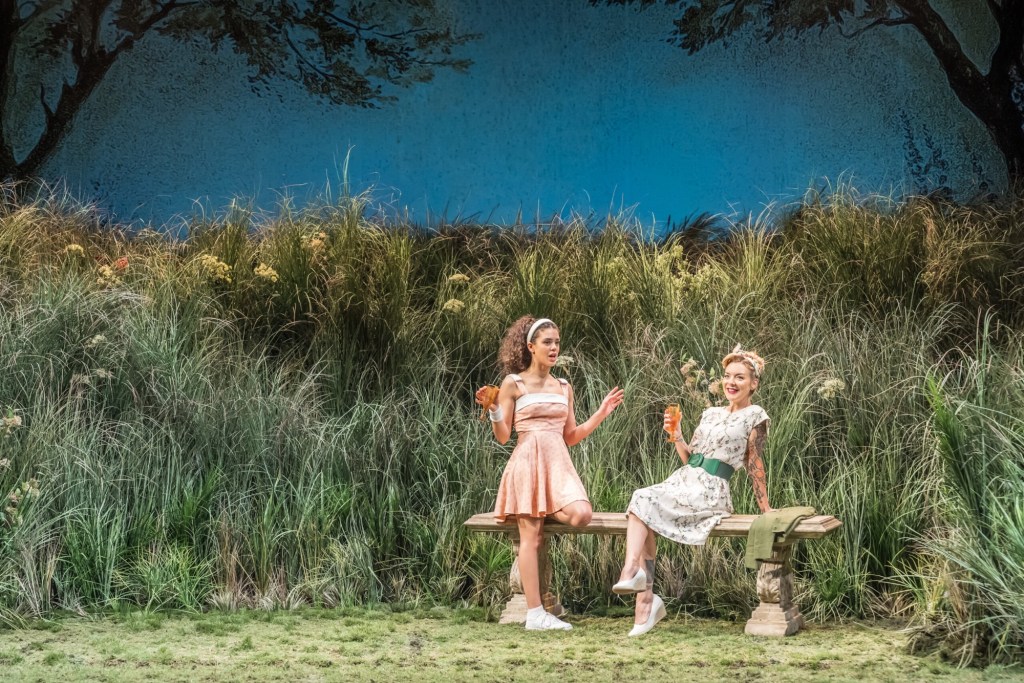
Sheridan Smith’s acting has an emotional availability and sparky comic aplomb that resonate irresistibly with audiences, and her versatility is admirable. She seems oddly miscast though as Susan, a vicar’s wife desperately losing her grip on reality and her sanity in this revival of Alan Ayckbourn’s 1985 tragicomedy Woman In Mind. Smith delivers an endlessly watchable, occasionally moving performance, but her pert wit, doll-like features, tattoos and mop of blonde hair collectively render her too modern, too glossy and rather too young to fully convince as the mother of grown-up children (one real, one imaginary) and the spouse of Tim McMullan’s brilliantly realised, terminally pompous Gerald.
Julia McKenzie won the Evening Standard Best Actress award for her turn in the original London production, and both she and her replacement Pauline Collins had a useful homely quality that cast a melancholy shadow over the scenes depicting Susan’s fantasised idyllic existence with her impossibly glamorous imaginary family. That same perceived ‘ordinariness’ rendered Susan’s descent into erotic and hysterical abandon all the more shocking. By contrast, Smith has a brassy glamour that makes her seem altogether more at home with Sule Rimi’s flamboyantly dressed alternative husband and Safia Oakley-Green’s doting but not-real daughter, at least until things turn nasty, than she does with their infinitely more pallid real life counterparts.
Smith does however have an extraordinary gift, used potently here, for allowing deep emotions to well up and sit momentarily on her face before being ruthlessly sucked back down into the depths of her being. When finally those feelings overwhelm her, as they do in the play’s unsettling final scene, and all reason is lost, it’s impossible not to be affected.
Ayckbourn’s script, which begins and ends with dialogue that is total gibberish reflecting Susan’s heightened mental distress, felt daring and profound when it premiered forty years ago, but attitudes towards women’s agency and possibilities and mental wellness, have thankfully come a long way since. It’s not that Woman In Mind is a misogynistic play, despite the depiction of Susan’s utterly weird grieving sister-in-law Muriel (an admirably committed Louise Brealey), Ayckbourn is too compassionate and even-handed for that. But it does feel dated now in a way that even the last West End revival, in 2008 with an incandescent Janie Dee, didn’t.
Romesh Ranganathan makes an energetic, if slightly one-note, West End debut as a gormless GP smitten with Susan. Chris Jenks and Taylor Uttley are very good in roles (Susan’s imagined brother and estranged real life son) that are more improbable sketches than fully realised human beings, although in fairness the former is only a figment of our heroine’s imagination.
Director Michael Longhurst scored a triumph a couple of years ago with another study of a woman in mental freefall – the Broadway musical Next To Normal at the Donmar then in the West End – but that material had an urgency and emotional clarity largely missing here. Set in a realistic garden against a backdrop of trees that warp and distort as a reflection of Susan’s tortured mind (design by Soutra Gilmour with video by Andrzej Goulding), Longhurst’s staging excels at building an atmosphere of comic chaos with an underlying sense of real threat and disquiet.
Smith’s inherent likability does a lot of heavy lifting here but neither that nor Longhurst’s energised staging can disguise that Woman In Mind, for all its ambition and empathetic heart, is a bit of a slog.
“It was shocking, outrageous, insulting…and I loved every minute of it.” So reads Andy Nyman’s unscrupulous Broadway producer Max Bialystock from a review of his new show, the astonishingly bad taste “Springtime For Hitler”, which he needs to flop epically so that he can pocket the investors’s cash, having deliberately over budgeted to the tune of $2 million. That same statement pretty much sums up Mel Brooks and Thomas Meehan’s The Producers, revived for the first time in late 2024 by the Menier Chocolate Factory and now happily ensconced in the West End.
You’ve got to hand it to him, Brooks is an equal opportunities offender. This rambunctious slice of Broadway, lovingly adapted from his 1967 movie, takes comic potshots at so many pockets of humanity (senior citizens, gays, Jews, theatre luvvies, Europeans, even Jesus this time around who turns up as a loincloth-wearing cocktail server in an exceptionally camp household) that it’s hard to know what to be affronted by first. Or maybe just buckle up and enjoy the ride of this high octane tuner that is as well-crafted as it’s crazy, and was hailed at its 2001 New York premiere as a glorious example of old school musical comedy in the grand manner.
Susan Stroman’s original staging of this tale of an attempt to create a bona fide Broadway disaster, was a glossy, huge affair; Patrick Marber, directing his first musical, goes for a much more downbeat aesthetic, leaning heavily into the innate Jewishness of the material. When Paul Farnsworth’s costumes turn on the dazzle dazzle, such as for the tap-dancing chorines or the statuesque German clichés served up as frothy flights of fantasy in the show-within-a-show section (“don’t be stupid, be a smarty! Come and join the Nazi Party!”) complete with giant pretzels, sausages and steins of beer, they’re a marvel to behold, but overall the emphasis is more on grit than glamour.
Scott Pask’s unit set of a massive metal grid reminiscent of those lightbulb-filled advertising hoardings that sit atop the theatres of Manhattan’s west 44th street underneath a golden Broadway marquee, is mainly transformed by a few simple additions. If the show is sometimes a little underwhelming visually now it’s on a proscenium stage as opposed to the Menier’s studio space, the fun still flows freely, and Marber’s production whips along at a cracking pace. Furthermore, Lorin Latarro, currently represented recently on Broadway by the financially successful Chess revival, has created dynamic choreography, energised but mindful of tradition, that more than matches Stroman’s original work.
The treatment of the Nazis throughout is (rightly) merciless: Hitler is carted on as a golden, high camp amalgam of himself, Caligula and sundry Broadway divas (“I’m the German Ethel Merman don’t you know”); we get dancers dressed as U-boats, tap dancing stormtroopers…it’s truly ridiculous. With the global emboldening of neo-Nazis and their extreme views, the show now exists in a very different world from the one that the original production opened in, and this gives Marber’s staging a real edge, even as it admirably demonstrates Brooks’s theory that the best way of disempowering something is by laughing at it. And laugh we surely do, even while occasionally cringing.
Brooks’s tunes sound like something from the Golden Age of Broadway, and Larry Blank and Mark Cumberland’s orchestrations package them with punchy energy but finesse. The quicksilver lyrics, ranging from witty to crude, have a rare brilliance and Paul Groothuis’ sound design ensures we can actually hear them.
This is a show that, for all its snark, is in love with the theatre, and the vivid gallery of characters Brooks created in egotistical director Roger De Bris (“that whole second act has to be rewritten. They’re losing the war? Excuse me? It’s too downbeat!“), his “common law assistant” Carmen Ghia, and their household of camp creatives are recognisable tropes. Also, for all his kvetching and bawling, Nyman’s Bialystock feels like a legit theatrical type who takes a bizarre pride in his ability to con little old ladies out of their money to put on his appalling productions.
Already terrific when the show opened fifteen months ago, Nyman’s Max has evolved into a transfixing masterclass in comedy playing. More low key than Nathan Lane and his successors in the original, he is uproariously funny but never lets us doubt that there is so much at stake for this sweaty chancer. There’s a palpable desperation and desolation, his comedy rooted in truth rather than the vaudevillian ‘business’ of his predecessors. He deservedly stops the show with ‘Betrayed’, the tour de force eleven o’clock number where the jailed shyster recaps the entire show in three minutes flat.
As the other titular producer, nebbish Leo Bloom, the put-upon accountant seduced by the bright lights of showbiz, Marc Antolin has dialled up the face-pulling and physical paroxysms several notches but still turns in a gorgeous study of somebody in a permanent state of anxiety, his body bent out of shape, his eyes wide and swivelling, his limbs somehow seeming too long for his torso. He’s totally endearing and even dances in character: his awkwardness giving way to something fleet-footed and entrancing when he gets together with his beloved Ulla.
The Ulla character, the Swedish blonde bombshell secretary-cum-starlet employed by Bialystock mainly because he fancies her, was very much a product of the time in the movie (original actress Lee Meredith was required to do little more than go-go dance in a bikini) but thankfully book writers Brooks and Thomas Meehan gave her more agency and material in the musical. Marber and his leading lady Joanna Woodward go even further, making her more wise to Max’s lechery and amused by the idiocy of the men she’s dealing with. It’s a subtle change, but it’s welcome, and she is clearly smitten with Antolin’s charming goofball from the get-go. Woodward brings an irresistible joie de vivre, a preposterous accent and a sensational singing voice to the role, as well as a knowingness that suggests that this stunning young woman is way smarter than Leo or Max realise. She’s fabulous.
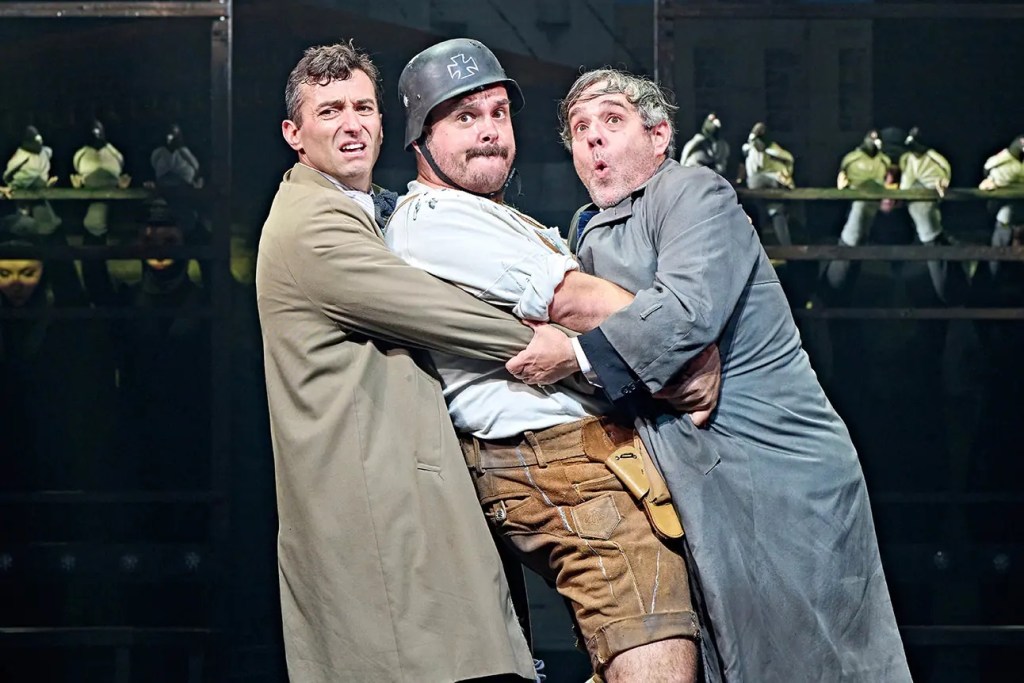
Another interpretation that continues to improve on the original is Harry Morrison’s Franz Liebkind, the lederhosen wearing, tin helmeted Nazi sympathiser (and Springtime For Hitler author) hiding out in Greenwich Village with his pigeons and a massive chip on his Teutonic shoulder (“the führer was BUTCH!”). Morrison plays him like a psychotic manchild who turns on a dime from guileless grinning idiot to gun-waving maniac, with a booming operatic voice and an imposing presence. As before, the performance is alive to the lunacy of its surroundings but infused with an unsettling sincerity and real sense of danger that makes him all the more hysterical. Sadly, that’s not true of Trevor Ashley’s over-the-top yet oddly lazy turn as flamboyant director Roger De Bris, who’s now so divorced from reality that he’s more exhausting than hilarious.
Minor quibbles aside though, this remains a classily outrageous show, tightly drilled and constructed. A thumping good night out, guaranteed to gently offend and delight practically everybody.
The impact of great art can vary considerably at different moments in history. Despite the medieval picture book aesthetic of the Bridge Theatre’s splendid new Into The Woods, the 1987 Stephen Sondheim-James Lapine Broadway tuner has seldom felt more timely. That’s especially true of the post-Happily Ever After second act where the safety and wellbeing of the many are threatened by the ego and lust for vengeance of the few. Feel familiar? Jordan Fein’s dark, handsome production is no didactic slog though; on the contrary, it’s an almost constant pleasure, but it’s too raw and truthful to function as mere escapism, and the piece itself is a meditation on culpability, compromise and yearning for a happier past, that remains startlingly relevant.
As with his devastatingly good Regents Park Fiddler on the Roof, which just completed a successful national tour, Fein looks at a canonic musical with fresh eyes and produces a version that satisfies traditionalists but has a vitality and imagination that feel original. Sondheim and Lapine’s creation sends beloved fairytale characters (Cinderella, Little Red Ridinghood, Jack…) into Jungian woods to sort out their familiar stories and find their expected ‘happy endings’. That’s act one, then act two is what happens next, and the musical enters territory not just uncomfortable but downright apocalyptic. Into The Woods disturbs as much as it delights and this version embraces its duality with real aplomb and flair.
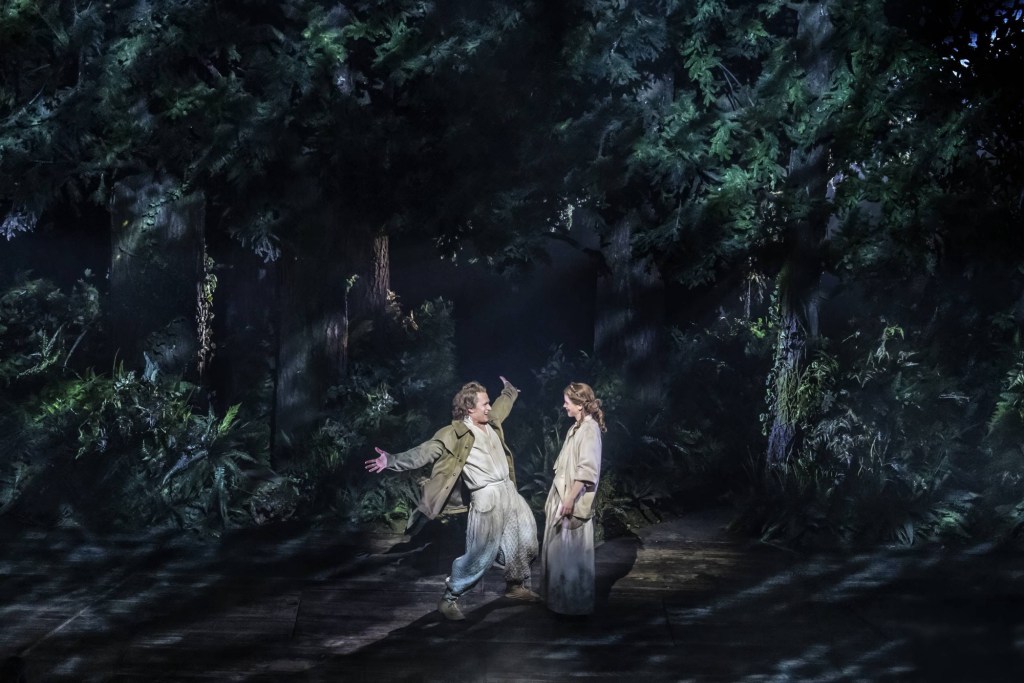
Fein and designer Tom Scutt start out by setting the storied dramatis personae, costumed like peasants in a Bruegel painting rather than the Disney-esque fairytale figures of Lapine’s own original production, in a jet black, liminal space. Dominated by a rising platform that also serves as a kitchen table and a hideyhole for Jack and his adored cow Milky White, it’s a place where witches and beanstalks can appear unexpectedly out of the gloom, and which can magically dissolve into lush foliage. Scutt’s woods, lit with breathtaking beauty by Aideen Malone, are a thing of wonder in the first half but come to resemble a devastated graveyard in the second, as the body count builds up, trees are decapitated, and a vengeful giant runs amok. The colour and warmth drains from the lighting and it feels as though we are looking at a war zone.
Also outstanding is Adam Fisher’s sound design which is loud enough to rouse and excite but nuanced to ensure that every beat and syllable of Sondheim’s deft, complex lyrics register, and that Jonathan Tunick’s peerless original orchestrations comes across with irresistible sparkle. When the jump-scares happen (no spoilers but anybody familiar with the show will know what I’m talking about), the volume level increases so dramatically and unexpectedly that a sense of genuine fear and panic ensues. Musical director Mark Aspinall’s band of a dozen, placed on either side of the stage, is wonderful, precise and crisp.
There’s a certain received wisdom with Sondheim that it’s hard to cast performers who can act the roles with the requisite depth as well as sing the (frequently technically complex and rangy) scores to an ideal level, and either dramatic finesse or musicality gets compromised. The late, great Sheridan Morley, reviewing the original London Company, noted that the cast “owe their allegiance to the stage itself rather than the orchestra pit underneath it”. Casting director Stuart Burt has done a fine job with this Into The Woods though and we get performances that are, mostly, as delightful to the ear as they are searing to the heart and pressing to the funny bone. They also throw up some interesting new insights on characters regular Sondheim viewers will have seen multiple times.
Jamie Parker and Katie Brayben’s Estuary-accented Baker and wife are gloriously relatable: practical people doing their best under less-than-ideal circumstances. Parker gives his Baker more pent-up anger than in other iterations I’ve seen but it makes absolute sense; Brayben’s pragmatic, hearty, jolly-but-tough Baker’s Wife is the perfect yang to his ying. I could have done without Brayben’s poppy vocal stylings at certain points, embellishments that this quicksilver-and-steel score really doesn’t need. She has a terrific voice, but, at least here, a tendency to push that doesn’t add anything. That’s also true, but to a slightly lesser extent, of Chumisa Dornford-May’s tomboyish, altogether entrancing Cinderella.
Kate Fleetwood’s Witch, more humanly eccentric and sad than grotesque prior to her transformation, is a superb creation, finding the truth as well as the camp. It’s a shame that her reversal to the beauty she had prior to being cursed, isn’t a little more flamboyant. With her long black hair and flowing white robe, she looks more like the young woman who used to crawl out of TVs in the Ring horror film franchise than the fantastical glamourpusses Bernadette Peters and Julia McKenzie became in the original New York and London versions respectively. It’s still a fabulous performance though.
Gracie McGonigal’s brutal, gore-spattered Little Red is something of a revelation. Lapine has written her as a diminutive survivor but here she’s a real bruiser in a riding hood, so ballsy and forthright that when she cracks open to reveal the frightened child within during the ‘No One Is Alone’ section, it’s shockingly moving. Jo Foster’s Jack, toting Milky White around like a moth eaten ventriloquist puppet, is very effective, and Julie Jupp is a beguiling mix of sympathetic and unhinged as Jack’s exasperated mother. Oliver Savile and Rhys Whitfield as the preening, priapic but endlessly precious Princes are spot on, their competitiveness borne of ennui rather than machismo, and Michael Gould’s lugubrious narrator also makes a potent impression. I also loved Jennifer Hepburn’s gorgeous, self-obsessed Stepmother (to Cinderella): all done up like everyone’s idea of a medieval noblewoman but with the sensibility of one of TV’s Real Housewives.
There’s a seething energy and saturnine magic to this staging that excites and disquiets. It may be because of the world we’re living in right now, but the sense of order being undone and division equalling disaster is more keenly felt than in any Into The Woods I’ve seen since Richard Jones’ original West End production, set in a gradually disintegrating Freudian nursery, and staged at a time (1990) when world politics seemed similarly to be careening towards doomsday. This is bold, thought-provoking entertainment, richly enjoyable even as the smile freezes on your face. Irresistible and essential.
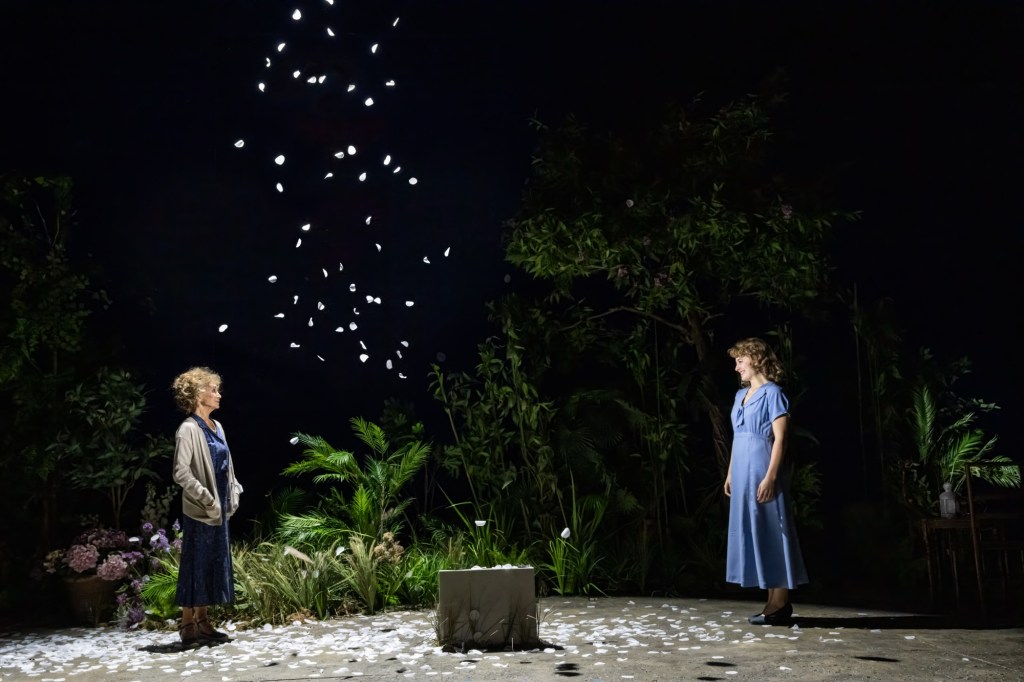
Arriving less than a month after his death, this rare revival of Tom Stoppard’s 1995 drama Indian Ink could hardly have been timed more appropriately or poignantly. Stoppard is generally regarded as one of the most intellectual and literate of modern playwrights, but pieces like this, along with The Real Thing, Arcadia (often perceived as his masterpiece and receiving a new production at the Old Vic in early 2026) and his final, emotionally charged Leopoldstadt, make a great case for the beating heart beneath the crackerjack brilliance and verbosity.
Indian Ink was originally a radio play entitled In The Native State, and the multiple changes of location and time period continue to strongly suggest that. Jonathan Kent’s visually arresting production is great at pointing Stoppard’s pithy dialogue, which is sharp and witty then suddenly surprisingly heartfelt, and just occasionally winningly crude. The bluey-black hues of the visual aesthetic are attractive and appropriate: Leslie Travers’ rising and falling flower-bedecked sets and Peter Mumford’s lighting evoke both ink and the skin colour depicted by traditional Indian painters when portraying the supreme Hindu deity Krishna, whose loric presence runs throughout the text.
This version also excels at exploring the complexities of the central characters: plucky, forward-thinking 1930s poet Flora Crewe (Ruby Ashbourne Serkis) travelling through late Colonial India for her failing health and, in the 1980s, her younger sister Eleanor (Felicity Kendal, who originated Flora in 1995), now in her dotage and reflecting back on her sister’s adventurous life. Then there’s Nirad Das (Gavi Singh Chera), the sensitive Indian artist painting Flora and whose attitude to her is complicated and ambiguous, and, fifty years later, his son Anish (Aaron Gill), also an artist, helping Eleanor to piece together their joint family histories.
The production is less successful when dealing with the duality of time frames, too often submerging half of the stage in twilight while the action of the moment unfolds on the other side of the playing area, which gets a little samey. Peter Wood’s original West End staging had a gorgeous, impressionistic sweep but Kent’s production is more prosaic, and inadvertently points up how Stoppard’s text, while mostly engrossing, tends to meander. A strong case is made for cutting some of the extraneous characters who extend the show’s playing time while adding little to the overall story.
There’s so much here to savour though. Ashbourne Serkis, reminiscent of a young Helen McCrory, is unshowy yet entirely riveting as Flora, capturing unerringly her kindness, intelligence and unconventional spirit. She’s sensual, vulnerable yet powerful, the kind of young woman you’d immediately want as a friend but with whom you wouldn’t want to mess.
Kendal is a wonder as Eleanor, spiky, charming, vain but with a rare emotional availability that genuinely touches. She’s a fascinating mix of eccentricity and laser sharp focus, dropping names like Modigliani from her sibling’s storied past to the avid excitement of Donald Sage Mackay’s loquacious American biographer. She is also entirely plausible as the surviving younger sister of the marvellous, long deceased Flora. Margaret Tyzack was also terrific in this role back in the first production but didn’t have the same sense of connection to Kendal’s original Flora as we get here. Kendal and Stoppard have long been a winning theatrical combination, and it is tremendously moving to be reminded of that with this Indian Ink.
Singh Chera beautifully delineates Das senior’s quicksilver mood changes, and Gill delivers convincing, intelligent work as his more grounded son. Tom Durant Pritchard steers a winning path between ex-pat David’s stiff-upper-lip solicitude and romantic fixation with Flora. Irvine Iqbal has a delicious cameo as a wealthy, cosmopolitan Rajah, smitten with our heroine but with a troubling hint of coercive control.
Stoppard in the last decade of the twentieth century had a penchant for juxtaposing different timelines as he considered romantic loss and the nature of nostalgia, as evidenced in Arcadia and The Invention Of Love. Indian Ink is part of the same thematic pattern, but is also about the legacy of art and the contrast in approach between Western and Indian artists. It’s also an exploration of colonialism, both sociopolitical and artistic: “you’re trying to paint me from my point of view instead of yours” observes Flora to Nirad, frustrated at his subsuming of his own culture to an all-pervasive European one.
The uneasy post-British Raj relationship between the United Kingdom and the Indian subcontinent makes for interesting subject matter: “we made you a proper country, and when we left you fell straight to pieces like Humpty Dumpty!” cries Eleanor, from a decidedly partisan viewpoint. If it isn’t presented here in a particularly dramatic way (Stoppard himself observed that Indian Ink is a play devoid of villains), it’s still absorbing enough to be worth our time, especially with such fine writing and the performances at the heart of Kent’s handsome staging.
This isn’t perhaps top-tier Stoppard, but even at less than his best, the late, great playwright is still more stimulating and impressive than many other dramatists. Although a tad overlong, and at times unfocused, Indian Ink remains a fragrant, thought-provoking pleasure, skilfully balancing poignancy and intellectual buoyancy. With its scenic challenges and large cast, it doesn’t get done often, so even if this Hampstead production wasn’t as good as it unquestionably is, it would still be worth seeing. Ruby Ashbourne Serkis is a star, and another opportunity to see Felicity Kendal drive Stoppard’s dialogue with such wit and elegant potency, makes it pretty much unmissable.

 ajhlovestheatre