VINCENT IN BRIXTON
by Nicholas Wright
directed by Georgia Green
Orange Tree Theatre, RIchmond – until 18 April 2026
running time: 2 hours 20 minutes including interval
https://orangetreetheatre.co.uk/whats-on/vincent-in-brixton/
There’s a seam of magic running through the melancholy and the humdrum in Nicholas Wright’s remarkable drama, first seen at the National in 2002 before hitting the West End and Broadway. This intimate piece is now revived in-the-round by Georgia Green at Richmond’s Orange Tree Theatre, and the balance between the earthy and the ethereal is exquisitely managed. If D H Lawrence had written a play about a youthful van Gogh’s brief residence in London before becoming a fully fledged artist, and had had access to a really good editor, one imagines it would have been something like Vincent In Brixton.
Stage or screen depictions of artists frequently come unstuck as they tend to be either overly precious or downright exploitative, their central figures appearing banal and/or two dimensional. Wright neatly sidesteps all this however by focusing on Vincent van Gogh as a young man, newly arrived in 1870s London to work for an art dealer, not yet a creative but with plenty of opinions on art and artists, and the writer does so with a wondrous lightness of touch. That life-enhancing delicacy is all the more surprising and impressive since the play is as much about depression and the intertwining of inspiration and despair as it is about art. This suggests that Vincent In Brixton could be a chore to sit through, but that’s unequivocally not the case.
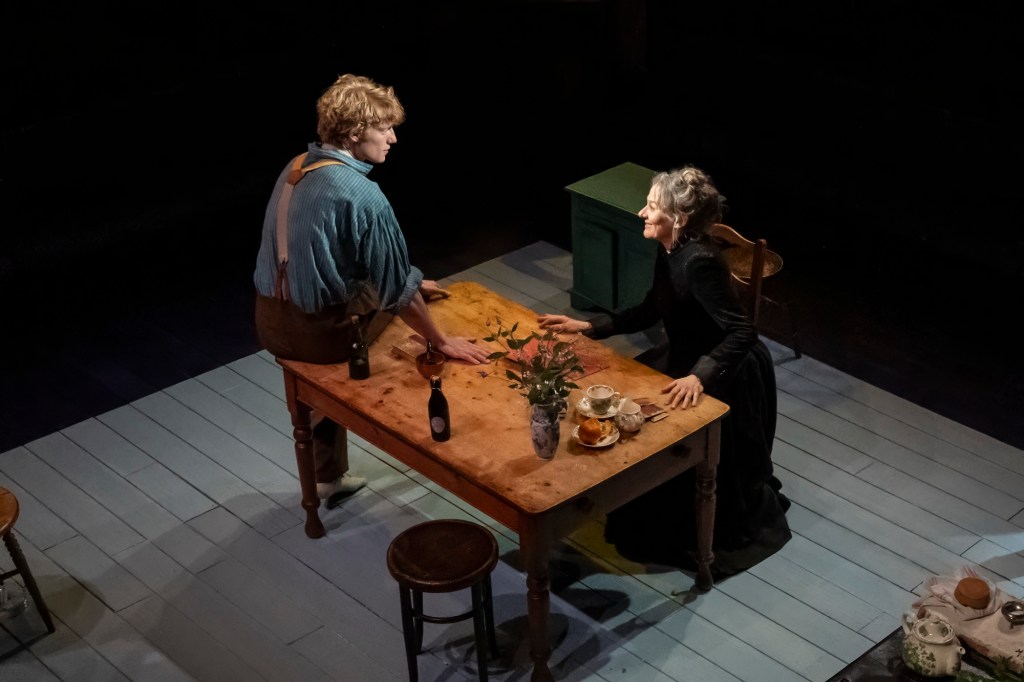
As played here by Jeroen Frank Kales, van Gogh is wonderfully gauche: tactless, watchful, almost painfully direct but also puppyishly enthusiastic. If this delightful but frustrating young man were alive now, his neurodivergence might be obvious, but in less enlightened times he’s regarded with a degree of suspicion and annoyance. Kales brilliantly conveys his mixture of guilelessness with the ruthlessness of a loner.
The play’s leading role isn’t really van Gogh, but rather Ursula Loyer, the progressive-thinking, middle aged widow with whom Vincent lodges, shaken out of fifteen years of mourning by the presence of this unconventional young Dutchman. Ursula clearly suffers from bouts of severe depression -something simultaneously managed and glossed over by her daughter Eugenie (Ayesha Ostler, winningly no-nonsense in the role created by Emily Blunt at the NT) and her other lodger, aspiring painter Sam (a hugely likeable Rawaed Asde)- but blossoms under the light of Vincent’s unexpected romantic attention. In a beautiful performance, so natural it barely feels like acting but so emotionally true that it’s hard to watch at times, Niamh Cusack charts Ursula’s progression from brisk pragmatism to furtive but unbridled joy, before reaching a state of almost vegetative sadness tinged with real, raw anger.
Cusack is unforgettable but so was Clare Higgins in Richard Eyre’s original London and New York stagings; Wright has created one of the most complex, richly textured leading female roles in modern drama, one pleasingly open to considerable interpretation. Higgins was saturnine yet warm, while Cusack feels more fragile, yet kinder and more open, and she becomes positively girlish post-seduction, vitally embodying Vincent’s assertion that “no woman is old so long as she loves and is loved”, where Higgins luxuriated in a womanly sensuality. It’s fascinating to note that both contrastingly different approaches work equally as well as each other.
One aspect of Green’s production that is an active improvement on Eyre’s is in the presentation of Anna, Vincent’s determined younger sister, arriving in the second act as a forthright whirlwind of puritanical judgement and organisation to sort out her troubled sibling. Originally she felt like a fugitive from entirely another play, providing jarring comic relief. Not here though, in a bracingly funny but bruisingly truthful, and altogether more authentic-feeling, performance by Amber van der Brugge, looking like a Vermeer painting made flesh, she’s simultaneously appalling and sympathetic, and a very compelling figure.
Wright’s script and Green’s tender, powerful staging, designed with economical flair by Charlotte Henery and lit with the perfect combination of gloom and enchantment by Lucía Sánchez Roldán, satisfyingly include visual motifs from van Gogh’s later art works. There’s also verbal foreshadowing both of the art and of Vincent’s subsequent psychological issues.
Vincent In Brixton is perhaps guilty of the same accusation that gets levelled at Stoppard, namely that it’s theatre that makes its audience feel clever, in this case particularly anybody with a smattering of art history knowledge. Does that really matter though? This is a thoroughly engrossing evening, a romantic fantasia rooted in harsh realities, and a nuanced riff on the life story of a tragic, multi-layered artistic figure. The entire run is currently sold out but keep trying for returns, this really is glorious.
 ajhlovestheatre
Leave a comment