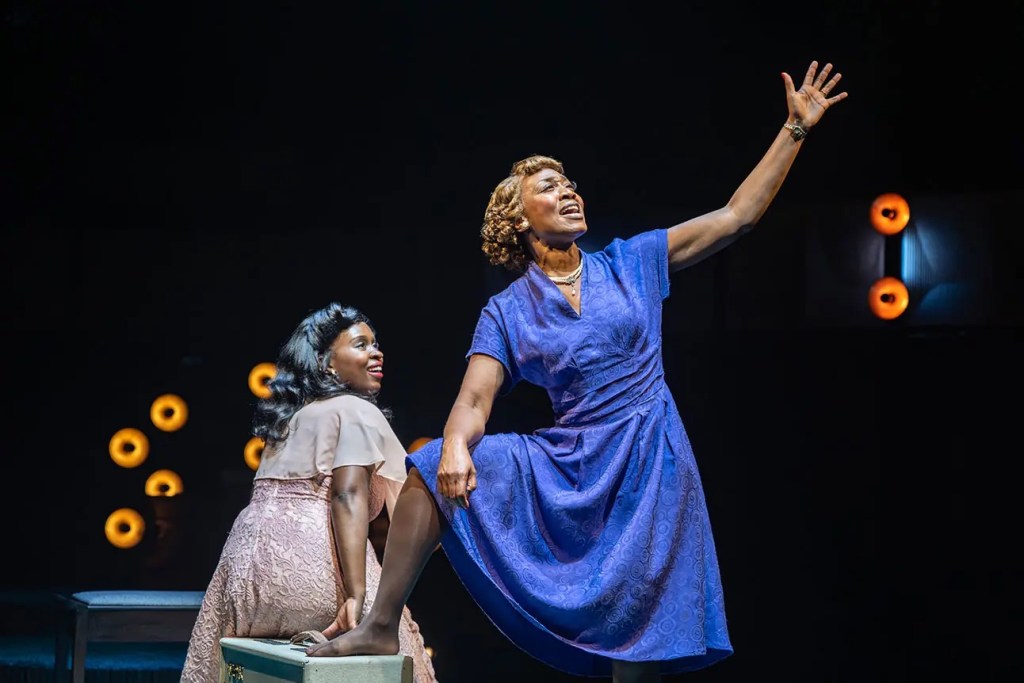
MARIE AND ROSETTA
by George Brant
directed by Monique Touko
@sohoplace, London – until 11 April 2026
running time: 2 hours including interval
https://nimaxtheatres.com/shows/marie-rosetta/
If it takes a star to play a star, then that aspect of Marie and Rosetta is in very safe hands. A vibrant Beverley Knight plays “the Godmother of rock’n’roll” Sister Rosetta Tharpe in George Brant’s enjoyable two hander examining the legacy of the musical pioneer who inspired greats such as Elvis, Johnny Cash and Ray Charles, but whose name isn’t as universally well known as it deserves to be. Knight brings dynamic stage presence, exquisite comic timing tempered with a rare emotional availability, and, as expected, roof-raising, majestic vocals.
She’s partnered by rising star Ntombizodwa Ndlovu as Marie Knight, Rosetta’s protégée, musical collaborator and (alleged) lover, although Brant’s play (first seen off-Broadway a decade ago in a different production) is curiously noncommittal about exploring that part of their relationship. Ndlovu is excellent, but the role feels underwritten in comparison to the barnstorming opportunities Knight is afforded as Tharpe.
The play opens in a funeral parlour in Mississippi in 1946, as Rosetta persuades Marie to tour with her. Brant emphasises the grimness and racism of the mid twentieth century touring circuit in much of America as it pertains to these two Black women, who, almost unbelievably, will be expected to sleep amongst the coffins, no other accommodation being permitted to them. “We not in New York anymore, honey” states Rosetta, “we not in Chicago. Can’t stay in no hotel down here.” The script bounces fleetly and, honestly, a little confusingly through various life events, some traumatic, for both women, before returning to the funeral parlour and a would-be tear-soaked conclusion that feels earned by the acting if not the writing.
Brant’s work is at its best when depicting Rosetta’s passion and fervour around her music, as she moves between gospel and the roots of rock’n’roll, and Knight, with her rolling gait and bruised survivor’s vitality, handles it so persuasively. This in turn leads to the sections when Monique Touko’s in-the-round production really excels, and the music takes over. An all-female quartet of musicians, led by Shirley Tetteh, tear through gospel, r’n’b, rock numbers, while the voices holler and soar thrillingly overhead. If the dialogue is sometimes tepid, when the singing starts, Marie and Rosetta becomes red hot.
The real Rosetta and Marie played instruments and having Knight and Ndlovu mime invisible guitar and piano at various points becomes distracting and enervating, given the amount of music in the production. Despite the sketchiness of the characterisations as written, the contrast in the two women’s energies and outlooks is nicely conveyed. Liam Godwin’s orchestrations are suitably rousing and Tony Gayle delivers a sound design that captures the rawness of rock’n’roll in its infancy and ensures that we all feel the music in our bones. Visually, the show is attractive, driving a decent middle path between glamour and grit (set design by Lily Arnold, costumes by Jodie-Simone Howe, wigs, hair and make-up by Keisha Banya) and it’s beautifully lit by Matt Haskins.
Marie and Rosetta isn’t a great play: its structure is unwieldy and the storytelling is unclear, and having the audience on all sides is great for the intimacy but problematic for sightlines, at least as staged here. Still, it has genuine heart and humour. It also sheds a welcome light on a pair of neglected musical talents, one of whom really should be spoken of in the same breath as the other ‘greats’. See it for that, for the unforgettable music, and for the performances.
 ajhlovestheatre
Leave a comment