OUR TOWN
by Thornton Wilder
directed by Francesca Goodridge
creative associate: Russell T Davies
a Rose Theatre and Welsh National Theatre co-production
Rose Theatre, Kingston – until 28 March 2026
running time: 2 hours 25 minutes including interval
https://www.rosetheatre.org/whats-on/our-town-m74x
For all its warmth and lyricism, the 1938 American drama Our Town is a curious choice as inaugural production for the Welsh National Theatre, despite being a natural precursor to that quintessential Welsh text, Dylan Thomas’ Under Milk Wood. Both use a narrator and panoply of characters to bring to life a fictional community, rich in intrigues and eccentricities but revelling in their crucial ordinariness, and with just a touch of the fantastical. One wonders if that’s what inspired WNT artistic director and onstage star Michael Sheen, in tandem with director Francesca Goodridge, to select Thornton Wilder’s metatheatrical masterpiece, in a co-presentation with Rose Theatre Kingston.
Sheen already played First Voice, the role immortalised by Richard Burton, in a post-pandemic staging of Under Milk Wood at the National, so maybe didn’t want to revisit it so soon, but there are undoubtedly echoes of that performance in his charismatic turn here as Our Town’s Stage Manager. Where Thomas’ play is marinated in poetic melancholy and humour, the figures deftly, vividly conjured up in a few brilliant lines, Wilder’s writing is blander, more pedestrian, his people thinly characterised. The form of Our Town (revolutionary in the 1930s) strikes me as more remarkable than its execution, which manages to be simultaneously treacly and profound, theatrically heightened yet, until the last of the three acts, dramatically inert.
Our Town is certainly an important play in the American theatrical canon, with opportunities for a large ensemble cast, but one can’t help wishing that, for this debut Welsh National Theatre show, Sheen and gang had gone for something by an actual Welsh playwright. The production is performed with Welsh accents, and traditional hymns are sung at certain points, but the nods to the Principality feel grafted on. Enthusiastic programme notes by Sheen and Goodridge seek to sell us on the universality of Wilder’s creation, but in practice this iteration doesn’t fully convince. Welsh place names are used inconsistently, which is a bit confusing, and references to dollars, the Appalachians, New Hampshire, Boston etc. sound weird coming out of the mouths of these Welsh people. The accents are generally from South Wales yet some (not all) of the cast pronounce the town’s name (Grover’s Corners) with the pinched gutturality of North Wales.
Sheen invests the Stage Manager, conjuring the inhabitants of Grover’s Corners, living and dead, out of thin air, with authoritative charm and wry humour, plus, it must be said, a large helping of grandstanding ham. He certainly owns the stage, and his legion of fans won’t be disappointed. The acting (particularly in the overlong first half; it all gets a bit more subdued in the death-centred final act) tends towards the broad: the energy is admirable, but it does appear that most of these overwrought Welsh-Americans never met a gurn, grimace or double-take they didn’t like. That said, there’s some lovely nuance in the performances of Gareth Snook as a sensitive town undertaker, and of Peter Devlin as a youngster who goes from idealism and romance to disillusioned grief in the course of the play, and Sian Reese-Williams as his tough but tender mother.
Our Town is divided into three acts and the decision to perform the first two prior to the interval results in a ninety minute first half that might prove interminable to anybody with a low threshold for down-home charm and whimsy. The last section is genuinely affecting though, as it looks at Grover’s Corners – and by extension all human existence – from both sides of the grave (“the dead don’t stay interested in us living people for long…gradually they lose hold of the earth”.) Wilder’s writing and Goodridge’s staging acquire a welcome gravitas and emotional pull that unsettles but satisfies. I defy anybody not to be moved by the Stage Manager’s ultimate assertion that the only people to truly appreciate life in all its joys and complexities are “saints and poets maybe…they do some.” The whole show ends on a note of rapturous, contemplative stillness.
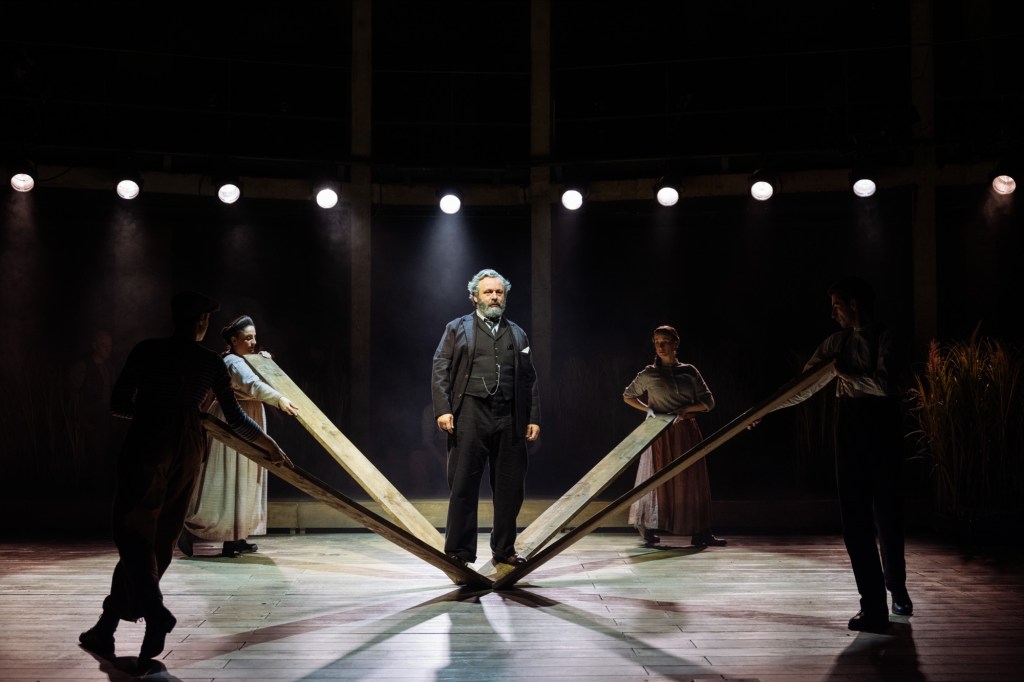
Goodridge’s busy, good-looking production is dominated by the fluid, dynamic choreography and movement direction by Jess Williams and Ryan Joseph Stafford’s gorgeous, evocative lighting, all golden glow in the first half and sepulchral pallor in the second. If this show had scenery, most of the cast would be chewing it but Hayley Grindle’s design makes inventive use of ladders and planks to delineate locations. Dylan Jones provides a magical, ubiquitous musical score that occasionally overwhelms the spoken words.
TV’s Russell T Davies is credited as creative consultant but it isn’t immediately clear what his contribution is. Welsh accents aside, this is a fairly straight rendition of a play that’s wholesome and full of heart, but probably more interesting for its place in American theatre history rather than its content and characters. It’s a respectable start to the much-needed Welsh National Theatre but one hopes that future projects will be packing a bit more hwyl.
 ajhlovestheatre
Leave a comment