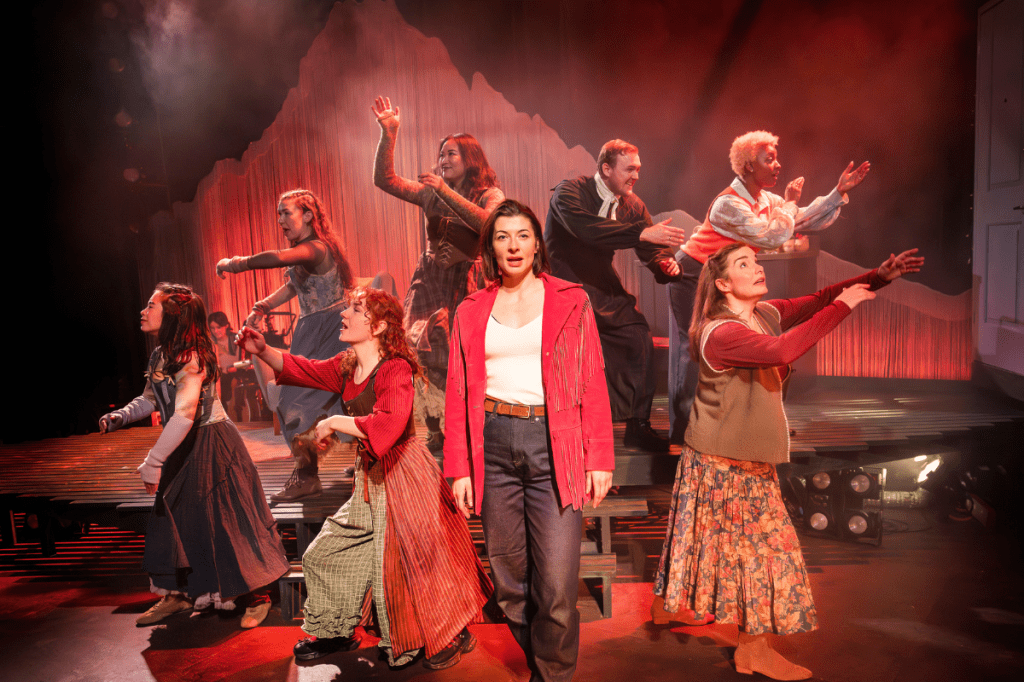
BALLAD LINES
Music and lyrics by Finn Anderson
Book by Finn Anderson and Tania Azevedo
directed by Tania Azevedo
Southwark Playhouse Elephant, London – until 21 March 2026
running time: 2 hours 25 minutes including interval
https://southwarkplayhouse.co.uk/productions/ballad-lines/
The dual legacy of music and stories handed down through centuries, traversing centuries, lifestyles, oceans and continents, is at the heart of Finn Anderson and Tania Azevedo’s engrossing, female-centric musical. Ballad Lines feels at once intimate and epic, and equal parts Celtic and American. It’s also possibly the best sung show in town right now.
One certainly can’t accuse songwriter and co-author Anderson and director/co-author Azevedo of lack of ambition. In less than two and a half hours, they examine how traditional songs get passed from person to person, all around the world, and the resulting cross fertilisation of cultures. Equally, the show, previously known as A Mother’s Song in an earlier iteration, considers how women’s bodies are commodified and controlled, across three different time frames but centring on one extended family.
There’s 17th century Scottish ministers wife Cait (a luminous Kirsty Findlay), unwillingly pregnant and defying social norms, then, a hundred years later, her free-spirited descendent Jean (Yna Tresvalles) unexpectedly pregnant at fifteen and compelled to make the long journey to start a new life in America. In the present day, Sarah (Frances McNamee), the distant offspring of these woman, moving into a new apartment in New York with her girlfriend Alix, is floored when she listens to a series of tapes from her deceased aunt (golden voiced Rebecca Trehearn) recounting family stories and reciting folk songs carried half way across the world by her female forebearers.
There is a degree of contrivance in the way the three timelines interweave but the sheer potency of the music and the truth of most of the performances ensure that it never devolves into schlocky sentimentality. The score (played gloriously by a four-strong all-female band, and sung by the cast like their lives are depending upon it, which, in the context of the story, is frequently true) is folk made vibrantly theatrical. It’s easy to make comparisons with Once, Come From Away and Benjamin Button, and indeed the music, lyrical yet thrillingly rhythmic, does punch you straight in the heart in a similar way, but Ballad Lines seldom feels derivative.
The show isn’t perfect: the second half unsatisfactorily resolves a conflict between Sarah and Alix (Sydney Sainté, utterly wonderful) over them having their own child, that blows up too quickly and results in a schism in their relationship that is dealt with too perfunctorily to be fully credible. The sole male in the cast, Ally Kennard, is a capable and likeable triple threat but feels fundamentally miscast. He is a warm, almost cuddly presence but doesn’t feel rough or alpha male enough as to be a physical threat to Findlay’s desperate Cait.
Still, the sense of generations of women’s joys, struggles, traumas and triumphs being channelled through drums, fiddles, guitars and roof-raising vocal harmonies is palpable and powerful. At the centre of it all as the conduit for all the memories, traditions and issues is Sarah, and McNamee is remarkable. She invests this conflicted young woman with a credible, all too human combination of fragility and edge. In all honesty, she’s sometimes better than the script which just occasionally veers into daytime soap territory. As her ancestor, Findlay – heartbreaking – finds a similar balance of softness and steel, while Tresvalles is all passionate determination as fiery but lovable Jean. All of the vocal performances will make the hairs on the back of your neck stand up.
T K Hay’s simple but ingenious set manages to simultaneously suggest Sarah and Alix’s New York apartment, the Appalachian mountains and the ship that carried Sarah’s ancestors across the Atlantic. Tinovimanashe Sibanda’s stomping and keening choreography, although sometimes hemmed in by the limited space, is rousing and hypnotic. The lighting by Simon Wilkinson is suitably atmospheric and helpful in delineating locales and while the sheer wall of sound (design by Andrew Johnson) frequently thrills the blood, there are lengthy sections where the lyrics are indecipherable.
The flaws in Ballad Lines are fairly minor, and as that music and those voices surge through the house, it’s impossible not to get swept up in the raw emotion and melodic brilliance. If the spoken material isn’t quite realising its full potential as yet, this is undeniably a cracking night in the theatre already, and could end up being a real world beater. I’ve already got the studio cast album playing on repeat.
 ajhlovestheatre
Leave a comment