INTO THE WOODS
Music and lyrics by Stephen Sondheim
Book by James Lapine
directed by Jordan Fein
Bridge Theatre, London – until 30 May 2026
running time: 2 hours 40 minutes including interval
https://www.bridgetheatre.co.uk/whats-on/into-the-woods/
The impact of great art can vary considerably at different moments in history. Despite the medieval picture book aesthetic of the Bridge Theatre’s splendid new Into The Woods, the 1987 Stephen Sondheim-James Lapine Broadway tuner has seldom felt more timely. That’s especially true of the post-Happily Ever After second act where the safety and wellbeing of the many are threatened by the ego and lust for vengeance of the few. Feel familiar? Jordan Fein’s dark, handsome production is no didactic slog though; on the contrary, it’s an almost constant pleasure, but it’s too raw and truthful to function as mere escapism, and the piece itself is a meditation on culpability, compromise and yearning for a happier past, that remains startlingly relevant.
As with his devastatingly good Regents Park Fiddler on the Roof, which just completed a successful national tour, Fein looks at a canonic musical with fresh eyes and produces a version that satisfies traditionalists but has a vitality and imagination that feel original. Sondheim and Lapine’s creation sends beloved fairytale characters (Cinderella, Little Red Ridinghood, Jack…) into Jungian woods to sort out their familiar stories and find their expected ‘happy endings’. That’s act one, then act two is what happens next, and the musical enters territory not just uncomfortable but downright apocalyptic. Into The Woods disturbs as much as it delights and this version embraces its duality with real aplomb and flair.
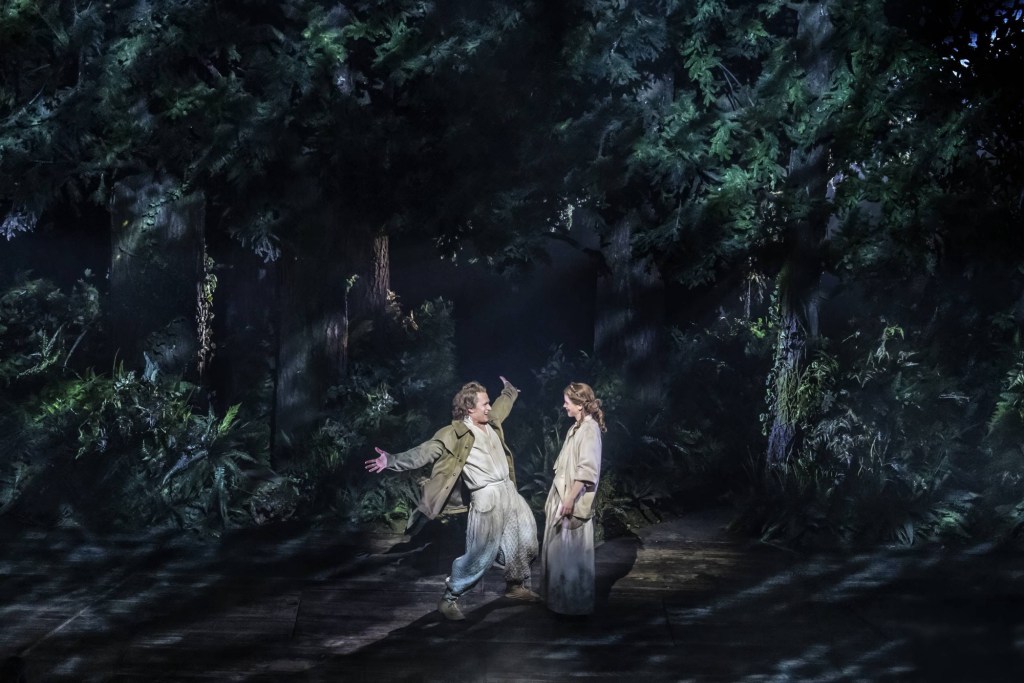
Fein and designer Tom Scutt start out by setting the storied dramatis personae, costumed like peasants in a Bruegel painting rather than the Disney-esque fairytale figures of Lapine’s own original production, in a jet black, liminal space. Dominated by a rising platform that also serves as a kitchen table and a hideyhole for Jack and his adored cow Milky White, it’s a place where witches and beanstalks can appear unexpectedly out of the gloom, and which can magically dissolve into lush foliage. Scutt’s woods, lit with breathtaking beauty by Aideen Malone, are a thing of wonder in the first half but come to resemble a devastated graveyard in the second, as the body count builds up, trees are decapitated, and a vengeful giant runs amok. The colour and warmth drains from the lighting and it feels as though we are looking at a war zone.
Also outstanding is Adam Fisher’s sound design which is loud enough to rouse and excite but nuanced to ensure that every beat and syllable of Sondheim’s deft, complex lyrics register, and that Jonathan Tunick’s peerless original orchestrations comes across with irresistible sparkle. When the jump-scares happen (no spoilers but anybody familiar with the show will know what I’m talking about), the volume level increases so dramatically and unexpectedly that a sense of genuine fear and panic ensues. Musical director Mark Aspinall’s band of a dozen, placed on either side of the stage, is wonderful, precise and crisp.
There’s a certain received wisdom with Sondheim that it’s hard to cast performers who can act the roles with the requisite depth as well as sing the (frequently technically complex and rangy) scores to an ideal level, and either dramatic finesse or musicality gets compromised. The late, great Sheridan Morley, reviewing the original London Company, noted that the cast “owe their allegiance to the stage itself rather than the orchestra pit underneath it”. Casting director Stuart Burt has done a fine job with this Into The Woods though and we get performances that are, mostly, as delightful to the ear as they are searing to the heart and pressing to the funny bone. They also throw up some interesting new insights on characters regular Sondheim viewers will have seen multiple times.
Jamie Parker and Katie Brayben’s Estuary-accented Baker and wife are gloriously relatable: practical people doing their best under less-than-ideal circumstances. Parker gives his Baker more pent-up anger than in other iterations I’ve seen but it makes absolute sense; Brayben’s pragmatic, hearty, jolly-but-tough Baker’s Wife is the perfect yang to his ying. I could have done without Brayben’s poppy vocal stylings at certain points, embellishments that this quicksilver-and-steel score really doesn’t need. She has a terrific voice, but, at least here, a tendency to push that doesn’t add anything. That’s also true, but to a slightly lesser extent, of Chumisa Dornford-May’s tomboyish, altogether entrancing Cinderella.
Kate Fleetwood’s Witch, more humanly eccentric and sad than grotesque prior to her transformation, is a superb creation, finding the truth as well as the camp. It’s a shame that her reversal to the beauty she had prior to being cursed, isn’t a little more flamboyant. With her long black hair and flowing white robe, she looks more like the young woman who used to crawl out of TVs in the Ring horror film franchise than the fantastical glamourpusses Bernadette Peters and Julia McKenzie became in the original New York and London versions respectively. It’s still a fabulous performance though.
Gracie McGonigal’s brutal, gore-spattered Little Red is something of a revelation. Lapine has written her as a diminutive survivor but here she’s a real bruiser in a riding hood, so ballsy and forthright that when she cracks open to reveal the frightened child within during the ‘No One Is Alone’ section, it’s shockingly moving. Jo Foster’s Jack, toting Milky White around like a moth eaten ventriloquist puppet, is very effective, and Julie Jupp is a beguiling mix of sympathetic and unhinged as Jack’s exasperated mother. Oliver Savile and Rhys Whitfield as the preening, priapic but endlessly precious Princes are spot on, their competitiveness borne of ennui rather than machismo, and Michael Gould’s lugubrious narrator also makes a potent impression. I also loved Jennifer Hepburn’s gorgeous, self-obsessed Stepmother (to Cinderella): all done up like everyone’s idea of a medieval noblewoman but with the sensibility of one of TV’s Real Housewives.
There’s a seething energy and saturnine magic to this staging that excites and disquiets. It may be because of the world we’re living in right now, but the sense of order being undone and division equalling disaster is more keenly felt than in any Into The Woods I’ve seen since Richard Jones’ original West End production, set in a gradually disintegrating Freudian nursery, and staged at a time (1990) when world politics seemed similarly to be careening towards doomsday. This is bold, thought-provoking entertainment, richly enjoyable even as the smile freezes on your face. Irresistible and essential.
 ajhlovestheatre
Leave a comment