END
by David Eldridge
directed by Rachel O’Riordan
National Theatre/Dorfman, London – until 17 January 2026
running time: 90 minutes no interval
https://www.nationaltheatre.org.uk/productions/end/
This isn’t the ending I was expecting, but then I guess that’s life, or indeed death. I’d naively supposed that End, the concluding part of David Eldridge’s masterful trilogy of standalone but connected plays about stages of relationships, comprising Beginning (2017) and Middle (2022), would just be about a marriage or long-standing partnership breaking down. But Essex’s answer to Ibsen is actually on about something even deeper and darker here – the end of actual life – and the result is pretty harrowing, albeit leavened with moments of genuine joy.
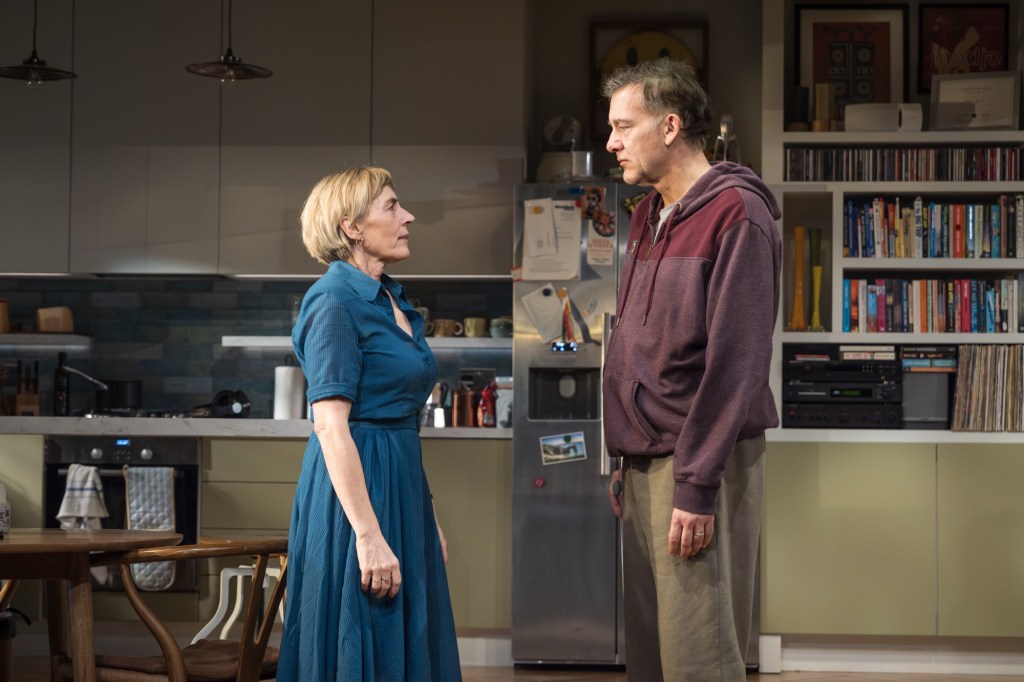
Like its predecessors, End is a two hander centred on a straight couple (but neither of the pairings featured in the first two plays), as each faces moving forward without the other. Alfie (Clive Owen) has a terminal cancer that means he won’t see his sixtieth birthday and floors Julie (Saskia Reeves) his partner of twenty plus years – they’ve never married – by announcing that once he is moved into a hospice for his very final stages he wants to be completely alone. This quietly shocking premise plays out in their pleasantly cluttered North London kitchen (beautifully detailed set design by Gary McCann) filled with the detritus of full, settled lives, a variety of objects giving essential clues to who these people are: there’s a framed football shirt, a giant clock the face of which is the round yellow smile emblematic of the Acid House movement, rows upon row of vinyl records and CDs, shelves of books (Alfie is a club DJ, Julie is a writer).
Also, it’s the eve of the Brexit vote in 2016, which for many of us was another catastrophic ‘end’ of sorts. Eldridge’s deftness at weaving together multiple thematic threads in a domestic setting and in real time is a marvel, as is his unerring instinct for capturing how real people speak to each other. As in the earlier plays, the minutiae of ordinary lives are elevated to something charged and riveting, and there is magic in the silences as much as in the salty, sometimes very funny dialogue.
Rachel O’Riordan’s understated but perfectly modulated staging is saturated with dance music, and one is reminded of the Noël Coward Private Lives line “extraordinary how potent cheap music is”. The euphoria of the beats and synths are a conduit and focus for the emotions and memories of this couple who met in the clubbing heyday of the late 80s and early 90s and clearly enjoyed the hedonistic aspects of it, Alfie even making an apparently notorious career on the rave scene. Watching these late middle age figures swaying to the music, remembering a shared past and trying to beat back the oncoming darkness, is profoundly affecting, nowhere more so than when Owen’s Alfie’s smile gets overtaken and he helplessly yelps “I just feel so young”.
So, End is also a lament for a time now lost, an examination of what happened to the rave generation, and Eldridge distils, generously but not too neatly, a collective experience down into these two figures. There’s a slight clumsiness to the way a former affair is introduced to up the dramatic ante, and a couple of lines are clearly present only to clue the audience in on backstory, but elsewhere the writing is coruscating and true. Eldridge understands crucially that many humans are at their funniest when staring into the abyss.
That’s certainly true of Alfie, who Clive Owen inhabits so fully that it almost doesn’t feel like acting. An all too human combination of brutality, tenderness and massive, kind spirit, he’s entirely convincing as somebody who, for a time, adopted debauchery as a way of life, and who, one suspects, is never as hard on other people as he is on himself. Saskia Reeves matches him with a luminous, clear-eyed portrayal of the rock that is tethering Alfie to this earth; an intelligent woman, pragmatic and massive of heart, trying desperately to accommodate her partners needs and keep him from the brink while tending to herself and their grown-up daughter. Reeves’ Julie screaming silently into a cushion in a brief moment of respite says more about the pressure on carers and loved ones than a page of dialogue and is one of the most moving things on any current London stage.
Not always an easy watch, End is nonetheless an emotionally resonant one, humane, witty and strangely haunting. Yet again Eldridge emerges as the chronicler supreme of ‘ordinary’ people’s lives, while understanding of course that, really, we are all extraordinary. Let the music play.
 ajhlovestheatre
Leave a comment