LIBERATION
by Bess Wohl
directed by Whitney White
James Earl Jones Theatre, New York City – until 11 January 2026
running time: 2 hours 30 minutes including interval
Understandably acclaimed by critics and audiences alike on its off-Broadway premiere earlier this year for Roundabout Theatre, Bess Wohl’s Liberation has now arrived on the Main Stem and is a significant enrichment to this Broadway season. It’s that rare and wonderful thing, an intelligent, politically and emotionally charged play about an important and essential subject, that is also terrific entertainment.
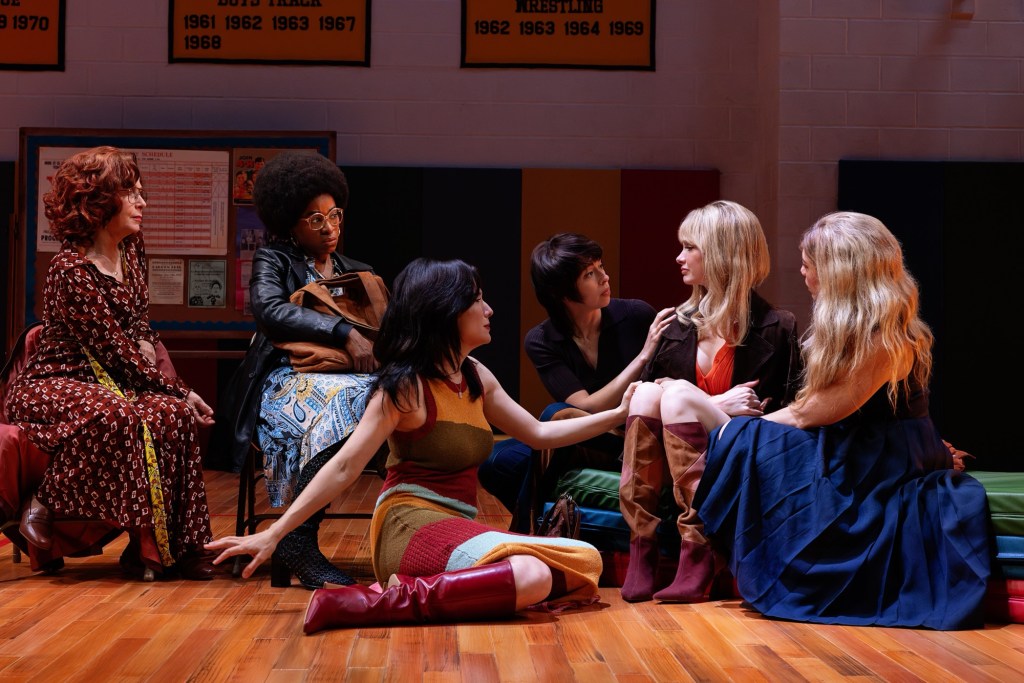
Inspired by her own mother’s involvement in the Women’s Liberation movement in the 1970s, Wohl filters her feminist agenda through a set of relatable but never stereotypical characters, spiky and gloriously quirky, placing them in a situation (regular Consciousness Raising meetings in an Ohio school gym) where the verbal and emotional fireworks are primed to explode. It’s infused with love, some anger and a degree of theatrical invention and fourth wall breaking that sets it apart from some other plays where people come together for discussion and reflection.
Whitney White’s almost note-perfect staging has transferred with its entire original cast intact and it’s impossible to imagine another team of women inhabiting these roles so fully and vividly. That said, the writing is so nuanced and rich in humour and the eccentricities and attitudes that make humans human, that there are probably several ways to portray these characters. No doubt other actors will get pleasure and praise from mining them in due course, as this feels like a play that will receive a multitude of productions in years to come. A modern American classic? It just might be.
A warm, luminous Susannah Flood plays journalist Lizzie deep-diving into her mothers past (“My devoted, dutiful mom who sewed the costumes for every school play and cooked every family dinner and did all the dishes and took me to every piano lesson… she was actually… a radical?”) and specifically the Women’s Group she founded in 1970. She also doubles as her Mum and out of her memory come the women who became such friends, allies and, occasionally, antagonists.
And what a bunch they are: there’s garrulous, boisterously self-aware aspiring film-maker Isidora (Irene Sofia Lucio, outrageous and irresistible) from Italy (“I have the husband but really only for the Green card”), and vinegary, older housewife Margie (Betsy Aidem) who claims to be in attendance so as to avoid stabbing her husband (“I realize that sounds like a joke. It’s not a joke”). Then there’s nomadic, rebellious lesbian Susan (Adina Verson, ultimately as touching as she’s hilarious) who’s currently living in her car, Kristolyn Lloyd’s elegantly fierce Celeste, a Black book editor temporarily back from New York to look after her ailing mother, and Dora, a people-pleasing fugitive from the epically sexist corporate world who has wandered in thinking it’s the knitting circle (lovely Broadway debut by Audrey Corsa). Costume designer Qween Jean dresses them in attire that looks authentically 1970s but also gives valuable clues as to who these women are, aided by Nikita Mathis’ eye-catching, slightly heightened wigs and hair designs.
Lizzie’s opening speech directly addresses that we’re watching a play as she welcomes and reassures the audience (“surely you’ve noticed all of those six hour, eight hour, ten hour plays are by men with no children? A woman with children would never. Could never”) and Flood’s delivery of it is so chummy and lowkey that some of the other performances feel comparatively over-emphatic, but only at first. What’s refreshing though is that Wohl, White and team give these women so much detail and definition that, as in real life, they constantly surprise but never at the expense of credibility.
They evolve too. Three years elapsed between acts one and two, and the way their relationships with each other and with themselves change is beautifully done, quietly fascinating in a show that is frequently anything but quiet. Corsa’s initially delicate Audrey transforms the most perhaps but it’s done with subtlety and precision. There’s a lot to love in all the performances but what Aidem is doing as wise-cracking but decent Margie is remarkable and has the audience eating out of the palm of her hand: her comic timing is stellar but the moments where she digs deep, bemoaning the speed of times passage and suggesting resigned amazement that all her significant life moments featured her husband or her kids and grandkids, pierces the heart. Even more astonishingly, there is a brief, deeply moving, scene where she has to portray Lizzie’s mother so that Flood’s character can have a conversation with her, and it’s done with little more than a change in posture and vocal timbre plus the removal of a pair of spectacles, but it’s a transformation. This is acting of the very highest order, and there was barely a dry eye in the house.
With Liberation, Wohl celebrates the Women’s Lib movement and the pioneers who went on strike and protested but also interrogates if they went far enough, given how much work there still is to do. It examines through these relatable, lovable women where the wheels sometimes came off. It’s intelligently but playfully critical: “no normal woman with school-age children can join a group that meets consistently at six p.m. on a school night” observes Joanne (played wonderfully on the night I attended by understudy Kedren Spencer), a local woman who popped by to retrieve her son’s sports bag and ends up arguing with Celeste, “you make a women’s group that women can’t come to…..this is exactly the kind of liberal bullshit that drives me bananas.”
Although written with spice and passion, that contretemps is one of a few moments where the play strays into contrivance. The sole male character, Lizzie’s Dad as a young man, feels necessarily like an intrusion into David Zinn’s hyper-realistic yet oddly dreamlike setting, nicely lit by Cha See, but probably gets a little too much stage time, though touchingly played by Charlie Thurston.
Ultimately, Liberation is a grand achievement, a play to be embraced and cherished by women but that also educates the men that love them, while also giving everyone a rollicking good time in the theatre. It celebrates the extraordinary resilience of women but it’s also about healing and giving ourselves and other people a second chance. Very special indeed.
 ajhlovestheatre
Leave a comment