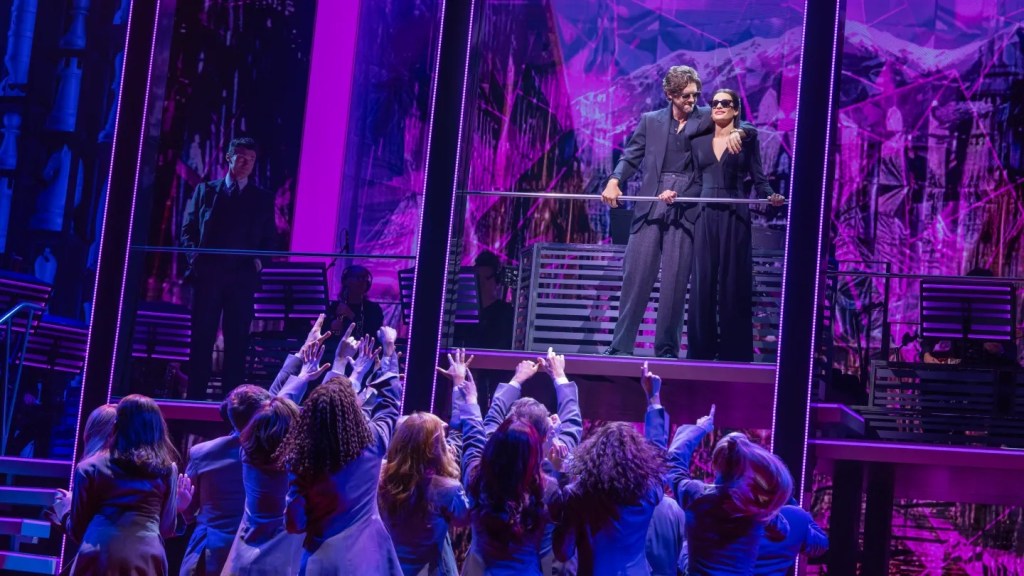
CHESS
Music and lyrics by Benny Andersson, Tim Rice and Björn Ulvaeus
based on an idea by Tim Rice
New book by Danny Strong
directed by Michael Mayer
Imperial Theatre, New York City – open ended run
running time: 2 hours 45 minutes including interval
Your perception of Chess probably depends which side of the Atlantic you’re from. The first Broadway version was a notorious flop garnering rotten reviews, but the London premiere, which had opened five months ahead of the original Phantom in 1986, was much more successful, filling the sizeable Prince Edward for over three years. Both productions were helmed by Trevor Nunn but were very different in look, feel and even script, the New York iteration having a completely new book by acclaimed American playwright Richard Nelson. The overall impression was that the score by ABBA’s Benny Andersson and Björn Ulvaeus with lyrics by Tim Rice in his first large scale departure from working with Andrew Lloyd Webber, was magnificent but the story and script, not so much.
By the time Chess hit Broadway in 1988, out was Elaine Paige plus the gigantic electronic chessboard stage that elevated and rotated, and the banks of TV screens showing Cold War news events and the moves in the all-important chess games, all inherited by Nunn from the original concept of Michael (A Chorus Line, Dreamgirls) Bennett who had become too sick from AIDS to continue working. In instead was Judy Kuhn and a less spectacular but still complicated staging featuring a series of beige towers that moved about to suggest multiple locations. The general consensus among New York theatre folk was that the “British Invasion” started by Cats and Les Mis had come to a shuddering halt with this tale of romance and betrayal amongst fractious East-West relations, and Chess Broadway shuttered after a mere two months.
But now it’s back, in an eagerly awaited revisal led by Tony-winning director Michael Mayer, with a starry trio of central players and yet another new book, this time by Danny Strong, known more for his TV than theatre work. It would be lovely to report that this is the definitive Chess, that Strong, who in more than one press interview has proclaimed that he’s “fixed” the problematic musical, has finally cracked it and turned the show into the beloved blockbuster that diehard fans of this undeniably thrilling score always felt it should be.
Well, it certainly seems to be making a lot of money, mainly one suspects due to the presence of Lea Michele as lovelorn, power-belting Chess analyst Florence, evacuated to the USA as a child from her native Hungary when the Soviets invaded. She’s alongside Broadway darling Aaron Tveit and rising star Nicholas Christopher as the (respectively) American and Russian Grandmasters competing with each other and squabbling over her. These bare bones of plot seem to be the only constant between each variation of the show.
Unfortunately though, what’s currently doing phenomenal box office business at the Imperial (the same theatre where the original production played) is nearer to a particularly ballad-heavy episode of American Idol with a bit of politics and witless narration thrown in, than a coherent, fully realised musical. Essentially, it’s a semi-staged concert with Ian Weinberger and Brian Usifer’s band (excellent by the way, but less satisfying than the symphony sized orchestras on some recordings of the score) on platforms at rear and fully visible at all times, and the suited (women as well as men) ensemble sat around on couches throughout like a less decadent version of the cast over at Chicago.
They don’t just sit there, to be fair: they also execute choreography by the usually terrific Lorin Latarro that occasionally finds a natural dynamism but mostly feels like a confused distraction from all the park-and-bark singing. Why the bizarre sat-down interpretive dance when Christopher’s Anatoly is delivering his first crie de cœur solo ‘Where I Want To Be’? They strip to their underwear for ‘One Night In Bangkok’ but it feels more desperate than sexy, and a bit odd since they don’t change clothes at any other time (no Tyrolean costumes for Merano!) Much is made at the beginning of them donning a blue or red kerchief to denote American or Russian, but that concept is abandoned for the rest of the show.
Worse is Strong’s misguided book which sets up Bryce Pinkham’s Arbiter (“from square one, he’ll be watching all sixty four”) as a narrator-cum-MC, commenting on scenes as they unfold. There was a not-fully-realised antescendent to this with the late, fabulous Tom Jobe in the original London version, but Pinkham, working very hard, seldom shuts up. Strong has him rabbiting on incessantly, re-describing dialogue sequences we either just witnessed or are about to watch but are really not that complex, as though to an audience of halfwits. Then there’s the contemporary “jokes” and allusions he’s saddled with: Chess is set at the height of Soviet vs West tensions in the 1980s but we get gags about Robert F Kennedy Jr’s brain worm, Biden and Trump, constant references to “our Cold War musical” and fatigued digs at the show and characters we’re watching (“see I told you he was a dick” he winks at us over the head of a villainous American agent; “that was HOT!” after Bangkok…like ok we get it, we’re right here).
It’s as though Strong doesn’t trust the piece to speak for itself, and his approach keeps us at a constant emotional remove from a show that, while soaringly effective as a collection of bombastic theatre songs, suffers from a certain chilliness that I doubt even its most passionate advocates would deny. Mayer’s staging, glossy but soulless, doesn’t help, favouring the prosaic over the inspired, and giving two of his three leads little to make their dramatic mark with. Michele and Christopher are authentically great singers and have moments of vocal power here (‘Nobody’s Side’, ‘Anthem’, ‘Endgame’) that make the hairs on the back of your neck stand up, but neither registers much in the way of personality beyond a general air of discontent. Comparisons may be odious but anyone who saw Elaine Paige and Tommy Körberg in these roles will likely miss the edge, warmth and humour these two performers brought (and Florence as a leading lady role that barely passes the Bechdel test needs as much help as she can get).
Tveit, on the other hand, nails American player Freddie’s mix of swagger, instability and vulnerability, plus has the perfect stratospheric rock tenor to really do justice to the role’s extraordinary vocal demands. He’s superb and his breakdown number ‘Pity The Child’ has never sounded better. Strong ups the ante by making explicit the character’s mental health issues but then turns us off Florence by having her snatch away the meds that keep him on an even-ish keel, just as she’s leaving him for Anatoly.
The other improvement in this new Chess is the depiction of Anatoly’s abandoned wife Svetlana, forced to come to Bangkok by the KGB to plead for his flunking of the international championship game and return to Moscow. No longer the dowdy drudge of old, here she’s a manipulative, ambiguous vamp, tough, sexy as hell but with an edge of real desperation (one of Strong’s more inspired modifications is suggesting the mortal danger Russians found themselves in if perceived as having shamed the motherland in some way). Hannah Cruz invests her with a powerful presence and fascinating, focused unknowability, plus a steely, enthralling vocal belt (has this woman ever played Evita?!) She is stunning but when the most complex and satisfying performance is from a secondary character who only appears in act two, you know the show has issues.
Bradley Dean and Sean Allan Krill are enjoyably nasty as a pair of men from opposing sides of the political divide with more interest in furthering their national interests than fair play, and the ensemble singing is consistently potent. A pivotal character shows up in the very final moments but in a way that comes across as more eye-rollingly risible than the deeply moving that was presumably intended.
In eschewing the black and white colour palette, redolent of an actual chessboard, employed by original designers Robin Wagner and Theoni T Aldredge and many of their successors on later revivals of the show, this Chess is a retina-bruising mishmash of colours and styles that don’t add up, the visual storytelling being virtually non-existent. David Rockwell’s set, static but gleaming and surrounded by giant chess pieces with the occasional nuclear warhead thrown in to unsettle, is dressed up with garish lighting by Kevin Adams and video designs by Peter Nigrini that only really register properly if you’re sitting centrally. The stage is mostly empty (well, apart from the omnipresent orchestra that encroaches on everything) but then, ponderously, a bed will elevate through the floor for Michele to deliver a power ballad from, while chandeliers that look like they’ve been borrowed from the Met Opera twinkle overhead: it just doesn’t feel very well thought through. Tom Broecker’s costumes are dismayingly drab, with little sense of the 1980s.
One of the finest, most moving songs in the show, Florence’s rueful admission of romantic defeat, ‘Someone Else’s Story’ premiered by Judy Kuhn in the original Broadway version, is placed now at the very end, making no sense beyond giving Michele an eleven o’clock number (although it feels well past midnight by this point). John Shivers’ sound design is impressive though, balancing the neo-operatic overwhelm with the pop/rock elements of the score and (mostly) letting us hear Rice’s wittily incisive then heartfelt lyrics.
Tveit and Cruz apart, the principal pleasure of seeing Chess is to hear this score again. Cleverer and more complex than Saigon and Les Mis, more urgently grandiose than Phantom, with a Puccini-esque richness offset by bracing Scandinavian steel, it’s gorgeous, and apparently indestructible. Anders Eljas’ orchestrations, in collaboration here with Usifer, remain distinctive and exciting.
The perfect Chess though? We are all still waiting for that. Maybe, like world peace, it can’t exist. This glittering Frankenstein’s monster of a makeover, only intermittently stirring, isn’t it, but the cast album will be a cracker.
 ajhlovestheatre
Leave a comment