TROILUS AND CRESSIDA
by William Shakespeare
directed by Owen Horsley
Shakespeare’s Globe, London – until 26 October 2025
running time: 2 hours 45 minutes including interval
https://www.shakespearesglobe.com/whats-on/troilus-and-cressida/
In all honesty, you can see why Shakespeare’s anti-war satire-cum-love story doesn’t get done all that often. It’s is all over the place tonally, and, although a mid career play, it sometimes feels like the bard was trying to cram in as many echoes of his earlier ‘greatest hits’ as possible. So we get the doomed lovers of Romeo and Juliet, the warring battles of the Histories, the ribald humour of the Comedies and an exotic setting (Ancient Greece and Troy) comparable to that of the Roman plays Julius Caesar and Titus Andronicus. The abhorrent treatment of women from the latter also rears its ugly head in Troilus and Cressida.
Instead of trying to make a coherent whole out of the various strands and milieux, director Owen Horsley (who did last year’s gorgeous, queer-accented Twelfth Night in Regents Park) embraces the lunacy and allows the play to speak for itself, albeit through a flamboyant, modern(ish) dress prism. The result is an uneven, surprisingly camp, rendering that, when it works (mainly the Trojan sections and whenever Samantha Spiro’s gender-swapped Pandarus, now Cressida’s aunt, is on stage) is zany, unsettling and just tremendous fun, but can, at other times, tend to be plodding and confusing. The havoc wreaked by poor leadership, military and civic, is profoundly felt though.
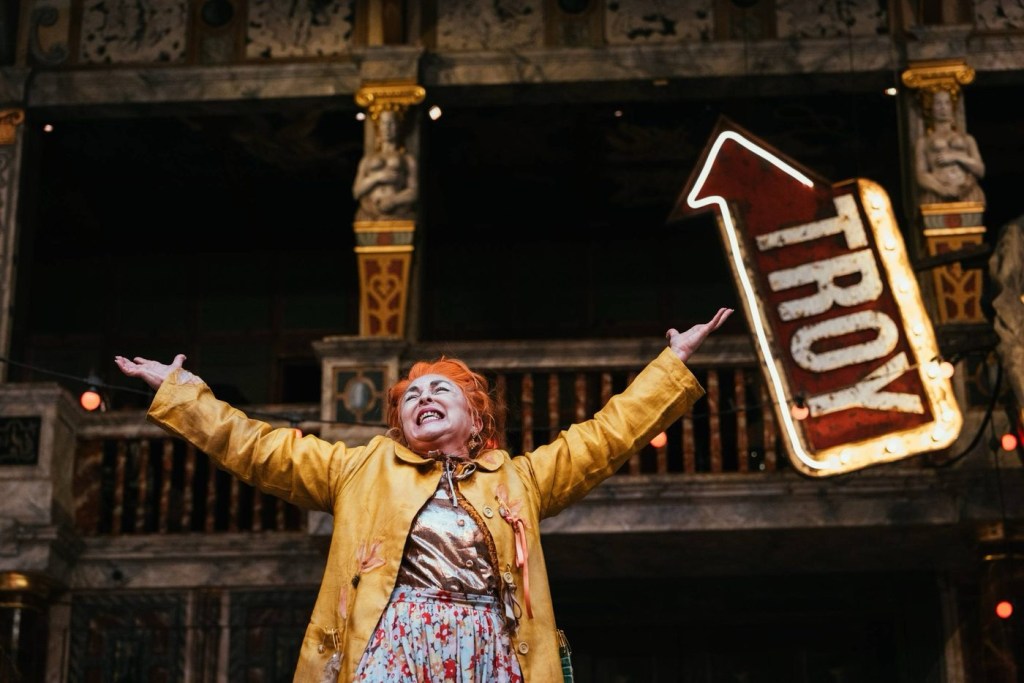
If a messy play is matched with a messy but boldly theatrical production, there’s still a hell of a lot here to savour. Anachronisms abound in Horsley’s concept and Ryan Dawson Laight’s designs: Kasper Hilton-Hille’s confidently spoken Troilus lounges about in shiny leisurewear while his sister Cassandra (Jodie McNee, also doubling as Ulysses) bellows through a megaphone and sports a CND slogan-daubed parka coat. Tadeo Martinez’s Helen of Troy fanboy Alexander is a social media influencer who wields an enormous ‘APPLAUSE’ sign at the groundlings when the warriors Ajax, Hector et al come on like participants in a garish fashion show, and David Caves as mighty Achilles looks like an Old Compton Street muscle daddy who has gone spectacularly to seed.
It initially all seems so deeply unserious what with the provocative poster of Helen of Troy’s half open, lipsticked mouth plastered all over the Globe’s yard and a giant Grecian statue’s foot dominating the stage, that the darker elements of the play (and it does get pretty dark) feel startlingly out of place when they come. Maybe that is the point but it’s such a bewildering gear change that it threatens to upend any engagement with the piece.
The contrast between the vividly attired Trojans and muted, austere Greeks is mainly well done although the former are so much more fun than the latter, and the multitude of accents amongst the cast doesn’t help us with working out who is related to who etc. The first appearance of Lucy McCormick’s glittering, marvellous Helen of Troy, all sequins and breathy joie de vivre supported by Matthew Spencer as a screamingly camp Paris, is pure showbiz, but concludes alarmingly, suggesting that we’ve all just been had. Eamonn O’Dwyer’s off-kilter musical score unsettles too, like a colliery band playing a film soundtrack that’s by turns lush then funky.
Many of the individual performances are superb. Hilton-Hille and Charlotte O’Leary are appealingly unconventional as the titular lovers, a gritty, modern couple with agency and wit, although this approach makes their relative passivity when Cressida is promised by her father to the opposing Greeks, seem a bit odd. McNee’s uptight, lesbian Ulysses is very striking and Caves gives Achilles just the right mixture of aggression and dissolution. Oliver Alvin-Wilson is glorious and multi-layered as warrior Hector, an outward nobility and physical grace masking an all-too-flawed inner life.
Best of all is Samantha Spiro as Pandarus: garrulous, meddling, amoral, in this version a woman, and the individual responsible for driving the lovers together. She’s conceived here as a chirpy, cockney-accented Mother Courage but armed with beauty products (in a case marked ‘War Paint’) rather than the spoils of war, equal parts Music Hall, Eastenders, Carry On and classical tragedy. She’s hilarious and endearing yet strangely worrying: ultimately a survivor, despite being permanently on the verge of coughing her guts up. Spiro is fearless with the language, and makes the cynical final speech, predicting ongoing sickness and decline for mankind as a whole as war rages on, into something simultaneously chilling and pitiful. Watching her, bloodied and disheveled yet attempting to lead the audience in a mirthless singalong like one of Julie Walters’ most baroque comic creations, is to see an actress at the top of her game, full of pathos, wicked craft and sheer theatrical bravura.
It’s a memorable, ingenious performance that anchors a production so eccentric it runs the risk of floating away. Ultimately, enjoyable as this Troilus and Cressida is, it also demonstrates why the play isn’t universally beloved. Still, it’s worth seeing, for the performances and the sheer inventiveness of Horsley’s vision, but it might be worth reading a synopsis of the plot before you go.
 ajhlovestheatre
Leave a comment