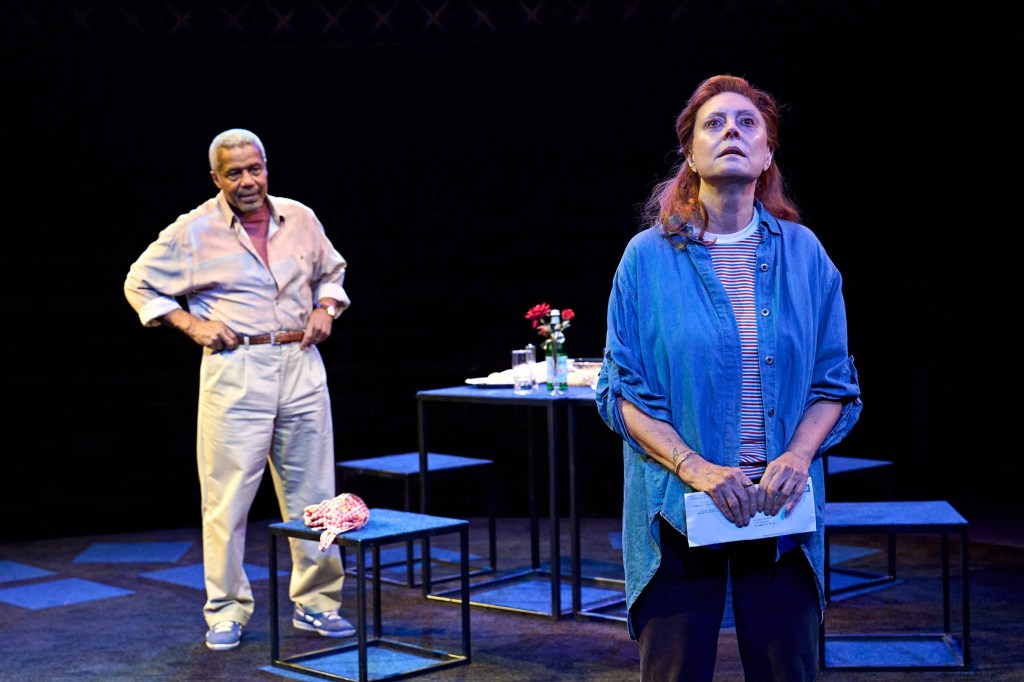
MARY PAGE MARLOWE
by Tracy Letts
directed by Matthew Warchus
The Old Vic, London – until 1 November 2025
running time: 100 minutes no interval
https://www.oldvictheatre.com/stage/mary-page-marlowe/
Take an apparently unremarkable life, cut it into pieces, throw those fragments up in the air then see where they land, and you have Mary Page Marlowe. Tracy Letts’ 2016 play, first seen at Chicago’s prestigious Steppenwolf Theatre, is a minor key yet compelling look at a flawed, relatable woman who endures a long life marked by sometimes questionable choices and a diffidence that makes her strange yet captivating theatrical company.
Anybody who comes to Matthew Warchus’ oil-smooth but emotionally resonant production, staged in the round, primarily to see Susan Sarandon in her London theatre debut may be surprised at how much of an ensemble piece this is, and perhaps even more by how little the absence of a scenery chewing central turn matters. The acting thoughout is utterly flawless and Sarandon is magnificent, but so is everybody else. The title role is split between five actresses portraying Mary Page at various points in her life and each one (in descending age: Sarandon, Andrea Riseborough, Rosy McEwen, Eleanor Worthington-Cox, Alisha Weir) is tremendous. If Sarandon’s portion isn’t overly taxing, she is so real, generous and magnetic that you’re unlikely to feel short changed, and better to appear in a manageable but still impressive stage role than to over-extend and come unstuck as poor Sigourney Weaver did in last year’s Jamie Lloyd Tempest.
Letts’ stripped-back text is terse and naturalistic, not a word, gesture or pause is wasted. We see the eponymous Mary Page at every stage of life from cradle (literally) to grave (almost), but not in chronological order. There is a strong, sad sense of Mary’s wasted potential as her story covers loss, alcoholism, marital strife and the idea of damaging behaviours repeating themselves and echoing down the years. Some sequences, such as the Tennessee Willams-esque showdown between Mary’s parents (Eden Epstein and Noah Weatherby, both superb) are gripping while a couple of others (a therapy session scene feels a bit rote and heavy going, despite the excellence of the acting) seem to take their foot off the dramatic pedal.
Ultimately, it’s like piecing together a puzzle (the opening scene has Riseborough’s astonishingly authentic middle aged Mary talking to her young son and daughter about the collapse of her marriage but in a later scene Sarandon’s elderly incarnation tells a doctor she only has one child; we also see Mary celebrating being a free woman but only find out much later what she was incarcerated for), and it requires concentration on the part of the audience lest the brief scenes become a parade of random non sequiturs. The play is likely to frustrate as many people as it delights, but it has a clear-eyed humanity and truth that makes it worth investing in, and a mordant sense of humour. The changing decades are lovingly conveyed by Rob Howell’s evolving costume designs and the wig creations of Campbell Young Associates.
There’s beautiful work from Hugh Quarshie and Paul Thornley as two of Mary’s husbands, and equally fine, funny, kind contributions from Melanie La Barrie, Kingsley Morton and Daniella Arthur-Kennedy as benign figures in her sometimes rocky life story. Ronan Raftery is appropriately tragicomic as a married man Mary gets involved with, and there’s a belting UK stage debut by Clare Hughes as her volatile teenage daughter. There’s not a single weak link in the sizeable cast.
Mary Page Marlowe is a curious work, mostly lacking the incendiary dramatic firepower of Letts’ signature works Killer Joe and Bug or his masterpiece August: Osage County (surely due a revival?), but sharing the same gritty wit and gleeful love of people behaving badly. I suspect it’s a piece that rewards a second or even third viewing to fully appreciate the poignancy, the unconventional storytelling and richly textured characterisations, but it’s quietly engrossing. Most of the writing is raw and exquisite, and there probably isn’t an acting ensemble on any other current London stage to rival this one.
 ajhlovestheatre
Leave a comment