A LITTLE NIGHT MUSIC
music and lyrics by Stephen Sondheim
book by Hugh Wheeler
Norwegian dramaturg: Olaf Torbjørn Skare
directed by Tomas Glans
Nationaltheatret – Amficenen, Oslo – in repertoire until 29 November 2025
running time: 2 hours 50 minutes including interval – performed in Norwegian
https://www.nationaltheatret.no/forestillinger/a-little-night-music/
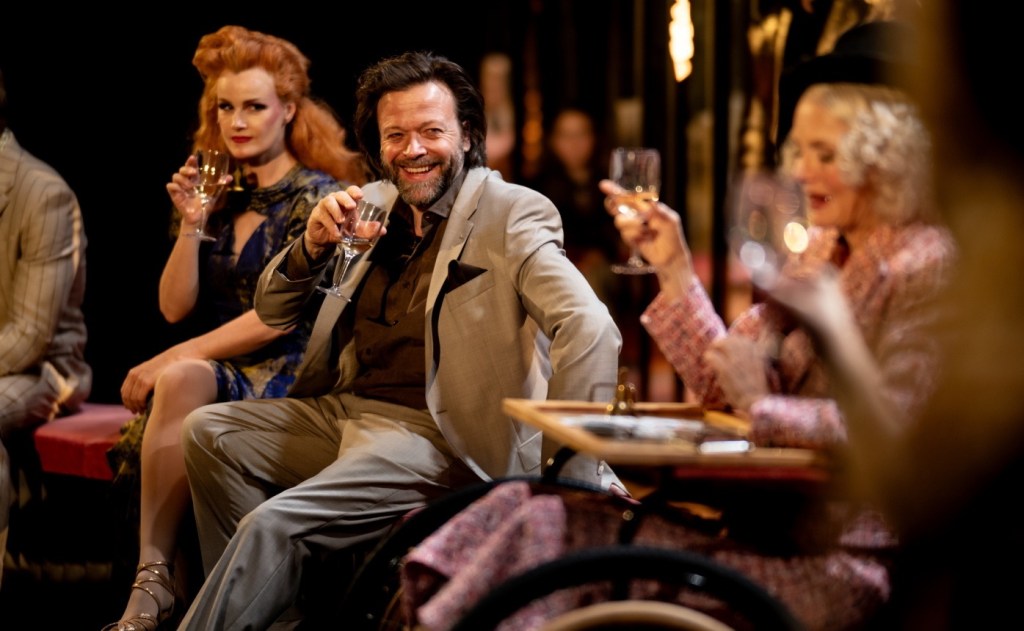
There’s something delightfully perverse about mounting one of the most elegant musicals ever written at a gorgeously ornate period-appropriate theatre (Oslo’s Nationaltheatret dates from 1899, A Little Night Music is set as the nineteenth becomes twentieth century) in the same part of the world as the story unfolds (the location of Hugh Wheeler’s book is Sweden, but Norway and Sweden were technically the same country until 1905), then throwing out all historical trappings and staging the show in the venue’s modern studio space. Famously referred to by original director Harold Prince as “whipped cream with knives”, A Little Night Music emerges here in Tomas Glans’ garish, unsettling new version, apparently set in the same decade (the 1970s) as Wheeler, Prince and Stephen Sondheim were creating this Broadway masterpiece, as more Instant Whip with serving tongs.
It’s a bold, campy reimagining boasting some nice fresh ideas, particularly for the female characters: Nora Frølich as flighty wife Anne Egerman so resembles a youthful version of her older husband’s previous lover Desirée, at least at first, that it’s remarkable nobody notices, and her lust for stepson Henrik (Ola Magnus Gjermshus) is made explicit from the outset. Hanna-Maria Grønneberg’s trousered maid Petra is aggressively bisexual, her ‘Miller’s Son’ number son less a celebration of “everything passing by” than a slightly desperate, defiant repudiation of ever being tied down.
I’ve never seen a Countess Charlotte as sexually in thrall to her husband as Henriette Marø’s is here, nor one so pitiably craving for male attention of any kind (observe the way she cosies up to Egerman when she briefly believes he’s as lost as she is.) A brilliant comedienne with edges of mania and tragedy, Marø is so good one wishes they’d reinstate the vicious ‘My Husband The Pig’ number that got cut originally, although on reflection it’s sourness and anger might not fully work with this interpretation. She brings a Piaf-like intensity to her lament for matrimonial happiness ‘Every Day A Little Death’ that feels entirely appropriate and slightly shocking.
Lena Kristin Ellingsen is a fairly traditional Desirée Armfeldt, apart from Glans’ decision to make her a heavy drinker, and she’s pretty much perfect, capturing the glamour, warmth and humorous free spirit of the actress but also her pragmatism and underlying sense of longing. Calculated in her attempts to win back Kăre Conradi’s likeable, charismatic Fredrik, she possesses a twinkle-eyed mischievousness that makes even her worst behaviours forgivable, as does her absence of self-pity. The decision to turn off her mic for the last verse of ‘Send In The Clowns’ after Fredrik’s departure is an interesting one: she sings acoustically (and beautifully, with refreshing dramatic economy) as though all artifice and pretence has been abandoned. It’s a powerful moment.
Conradi is convincingly torn between Desirée and Frølich’s neurotic, perpetually bewildered, superbly detailed Anne, and Gjermshus finds every note and colour in his tormented, sexually pent-up son. There’s a Monty Python-esque derangement to Jacob Jensen’s drop dead gorgeous but clearly unstable dragoon Carl Magnus that sometimes jars against the more nuanced work elsewhere. Mari Maurstad is a wonderful Madame Armfeldt, looking like a broken, slightly dishevelled doll in her wheelchair, salty-sweet but prone to sudden outbursts of volcanic fury. It’s consistently possible to see the fabled coquette under the facade of disapproving old woman.
If most of the characters are fundamentally the same, the world they’re now inhabiting looks more like late twentieth century Stringfellows night club than fin de siècle opulence: Katja Ebbel’s squat, abstract set consists of multiple slatted mirrors, horizontal neon strips and pink plush. Her eye-popping costumes are objectively hideous but undeniably redolent of the decade that taste forgot, and whoever’s in charge of hair clearly never met a fright wig they didn’t like. Location and mood are largely indicated and altered by the rearrangement of screens of mirrors (through which characters are sometimes fleetingly, intriguingly glimpsed even when not participating in unfolding scenes, in a perhaps unintended homage to Boris Aronson’s original design) and a pair of semi circular rose-coloured couches, and Oscar Udbye’s vivid, shapeshifting lighting.
Sondheim’s music is extremely well served in this production; the voices are uniformly good, and the choral singing on ‘A Weekend In The Country’ thrills the blood. Simon Revholt’s orchestrations for a five piece band are inevitably nearer to Jason Carr’s arrangements for the last London and Broadway revival rather than Jonathan Tunick’s sumptuous originals, but they wrap these divine tunes and waltz motifs with authentic sparkle and melancholy shimmer.
Overall, there are, perhaps inevitably, a couple of frustrations. The principal one is that the outlandish visual impact and general feeling of chaos mitigates any real emotional connection, apart from Charlotte’s plucky devastation and the aforementioned conclusion to Desirée’s musical cri de cœur. A really satisfying Night Music should break your heart as well as turn your head, and this one doesn’t quite manage that. The idiocy of the characters has been dialled up to ten at the expense of any gravitas or nobility.
Furthermore, reducing the all-seeing, all-commentating quintet of liebeslieder singers to just a pair doesn’t work. Sanne Kvitnes and Anders Gjønnes have magnificent voices but their presence feels pointless when they’re not an operatic Greek chorus. They’re now just unnamed characters wandering aimlessly through the action looking arch and wearing horrific outfits (he in a gold lamé suit, her in a shiny frock of excremental hue) while singing like angels.
Ultimately though, the show itself is so strong that it retains its power to entrance even in such a defiantly unusual production. Traditionalists may feel short changed in terms of scale and period elegance, but there’s no denying that director Glans has a fundamental grasp of these characters and their relationships, and the confidence to treat Sondheim and Wheeler’s work as though it is a new show. This production is exquisitely cast, but perhaps the most surprising thing is how easily the gaudy ‘70s setting and timeless classicism of the score co-exist in the same space.
 ajhlovestheatre
Leave a comment