JUNIPER BLOOD
by Mike Bartlett
directed by James Macdonald
Donmar Warehouse – until 4 October 2025
running time: 2 hours 35 minutes including two intervals
https://www.donmarwarehouse.com/whats-on/juniper-blood-n8df
Mike Bartlett takes on sustainability, climate change, and the tension between living an authentically virtuous life and remaining relevant in, and connected to, the modern world, in this absorbing but perplexing new play. Juniper Blood premieres at the Donmar in a magnificently acted production helmed by James Macdonald and, if it isn’t Bartlett at his peak, it’s certainly a huge improvement on his wan open marriage drama Unicorn seen in the West End earlier this year.
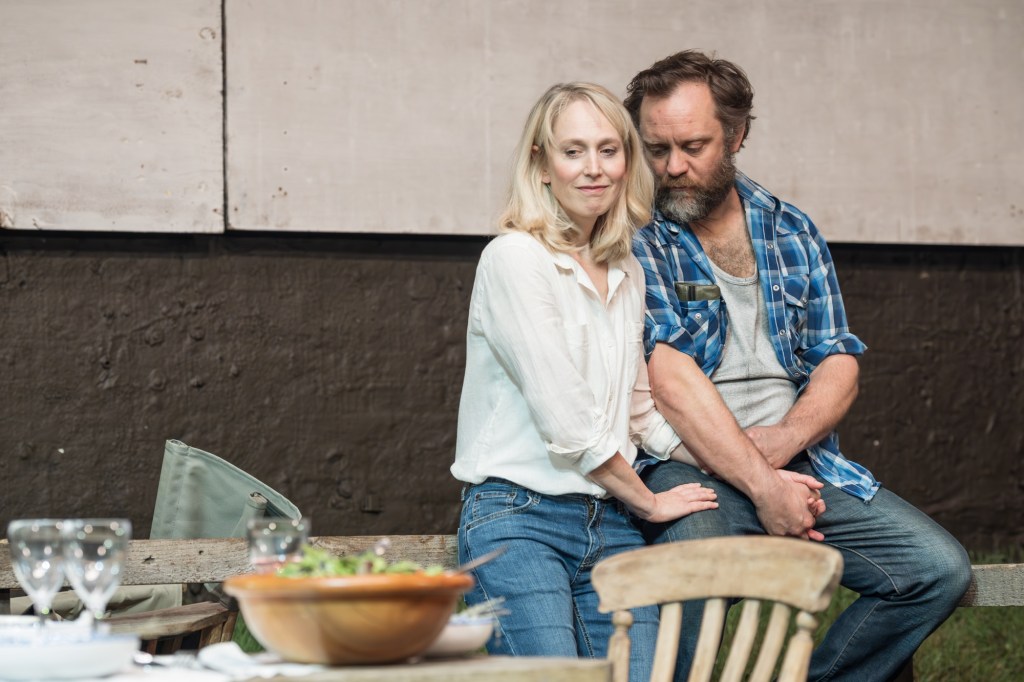
Bartlett sets up Juniper Blood with a quintet of characters that initially seem like stereotypes but some of whom, on closer inspection, reveal unexpected layers and foibles. Having relocated to a remote rural farm from a privileged London life, good-hearted middle class Ruth (Hattie Morahan) occupies the middle ground between her intense, monosyllabic partner, the ironically named Lip (Sam Troughton), and wealthy, potty-mouthed neighbouring farmer Tony (Jonathan Slinger). There’s a further culture clash with arrival from town of Ruth’s stepdaughter from a previous marriage, fragile, self-obsessed Milly (Nadia Parkes) and her intellectual student pal Femi (Terique Jarrett).
The script has a lot of fun pitting the precious, judgmental townies against sceptical country folk for whom bullshit is what you fertilise a field with not what comes out of your mouth. Bartlett brilliantly nails the differing rhythms, vocabularies and speech patterns of this disparate group of people. The dialogue crackles and fizzes, and each character, for the most part, sounds plausible, even though some of the situations they put themselves in during the course of the play, which takes place over the across several years and three acts, strain credulity.
Personally, I didn’t buy Milly’s drastic volte face in terms of her attitude to the land, despite the conviction of Parkes’s performance. Also, the brutal choice facing Lip and Ruth regarding their very different attitudes to the future, although conveyed with passion and truth by Morahan and Troughton, doesn’t fully ring true. The symbolism of taking a hammer to a mobile phone sure ain’t subtle. The third act is the least satisfactory, partly because the characters start to talk like mouthpieces rather than real people.
Despite these quibbles, it is refreshing to see a play with serious ambition, and a concept of the world beyond the limited confines of its setting. Bartlett detonates little dramatic bombs throughout each act, including the very final moment, that send shock waves through a script that engrosses as much as it frustrates. Juniper Blood is bold, knotty, imperfect, but weirdly haunting. I found myself processing it for hours and days after watching.
It helps that the performances and James Macdonald’s visually stark staging, played out under house lights that never dim as though we are all in some kind of giant hothouse (which we probably are), seldom strike a false note. Like the Broadway import Stereophonic just down the road, Juniper Blood dares the audience to buy into the minutiae of its characters lives. Macdonald isn’t afraid to take his time, so we get to watch Troughton staring thoughtfully into the middle distance for minutes on end, or an increasingly stressed Morahan juggling phone and laptop as she manages farm business, and if you invest, you’ll be riveted, but equally this won’t appeal to everyone.
Few actors project innate goodness as clearly as Morahan and she is just tremendous here. So is Troughton, who makes all too convincing the extremities of Lips’s views. Slinger is a formidable but playful presence as swaggering but strangely lost Tony, and gets to deliver a rather beautiful middle act speech interrogating the concept of a flawed but not cruel England lost and never to return, tonally reminiscent of Bartlett’s earlier work in the Almeida’s earlier Albion.
The set by Ultz, all wood, earth, grass and white panelled walls, is aggressively ugly. There’s no attempt to suggest a rural idyll, but then the play is hardly an ode to a bucolic existence, more an acknowledgment of the hard graft involved in farming, and a repudiation of the romanticism, usually by clueless urban types, of country life. If Bartlett offers no solution to the myriad of existential problems that Juniper Blood is juggling, well, there really aren’t any. If it feels bleak, he seems to be saying, then suck it up.
This is a challenging, unwieldy piece, by turns richly entertaining then dismayingly clumsy. It’s not an entirely satisfying evening, but it’s too intriguing and urgent to write off. Cautiously recommended.
 ajhlovestheatre
Leave a comment