THE WINTER’S TALE
by William Shakespeare
directed by Yaël Farber for the Royal Shakespeare Company
Royal Shakespeare Theatre, Stratford-Upon-Avon until 30 August 2025
running time: 2 hours 50 minutes including interval
https://www.rsc.org.uk/the-winters-tale
Visionary, internationally acclaimed, but sometimes divisive (remember her Salome for the NT?!), South African director Yaël Farber takes on one of Shakespeare’s most emotionally affecting plays…and the result is a magical, shattering piece of theatre. This is a Winter’s Tale that gives full rein to the majesty and poetry of the bard’s text while also making it feel fresh, dynamic and psychologically acute. Crucially and impressively, it marries together the courtly and pastoral elements of the play more successfully than any other production I’ve seen. It’s a night of dramatic fireworks and Beckettian gloom.
There’s something compulsive, almost soap operatic, about the earlier sections of The Winter’s Tale where the volcanic jealousy of Sicilian King Leontes rents asunder not only his own marriage but the platonic relationship between his pregnant wife Hermione and long-standing friend Polixenes, King of Bohemia. In a triumphant return to the RSC, Bertie Carvel (first revealed wrestling homoerotically with John Light’s chiselled, assured Polixenes) plays Leontes as palpably unstable from the very outset. He’s the kind of volatile tyrant around whom courtiers and lesser mortals pussyfoot lest they provoke his rage. It’s a superbly controlled performance, dangerous and compelling, with an edge of childlike vulnerability, and Carvel attacks the language with sibilant relish and breathtaking confidence. The play may be familiar but Carvel keeps you on the edge of your seat with tension (look out for the scene where he is holding his baby daughter Perdita…it includes a moment that has the audience gasping in shock).
Madeline Appiah’s gorgeous, touchy-feely Hermione appears to have his measure and seems the sort of woman used to pouring oil on the troubled waters stirred up by her difficult consort. Her relationship with Light’s matter-of-fact, likeable Polixenes is disarmingly physical -they stand at times as though on the verge of a kiss, their fingers entwined- and could perhaps be seen as ambiguous, except that Appiah radiates such warmth that one imagines she is the sort of woman that beguiles people on a regular basis.
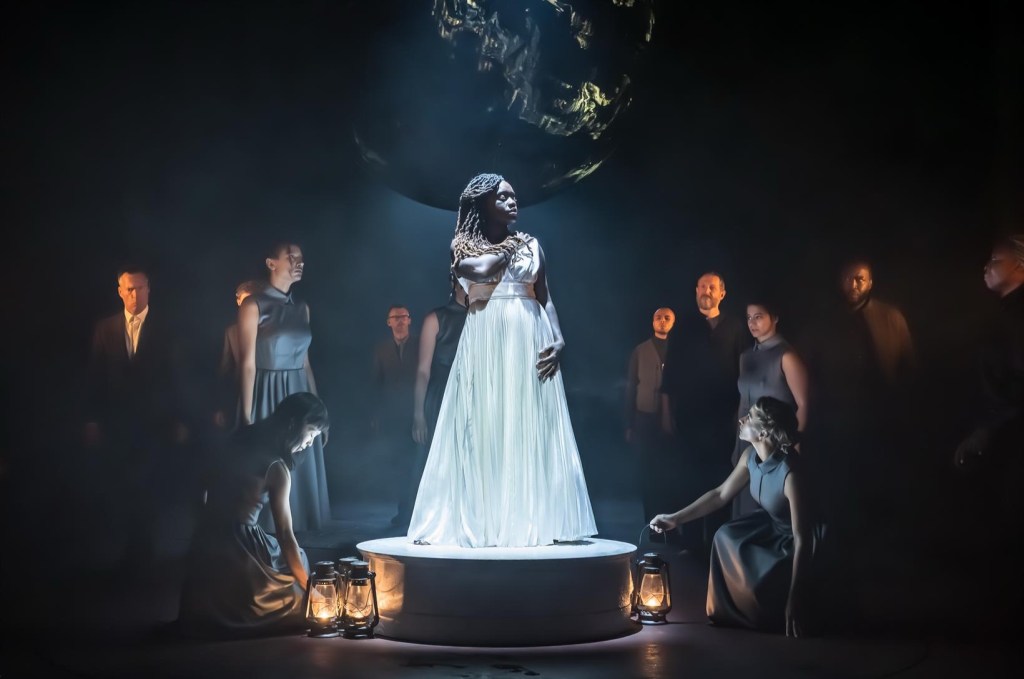
By putting everybody in slate grey, timelessly elegant clothing, Farber and her designer Soutra Gilmour suggest a modern-ish kingdom, which makes the brutal treatment meted out to Hermione all the more startling. Visually and tonally, this is a dark production, sepulchral even. Time The Thief (a laconically witty, disturbing Trevor Fox, looking like a refugee from Waiting For Godot), stalks the action like a Geordie-accented harbinger of doom, unseen yet sensed with unease by some of the courtiers, and acting as unexpected playmate to Mamillius, Hermione and Leontes’s isolated young son.
For much of the first half, it’s not easy to gauge where Farber’s work ends and the contributions of movement director Imogen Knight begins. The production moves with an almost balletic fluidity, making subtle but effective use of a pair of revolves on what is otherwise a bare stage presided over by a giant disc that at different times suggests a cold, unattainable faraway planet, a blood red moon and finally, the earth itself. Figures emerge from darkness as if by magic -Tim Lutkin’s lighting and Dan Balfour’s sound are tremendously accomplished and seamlessly in tune with Farber’s concept- and Max Perryment’s ethereal, unsettling music underscores every word, beat and moment but succeeds in enhancing the action and language, never detracting from them.
All these technical elements, muted but potent, work together seamlessly in the first half but explode into something even more extraordinary in the second, which is often where lesser productions of The Winter’s Tale falter. That is emphatically not the case here. The action fast forwards sixteen years and banished Perdita (Leah Haile) has been raised by rural shepherds (Amelda Brown and Ryan Duval, both delightful but tough, not the bucolic peasants often portrayed) and is in love with Florizel (Lewis Bowes), Polixenes’s slumming-it-in-disguise son.
All too often creative teams tend to pretty up these sections of The Winter’s Tale, making them so discrete from the rest of the play as to feel jarringly inconsistent. However, Farber et al lends them a wild, dark intensity that seem very much of the same world as the tyrannies and unease of Leontes’s court but unfettered by the social mores of society. Fire bursts from the stage, the Bohemians stomp and sway under a blood red moon, drums thunder overwhelmingly from on high, a solo voice wails….it feels shamanic and essential.
Equally thrilling is Aïcha Kossoko as a fine, authoritative Paulina whose “what studied torments, tyrant, hast for me” speech chiding the king is delivered with such elemental force that the seats nearly rattle. There’s magnificent support from Matthew Flynn as her kind, concerned husband and Raphael Sowole as a thoughtful, unwillingly complicit Camillo. Haile and Bowes have a striking but edgy chemistry.
In a text powered by male sexual jealousy, it is almost impossible to present the fairy tale-adjacent ending without some sort of comment in this day and age. Farber doesn’t overplay her hand here though, giving us a reconciliation scene that authentically wrings out the tear ducts but is subtly undercut at the last moment by Appiah’s revitalised Hermione who non-verbally suggests that all is not necessarily as well as one might hope. It’s an intriguing, troubling button on a remarkable production, one that stays true to the core of the classic play but builds a fascinating new world around it. A wonderful achievement, and the sort of show that will convert a Shakespeare-sceptic while also satisfying the purists. Unmissable.
 ajhlovestheatre
Leave a comment