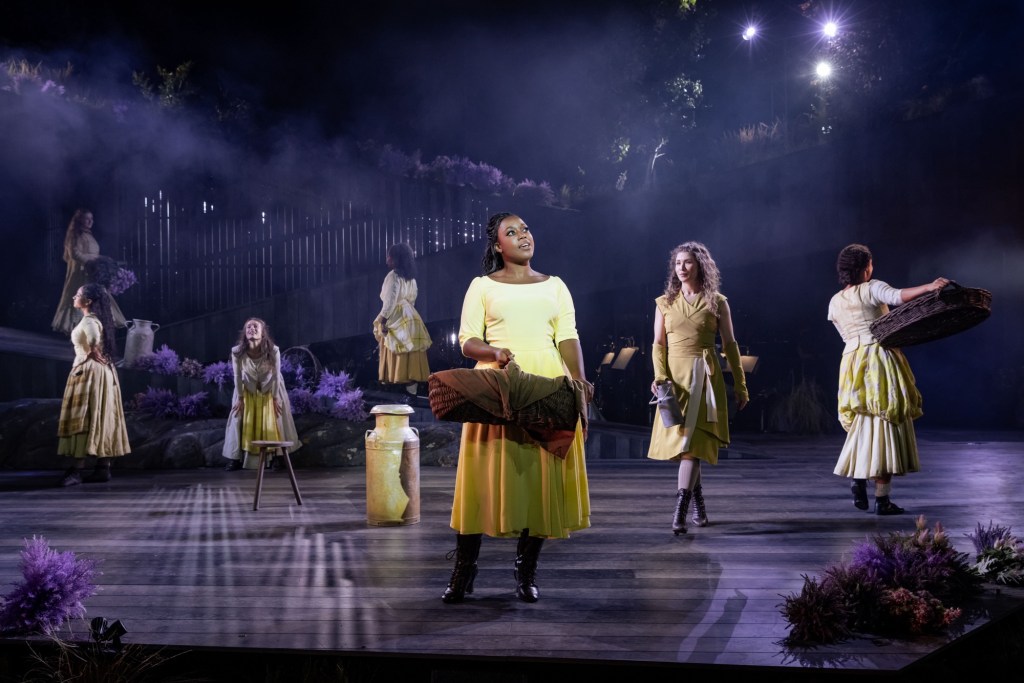
BRIGADOON
Book and lyrics by Alan Jay Lerner
Music by Frederick Loewe
in a new version by Rona Munro
original dances by Agnes de Mille
directed and choreographed by Drew McOnie
Regents Park Open Air Theatre, London – until 20 September 2025
running time: 2 hours 15 minutes including interval
https://openairtheatre.com/production/brigadoon
What with the state of everything at the moment, the idea of running away to a picturesque Highlands village where everyone is healthy, contented and entirely cut off from the outside world, has never seemed so appealing. The whimsy and escapism are strong in Brigadoon, receiving its first London production in almost forty years.
Drew McOnie’s open air revisal (Alan Jay Lerner’s book has been adapted by Rona Munro to include some authentic Scottish language and a rethought ending) is a pleasant, occasionally stirring, entertainment. It also unfortunately demonstrates why the show isn’t more widely seen, despite a lilting, romantic score.
Lerner and Loewe’s musical predated their better known My Fair Lady and Camelot on Broadway, and is now probably best remembered for the film version with Gene Kelly and Cyd Charisse. It’s full of gorgeous tunes but saddled with a fairytale premise – the spell-bound residents of Brigadoon who wake for one full day every hundred years thereby avoiding the pitfalls and stresses of modern life – that is almost impossible to take seriously.
Munro ups the ante somewhat by making the two Americans (Louis Gaunt and Cavan Clarke) who happen upon this Scottish idyll into WW2 military airmen whose bomber has crashed, rather than mere tourists. The yearning for an uncomplicated peace separate from the darkness and destruction of war is keenly felt, and allows heroine Fiona (a captivating Georgina Onuorah) to balefully intone lines like “wars happen and people get lost inside them”.
Suspend your disbelief though and there’s a lot here to like. The ceremonial opening to each act, with drummers and bagpipers roaming the auditorium, is absolutely thrilling and almost worth the cost of the ticket alone. Onuorah (who alternates with Danielle Fiamanya) and Gaunt make villager Fiona and air force captain Tommy an attractive central couple that it’s impossible not to root for, never overdoing the sentimentality but finding real emotional heft in their medium-tortured romance (he has to choose between returning to his real life or disappearing forever with her into this bucolic paradise…you’d think this might be a no-brainer…)
McOnie’s choreography, incorporating reels and sword dances as it references Agnes de Mille’s iconic originals, is swirlingly elegant. The airy freeness of the fine company of dancers is uplifting to witness, reaching an apotheosis in a searing, desperate dance of grief for a young villager mourning the loss of her unrequited love, stunningly performed by Chrissy Brooke. Personally I could have done without the too-contemporary all-male interpretive dance that accompanies Tommy’s rueful ‘There But For You Go I’ number as he envisions a life without his beloved Fiona. It’s such a beautiful song, and Gaunt delivers it with such heartfelt conviction, that it doesn’t need the extra visual help.
The score has been largely left alone, and it’s glorious. ‘The Heather On The Hill’, ‘Come To Me, Bend To Me’ and ‘Almost Like Being In Love’ – standards of the Broadway Golden Age – come up new-minted yet timeless in Sarah Travis’s orchestrations, and Laura Bangay’s exquisite band sounds larger than it actually is. The choral singing is strong but a couple of the individual vocals tend towards the shrill.
Visually it’s all a bit, well, beige: Basia Biñkowska’s bizarre wooden set, dominated by a lengthy slope which at least proves useful for melodramatic run-ups, looks more like a CenterParcs villa than a rustic town square and the Highlands countryside, and is monotonously lit by Jessica Hung Han Yung. That said, there’s a genuine sense of enchantment when the glowing lanterns and bushels of violet heather are used to dress the space, but overall the design intersects with the sylvan loveliness of the Park less than one might hope or expect. Sami Fendall’s costumes are appropriately earthy and simple, but the muted colour pallet of yellows and browns, with a bit of sugary pink thrown in for wedding festivities, gets a bit tedious to look at. Some full blooded reds and greens, and bold tartans, wouldn’t go amiss.
There are quite a few genuine Scots in the cast (there’s particularly lovely, selfless work from Norman Bowman as one of the village elders and veteran Anne Lacey as the spiritual leader, usually played by a man in earlier iterations) but their authenticity shows up the weakness in the accents of some of the other company members. Cavan Clarke injects some welcome acidic cynicism as the other stranded airman and Jasmine Jules Andrews is hugely endearing as Fiona’s perpetually giggling younger sister. Nic Myers is a fabulous triple threat talent but her sassy Meg, the Brigadoonian with the hots for one of the interlopers, doesn’t read as the resident of a rural 18th century village in any shape or form and McOnie has given her so much business to perform in her second act comedy number “My Mother’s Wedding Day” that she ends up breathless, and the lyrics and punchline go for almost nothing.
The big Regents Park musical every year is an anticipated event. Some of them (Evita, Jesus Christ Superstar, Little Shop of Horrors, La Cage aux Folles, last year’s Fiddler on the Roof) turn out to be transformative triumphs while others (Carousel, Legally Blonde) are wrong-headed. This Brigadoon is nearer to the former than the latter but doesn’t quite make the case for the show returning to the popular canon. The new ending, unexpectedly recalling the end of Rent, of all things, involving a briefly dead central character being returned to life by the power of love, is moving in its own preposterous way but not as much as the original ending.
Overall, it’s almost like being in love….but not quite.
 ajhlovestheatre
Leave a comment