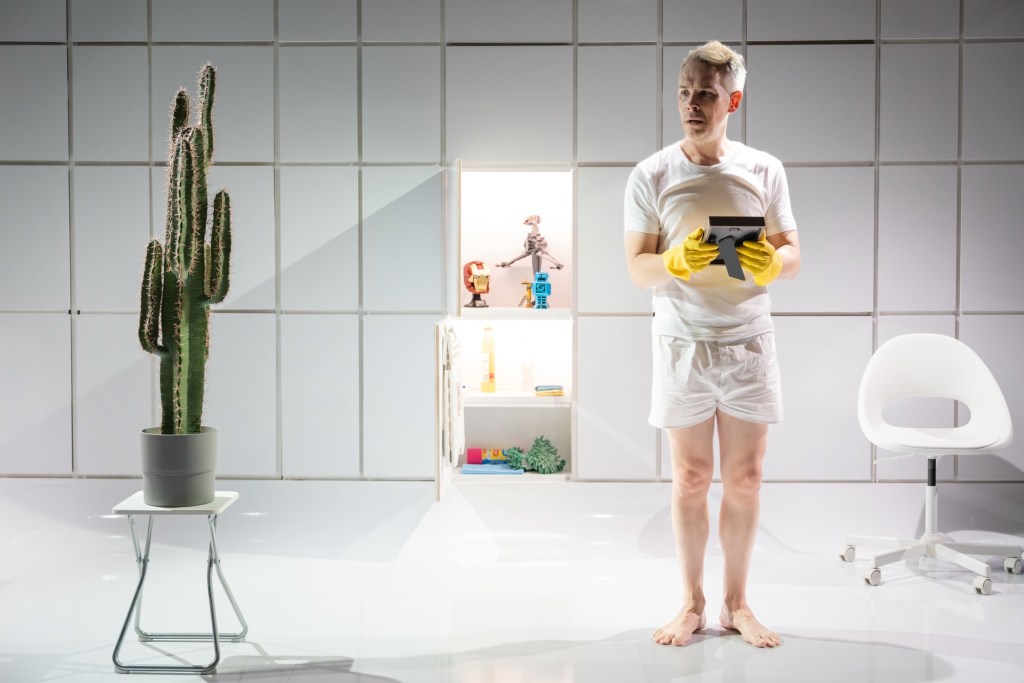
CLIVE
by Michael Wynne
directed by Lucy Bailey
Arcola Theatre, London – until 23 August 2025
running time: 1 hour no interval
https://www.arcolatheatre.com/whats-on/clive/
Mental health, the insidiousness of isolation, and office politics come under the microscope in this engaging monologue. It feels rather like a throwback to the Alun Bennett Talking Heads series of solo plays where a raft of information was telegraphed to the audience over the heads of the principal character doing the talking, and also to Covid times when it felt like the only theatre we were ever going to see was with one person on stage.
Clive is the name of the giant cactus that lonely Thomas shares a living space with, and to whom he confesses, complains and generally offloads, as he carries out his mundane office job working from home, in a flat he hasn’t left for more than two years. Paul Keating, in an exquisitely detailed performance, invests this likeable oddball with a cosy charm and mirthless jollity through which shards of absolute desolation occasionally pierce. When he gets angry, it’s unsettling but entirely plausible, the inevitable consequences of a desperation borne of always trying to do the right thing by other people but then getting shafted by life anyway.
Michael Wynne’s script is a great showcase for Keating, whether it’s wryly relating stories from when he used to work in an office, wistfully recalling a lost love, conveying the absolute shock of somebody facing accusations they had no idea were coming, or demonstrating the old adage of “dance like nobody’s watching”. He’s delightful yet strangely tragic as he observes, from his window, other people going about their lives while he remains indoors, either glued to his laptop, obsessively cleaning, or talking to a cactus. The performance is more accomplished than the writing which, though often witty and delicately but cleverly structured as a piece of storytelling, is pretty pedestrian.
There are some implausibilities in the telling of how and why Thomas is shaken from his safe but sterile isolated existence, and the final suggestion that he needs to get out more is hardly revelatory. Despite the brilliance of Keating’s delivery, I didn’t fully buy that an act of kindness could be so grossly misinterpreted leading to an implosion of Thomas’s limited world, although the systematic destruction of the titular Clive is a striking metaphor for that. The play is at its most interesting in its exploration of the dynamics of an “office” where the workers never see each other in person, and how extreme loneliness can take a dire toll on an individual’s mental health.
Lucy Bailey directs Keating with a subtle flair. They previously collaborated at this venue on Mike Poulton’s wrenching Rattigan spin-off Kenny Morgan, one of the theatrical highlights of 2016. That was a masterpiece and while Clive isn’t in the same league there is still something thrilling about watching world class talents lavish their efforts on a minor key work. Mike Britton’s brutally neat, almost clinical, set design contrasts nicely with the surprisingly extravagant lighting and sound contributions of Chris Davey and Nick Powell respectively.
Wynne ends the play on a welcome note of hope, and even if ultimately this is pretty small beer as a whole night in the theatre (in years gone by, this would probably have been half of a double bill) the craft, intelligence and talent involved still make it a worthwhile watch.
 ajhlovestheatre
Leave a comment