EVITA
Music by Andrew Lloyd Webber
Lyrics by Tim Rice
directed by Jamie Lloyd for the Jamie Lloyd Company
The London Palladium, London – until 6 September 2025
running time: 2 hours 20 minutes including interval
https://www.evitathemusical.com
Who would have thought that the most dynamic show in town would be a (nearly) half century old musical about an Argentine dictator’s wife who died over 70 years ago? Yet here we are. Master conceptualiser/enfant terrible director Jamie Lloyd revitalised and transformed Sunset Boulevard (still packing them in for a couple more weeks in NYC starring the now Tony-winning Nicole Scherzinger) and now works similar magic on Andrew Lloyd Webber and Tim Rice’s Evita.
An earlier edition of Lloyd’s take on this pop opera about Eva Perón was seen at Regents Park Open Air Theatre in 2019, with the same production team but different cast, and while there are cosmetic similarities between the two versions, this new one has been so significantly upgraded on every level as to feel like an entirely new show (the pandemic put paid to plans for a return season at the Barbican, as the Tim Sheader Jesus Christ Superstar had previously done). So, will this follow a similar trajectory to Sunset and end up on Broadway? It’s hard to imagine that preliminary planning hasn’t already started, given the mostly ecstatic word-of-mouth, media attention (more of that in a bit) and skyrocketing ticket sales during Palladium previews. The rollicking combination of extreme lights, sound, high octane choreography and diva worship is probably as well suited to Madison Square Garden as to a regular Broadway house.
Whatever happens, this Evita will surely launch American screen star Rachel Zegler on a similar stage career to that of Scherzinger: it’s a stupendous West End debut, and one that redefines an iconic role in the musical theatre canon. Tiny of frame and mighty of voice, Zegler makes no attempt to ingratiate Eva (Evita – “little Eva” – is an endearment favoured by Perón’s working class supporters) to us, instead offering a rock hard, unscrupulous manipulator who uses her charm and sexuality to rise up the greasy pole of Argentine society, from an impoverished backwoods pueblo to the Casa Rosada, Buenos Aires’s presidential palace.
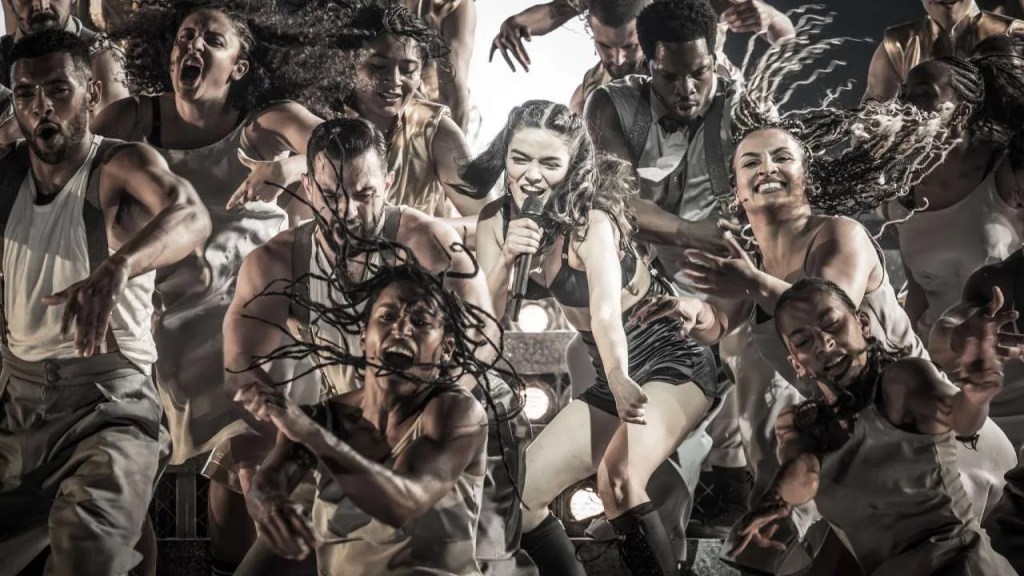
Clad for most of the show in a bra top and shorts (anybody who saw the Regents Park Evita will remember that period trappings of the early to mid twentieth century when the Perons were in power are almost entirely eschewed), she’s like a pop megastar at the height of her fame, a diminutive diva with killer dance moves, a voice that can turn on a dime from seductive soprano to fearless high belt, and a lethal ambition that can, and will, steamroller anything on her path to glory. Zegler takes on the often very challenging music as though going into battle….and wins, every time. There’s fierce intelligence too in the way she bites into Tim Rice’s witty, cynical lyrics.
If the concept doesn’t allow for much in the way of nuanced acting, the ‘Don’t Cry For Me Argentina’ sequence which controversially has Zegler performing the famed song on the exterior balcony of the theatre to crowds outside while the paying audience watches her on screen, shows us in dream-like, glowing close-up, Eva’s magnetism as a political speechifier and the cynical way she controls the throng. Technically, it’s breathtaking, but it has rubbed some people up the wrong way given how well known the number is; it’s a brilliant idea though, making a free event happen outside the venue every night for “regular” people while those who can afford tickets are inside watching our leading lady by live relay, which, as a metaphor for why and how the real Eva Perón was such a divisive figure, is about as on-the-nose as you can get. Personally, I thought it was magical from inside the auditorium, and even more effective than Tom Francis’s street walkabout to the title song of Sunset Boulevard. Zegler’s wily, impassioned performance of the beloved aria, dressed as the iconic blonde, ball-gowned Eva to suggest this is the public facade as opposed to the much less serene, more sinister face we are encountering behind closed doors, is one of the finest I’ve ever experienced.
Another American import with charisma to match Zegler’s is Diego Andres Rodriguez as an unusually energetic, youthful Che, the increasingly disenchanted narrator and lynchpin of the piece. Rodriguez has a warm, powerful voice and an appealing vulnerability that reads affectingly against Zegler’s granite princess. There are suggestions in the staging that the two characters serve as alter egos to each other, and they have considerably more chemistry than there is between Eva and Perón himself (a chiseled, unknowable James Olivas, excellent). I rather think that’s the point though – Eva’s relationship with Juan Perón is transactional, a power grab, while Che is nearer to Eva’s actual soul as a working class Latina, but represents a side of her she actively quashes in her quest for advancement.
Lloyd’s vision for Evita has similarities with the Harold Prince original, in that it is as much about the corrosive power of celebrity as it is a biographical study of real historical figures, and is similarly stripped back (Soutra Gilmour’s set is just gargantuan bleachers, some screens and the shows title in giant, moveable letters). Evita geeks will enjoy the homages to that first production, not just in the deployment in unexpected places of the signature look of blonde hair swept back into a bun atop jewels and a diamanté encrusted white ballgown, but also the sight of Eva’s heavies stripping aristocrats from their finery down to the street clothes of the poverty stricken, or Eva literally walking over the backs of the ensemble to traverse the stage.
Unlike the 2006 Michael Grandage revival, which was sumptuously realistic and softened Elena Roger’s Eva to the extent that ‘You Must Love Me’ (a lovely song created for Madonna in the film but strangely at odds with the rest of the stage score, where it’s now apparently obligatory) didn’t stick out like a sore thumb, this Evita makes no attempt to turn the show into a traditional musical. It happily owns its origins as a concept album, and also, for the first time, turns it into a dance show.
Fabian Aloise’s choreography, already marvellous in 2019 but further developed now, is everywhere, and it’s stunning. Although the moves have much in common with what you’d expect to see in a Beyoncé or Gaga concert (the indefatigable ensemble are fit in every sense of the word), the dance here is not merely decorative: it tells story, cuts emotional corners, conveys jubilation and distress. Rows of bodies undulate like an organic whole, while individual figures jackknife and hurtle through the air. It’s full throttle and fabulous.
Some of the stage pictures here will stay indelibly etched in the memory, but perhaps none more so than the act one finale ‘A New Argentina’ which sees the white and blue of the Argentine flag (a persistent motif) rain in torrents all over the Palladium auditorium in a recurring avalanche of streamers and confetti, amid a choral and orchestral wall of sound that is at once exhilarating and unsettling. It’s legitimately one of the most extraordinary things I’ve ever seen in a theatre. Adam Fisher’s thunderous sound design and Jon Clark’s razor-sharp, retina-bruising lighting are further essential components in a whole where clarity of storytelling is often sacrificed to style and bombast, but where you may be too busy picking your jaw up off the floor to notice.
If the Regents Park version felt like an outdoor political rally, the Palladium edition is an arena tour, with extra menace. That’s one thing this team has restored to Evita… a sense of real danger, a component conspicuously missing in Grandage’s bland but gorgeous vision, and the long running Kenwright tour that borrowed ideas from both earlier productions but just came off as derivative and cheap. Lloyd and gang give us a world where anything, however outlandish or plain nasty, can happen. The threat was there all along in Lloyd Webber’s music, in the potent downbeats of the ‘Buenos Aires’ number shot through with discordant, acidic brass, or the foreboding minor notes that cast a chill over the ‘I’d Be Surprisingly Good For You’ seduction song that later reoccur when Eva is dying. This is some of Lloyd Webber and Rice’s best work, a lyrical, often enthralling, sometimes downright eccentric score that still sounds original and distinctive to this day. Musical supervisor and director Alan Williams, also responsible for how wonderful Sunset Boulevard sounded, has contributed invaluably once again: musically, the show is simultaneously clear but overwhelming, as it should be, the magnificent nineteen piece orchestra occasionally, tantalisingly glimpsed through the golden light and haze at the back of the stage.
“All I want is a whole lot of excess” sings Eva on arrival in the big city. This production gives us that, but also a stark simplicity at moments which throws the visual and aural extravagance into profound relief. Not everyone will embrace Lloyd’s singular vision, but if you’re prepared to strap in for the crazy ride and you’re not too hung up on storytelling, this is a sizzling, sexy, transfixing couple of hours of music theatre, enriched by a powerhouse central pairing and a sensational, high energy ensemble. Eva also refers to herself in Rice’s lyrics as having “just a little touch of star quality”; when Rachel Zegler’s in the driving seat, you get a hell of a lot more than that. I’ve already booked to go again.
 ajhlovestheatre
Leave a comment