JUST FOR ONE DAY
The Live Aid Musical
written by John O’Farrell
directed by Luke Sheppard
Shaftesbury Theatre, London – until 10 January 2026
running time: 2 hours 30 minutes including interval
A popular success at The Old Vic last year, this Live Aid-inspired musical gets its belated West End transfer following a Toronto season, arriving at the Shaftesbury in a streamlined, mostly recast but still impassioned, roof-raising version. Luke Sheppard’s production, fast-moving and episodic, using spectacle with potent economy, remains catnip to audience members old enough to remember where they were when Sir Bob Geldof engineered his era-defining mega-concert simultaneously on both sides of the Atlantic to raise funds for the devastating Ethiopian famine.
It’ll also appeal to anybody who thinks the 1980s was the decade where rock and pop were at their pinnacle (it was). The music and the message are all, and from that point of view Just For One Day is an absolute triumph. The euphoria of the music is occasionally stymied by John O’Farrell’s earnest book which, while slightly shorter than in the original iteration, still can’t decide if it’s satire, polemic, or history lesson.
The story of Bob Geldof (an almost uncanny Craige Els) being so moved by TV footage of the famine victims that he sets up first the Band Aid single ‘Do They Know It’s Christmas’ before the full-blown Live Aid benefit, is framed by a mother-daughter relationship where Melissa Jacques’s Suzanne who was AT the concert in 1985 is sending her socially conscious daughter Jemma (Fayth Ifil in a striking debut) off to Uni. We also get younger Suzanne in flashback (Hope Kenna, like Els, another holdover from the original Old Vic staging) enjoying her first ‘summer of love’ with a chap she works in a record shop with. The parallels between youthful Suzanne and her feisty daughter are pretty obvious but muddled by a contrived connection between Jemma and a Red Cross aid worker (Rhianne-Louise McCaulsky in gorgeous voice) who was on the ground in Ethiopia in the ‘80s while acting as a sort of voice of conscience to the increasingly tormented Geldof.
The writing is pretty pedestrian, although there is a brutal, deeply moving monologue for Geldof where he cradles a starving child, that cuts, shockingly and urgently, through the extraneous pap. Els delivers it magnificently, and it emotionally anchors the first half, and inevitably prompts uncomfortable parallels with images of children coming out of Gaza right now. A jokey, Music Hall-esque Maggie Thatcher sits strangely alongside the serious stuff.
Act two is generally more successful as we get into the concert proper, the music and performances ascending into the stratosphere. Arranger and orchestrator Matthew Brind has done an astounding job of giving vital theatrical life to classic tunes by icons such as Queen, David Bowie Phil Collins, Madonna, Status Quo, the list goes on and on. Gareth Owen’s all-encompassing sound design, the most impressive I’ve experienced in a theatre since Broadway’s Hells Kitchen which was also Owen’s work, is wholly thrilling, creating thunderous sonic soundscapes that overwhelm but with clarity: you feel this music in your bones. Every harmony and lyric is heard, and the voices are sublime.
O’Farrell’s book raises its game considerably in act two as it charts, with thriller-like urgency, the logistical challenges Geldof and his promoter Harvey Goldsmith (Tim Mahendran, brash and fabulous) were up against to make Live Aid happen simultaneously at Wembley and in Philadelphia. The sense of relief and triumph by the end is hard won and emotionally satisfying.
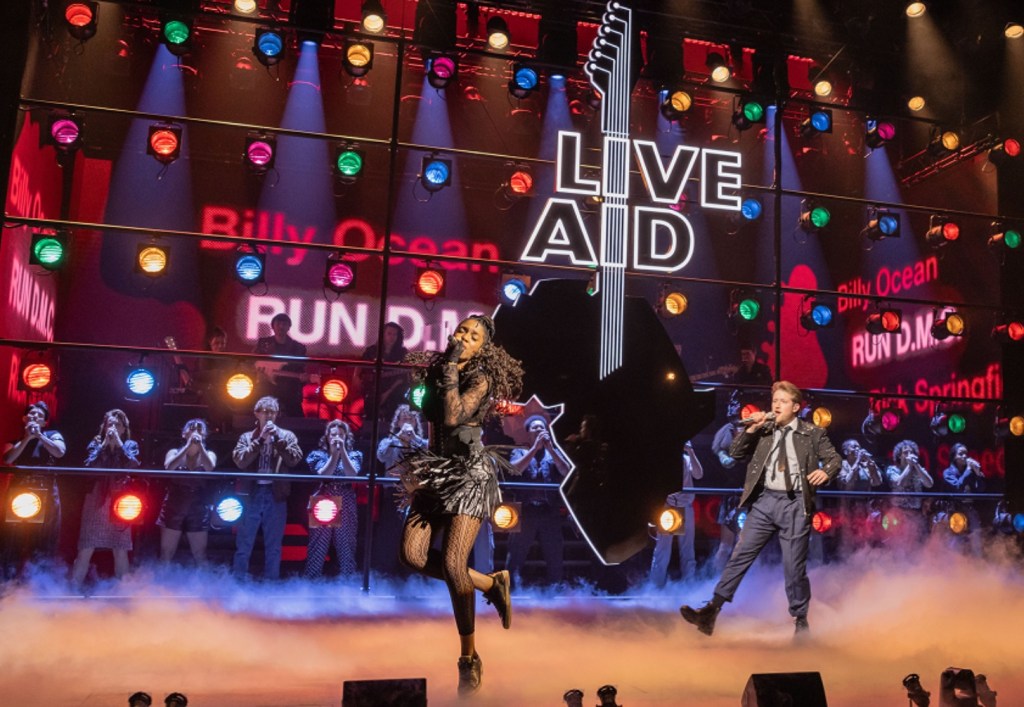
Els is superb but much of the rest of the acting feels blander and broader than in the first cast. George Ure is a terrific addition though as a spiky, witty Midge Ure (no relation), Geldof’s collaborator in setting up Band Aid and Live Aid, and does cracking, power-packed versions of Ultravox hits ‘Vienna’ and ‘Dancing With Tears In My Eyes’. Elsewhere the concert performances convey the essences of the original artists rather than slavishly impersonating them, which usefully stops the show sliding into one long tribute act. Probably the most successful is Freddie Love’s sizzling Mercury-adjacent take on ‘Bohemian Rhapsody’ but really everyone is excellent, and Patrick Hurley’s onstage band is the real rocking deal.
Howard Hudson’s stadium-style lighting and Andrzej Goulding’s video design, both dazzling, add to the impression of this being a special event. Personally I could have done without some of Ebony Molina’s choreography – songs this good don’t always need such embellishment – but at its best it finds a wild, elemental dynamism.
Just For One Day ultimately stands as a testament to the fact that when people pull together they can achieve astonishing things, even as it’s depressing to note that the world we live in now is probably even more screwed up and dangerous than the one Geldof, Ure et al were fighting to transform forty years ago. It’s a flawed musical but as a celebration of humanity and truly great rock and pop, it’s a sensation, and a show that, when it seeks to lift off the ground, truly soars. Not only is it a smashing night out, a percentage of ticket sales goes to the Live Aid foundation.
 ajhlovestheatre
Leave a comment