FIDDLER ON THE ROOF
Book by Joseph Stein
Lyrics by Sheldon Harnick
Music by Jerry Bock
Based on the stories of Sholem Aleichem
directed by Jordan Fein
Barbican Theatre, London – until 19 July 2025 then touring
running time: 2 hours 45 minutes including interval
https://fiddlerontheroofuk.com
“An eye for an eye, and a tooth for a tooth.”
“Very good. That way the whole world will be blind and toothless.”
….wise words, and amazing how a sixty year old musical, in this case the Broadway classic Fiddler On The Roof, can feel so relevant across the decades.
There are certain vintage tuners that, however well-crafted and admirable, I don’t really need to see another production of, but that’ll never be the case with Bock, Harnick and Stein’s exhilarating, sorrowful and sweet masterpiece. This Fiddler has now acquired an actual roof in the move from Regents Park to the Barbican but also an intensity and focus, plus a heightened sense of the drama and the comedy, that makes another visit mandatory.
It’s impossible in the present climate to watch the violent attack ruining the joyful wedding that closes act one and not equate it with the racist thuggery that periodically rears its ugly head across the so-called civilised world, in the same way that the statement in the script that “horrible things are happening in the world” chillingly foreshadows present times. Fiddler retains its power because it can encompass horrors yet still find the joy in being alive. The show as a whole is a paean to humanity, to faith, and to survival, or as one of the uplifting numbers has it, “L’Chaim” (“To life”).
Sadly, this tale of a rural Jewish peasant settlement in early 20th century Imperial Russia having to uproot and flee due to pogroms and anti-Semitic prejudice, feels even more relevant now than it did then. Joseph Stein’s book, based on a selection of short stories by Sholem Aleichem and centering on devout milkman Tevye, his opinionated wife Golde and their five unmarried daughters, is an engaging mix of Borscht Belt humour, brutal realities and unabashed feeling. Toughness and sentimentality co-habit in this depiction of the hardscrabble, make-do-and-mend lives of these people offset by a wonderful generosity of spirit.
Bock and Harnick’s score, the music owing more to Klezmer than the traditional brassiness of Broadway, thrills the blood. Beloved numbers such as ‘If I Were A Rich Man’ and the rousing chorale ‘Tradition’ get right under your skin. Expect a quickened pulse and wet eyes. We no longer get the magic of the real sun setting during ‘Sunrise, Sunset’ as we did in the Park but we gain way more than we’ve lost.
Director Jordan Fein creates a staging that, almost miraculously, manages to have its cake and eat it, leaving traditionalists happily tear-stained while simultaneously providing plenty of fresh insights for those seeking a little more edge and depth. It was a sensation last summer in the open air, but now it feels somehow tenser, more urgent.
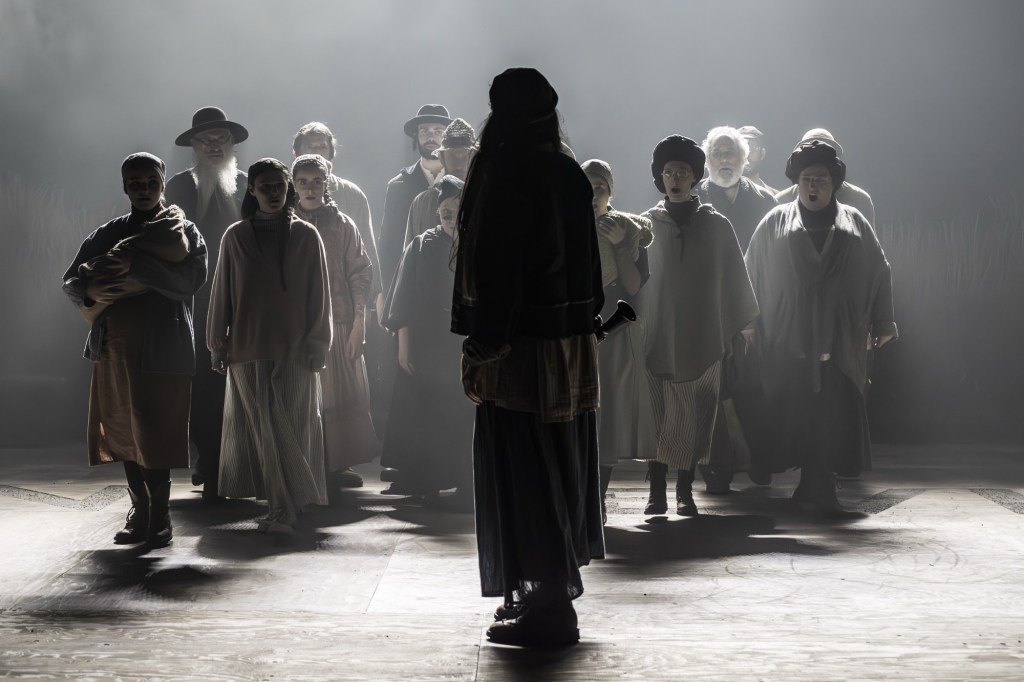
Fein has some bracingly original thoughts about this beloved piece, such as having the villagers sitting around bearing witness to even the most intimate family scenes, like a Jewish Greek chorus, or leaning more than usual into the concept that the eponymous fiddle-player (a virtuosic, thrillingly physical Raphael Papo) is an alter ego to Tevye. That said, he doesn’t go as far as the modern framing device Bartlett Sher used in the last Broadway revival (the show opened and closed with Danny Burstein’s Tevye in contemporary dress, clutching a book about historical Anatevka).
The women possess more agency though, and it’s a stroke of genius having oldest daughter Tzeitel play both her deceased grandmother and vengeful ghost Fruma Sarah in the fantastical dream section (impressively staged and lit by Julia Cheng and Aideen Malone respectively) whereby Tevye convinces his wife that the lucrative match between their first born and the older local butcher, is a terrible idea. There’s no attempt to adopt Yiddish or faux-Russian vocal inflections: everybody speaks in their own accent. This is a production full of glorious things.
Broadway actor Adam Dannheisser was a hugely engaging, affecting Tevye last year but his portrayal feels deeper and richer now. He still projects a magnetic combination of warmth and virility, plus a terrific singing voice. This dairyman is garrulous, sometimes irascible, a family man torn, between his love for his wife and daughters, and his strict obeisance to god, but the comic highs and tragic lows seem more pronounced now. His grief and anguish at rejecting his middle daughter Chava (a desperately moving yet entirely unsentimental Hannah Bristow) is so raw as to be almost unbearable to watch.
Lara Pulver brings gentle authority, an austere elegance and expressive, beautiful singing voice to Golde, while the casting of the three eldest daughters is perfection. Natasha Jules Bernard is steelier but no less likeable than her predecessor as Tzeitel, the harder edge giving an extra layer of plausibility to her union with the meek tailor Motel, whom Dan Wolff invests with a lovely plausibility, and makes her breakdown at the prospect of a lifetime with the entirely unsuitable butcher Lazar Wolfe (Michael S Siegel, excellent) all the more distressing. Georgia Bruce is all matter-of-fact charm and palpable melancholy as Hodel, and a mesmerising Hannah Bristow finds extraordinary inner life in bookish Chava. The much-loved ‘Matchmaker, Matchmaker’ is gorgeously sung but also etched in a real darkness and dread that may surprise some as the tragedy of having lives decided and mapped out for them is realised by these brilliant young women.
More conventional is Beverley Klein’s gossipy, overdramatic matchmaker, an irresistibly funny creation. Daniel Krikler makes something unique, passionate but haunting out of Perchik, the young revolutionary for whom second daughter Hodel (Bruce, delivering a lamenting ‘Far From The Home I Love’ that sounds like it’s being ripped from her very soul) leaves the village for the frozen wilds of Siberia. The glorious, character-filled ensemble create an entirely credible community on stage, and the choral singing is flat-out wonderful.
Tom Scutt’s split level set of corn field and wood, suggestive of both shelter and oppression, has transferred superbly indoors. Simultaneously evoking a giant book prised apart (perhaps a nod to the short stories upon which the show is based) with the word ‘Anatevka’ etched on the pages, and the rural harvests that sustains the population, it now partially descends to create a wedding canopy. Cheng’s wild, loose-limbed yet earthy choreography, frantic, celebratory and sometimes dangerous, is better than ever, as is Malone’s vivid, mood-changing lighting. The sound design by Nick Lidster is crystal clear, a significant upgrade from the outdoor acoustics of Regents Park, giving full rein to the lyricism and the acid of Larry Blank’s orchestrations, superbly played by Dan Turek’s onstage band, and ensuring that we get every lyric and delicate harmony. Fein’s direction is nimble and brilliant, many of the stage pictures lingering long in the memory after the performance is over.
You emerge from this revitalised Fiddler with a renewed sense of wonder at how Fein and his marvellous team have honoured what is already there while finding new colours, some subtle, some bold. The show succeeds in changing with the times in a way its hero struggles to do, and as long as some humans feel that they can beat down on people who think or believe differently from them, this story needs to be told. Essential, enthralling theatre, and a production for the ages.
 ajhlovestheatre
Leave a comment