AFTER THE ACT
by Billy Barrett and Ellice Stevens
music by Frew
directed by Billy Barrett
Royal Court Theatre, London – until 14 June 2025
running time: 2 hours including interval
https://royalcourttheatre.com/whats-on/after-the-act/
Billy Barrett and Ellice Stevens’s show, revised from its original 2023 outing (no pun intended) at the New Diorama, at the Royal Court briefly following a national tour, feels like a throwback in more ways than one. Not just to the later years of the twentieth century and the grim (for many gay people) two decades that followed the passing of the Conservatives’s controversial Section 28 banning the “promotion” of anything to do with homosexuality, but also to the agitprop political theatre of Joan Littlewood and the issue-driven work of companies like Gay Sweatshop and Monstrous Regiment.
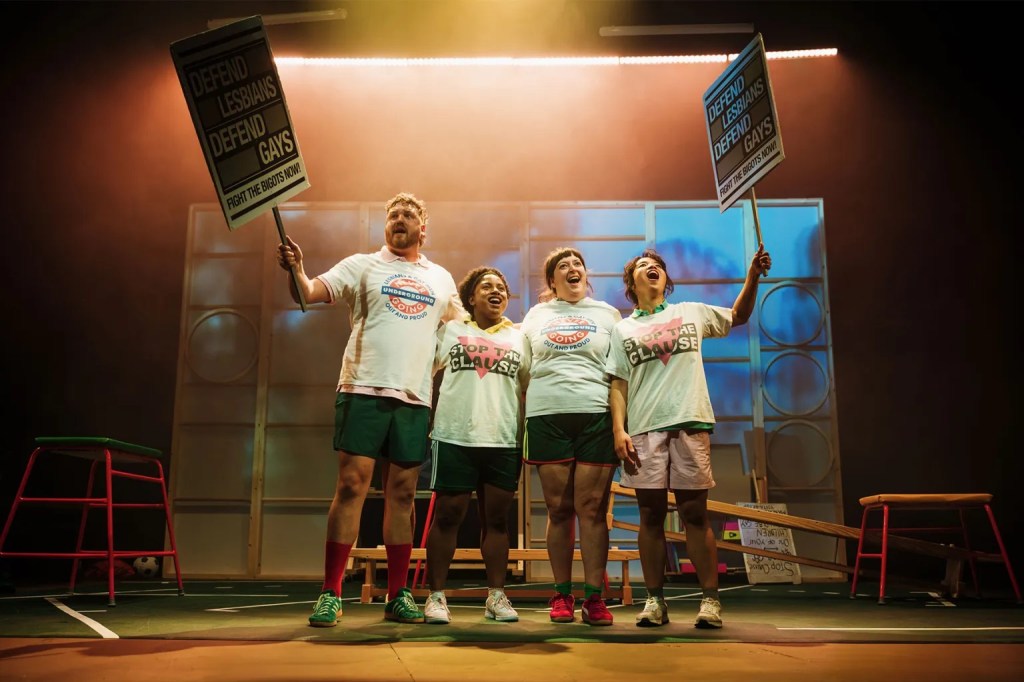
Described as a musical, After The Act is really more of a collage of verbatim accounts of effects and experiences triggered by the infamous bill and recreations of public figures of the time (look out for the disco Maggie Thatcher, and a re-enactment of the lesbian activists storming the BBC newsroom while Sue Lawley struggled valiantly to continue broadcasting). Barrett’s production for Breach Theatre features a cast of four, including co-creator Stevens who has a wonderful gift for deadpan comedy and finding the emotional truth in her various monologues, and has a deliberately makeshift, almost improvisational, tone and look.
Bethany Wells’s set, with it’s gym climbing frame, neon-lit vaulting tables, and school-style benches, adds to the overall feel of a Theatre-in-Education retelling of this lamentable slice of queer history. So does the performing style which has a chummy broadness for much of the show. None of this feels inappropriate actually, given how ignorant some young gay people seem to be about the struggles of their antecedents (I’ll always remember how mind-blown several youthful members of the community were when It’s A Sin first hit our TV screens), and After The Act often compensates in energy and interest what it lacks in finesse.
In all honesty, a production this rough around the edges sometimes looks a little odd in a pros arch theatre, even one as determinedly egalitarian as the Royal Court. The singing is cacophonous and enthusiastic rather than accurate, similarly the execution of Sung-Im Her’s overused choreography. That said, the show is dealing with a messy tranche of recent history, a time where queer people had to fight hard and shout loud to be heard, so the general approach does work. We are left in no doubt as to how much was at stake and also the very real human cost of such unfeeling, wrongheaded homophobic legislation, and the weaponisation of the AIDS crisis, despite the script often being hysterically, camply funny.
Frew’s synth-heavy music, by turns thrashy or haunting and portentous, occasionally pretty rousing, does a wonderful job of evoking the late 1980s/early 1990s. If there are no memorable tunes as such, it still feels like an accurate aural depiction of the era when Pet Shop Boys, Erasure, New Order et al were in their heyday. Barrett and Stevens mash up testimonials, some heartbreaking and others comical, with depictions of mass demonstrations (quite an achievement with a cast of four, but we get the gist) and scenes from House of Commons debates that look jawdroppingly archaic viewed through a 2025 lens.
The most interesting sections, and the ones with probably the most emotional resonance, come after the interval. Zachary Willis and Nkara Stephenson are deeply moving as fragile youngsters blighted by the ramifications of clause 28, Willis also excels as a youthful demo participant at the epic event in Manchester’s Albert Square, suddenly, joyfully aware this is the largest concentration of gays he’s ever encountered in his young life (“there are so many people here that I could potentially have sex with”).
Stevens is lowkey devastating as a P.E. teacher who spots one of her students in a gay bar at the height of the madness but later deals with the situation in a less than admirable way. These individual speeches have such power that it’s a shame the staging doesn’t always let the words carry their full weight, instead having the rest of the cast perform infuriatingly distracting slo-mo P.E.-type moves while the main actor speaks. While it’s fun to have the versatile Ericka Posadas abseiling down the length of the proscenium in tribute to the women who infiltrated Parliament, some bits of the production would benefit from being a little less busy.
Reservations aside, After The Act is an impressive achievement, taking something dark and cruel, and turning it into a piece of theatre that educates, delights and vitalises. It’s scrappy and stroppy for sure, but for all the paraphernalia and camp, it never trivialises the struggle of the gay rights movement and its allies, and it’s pretty powerful when it needs to. Perhaps most telling is a moment near the end where Stevens’s teacher Catherine points out “I absolutely think this era that we are in now is really the Section 28 of the trans community”….now that is a real gut punch.
 ajhlovestheatre
Leave a comment