THE DEEP BLUE SEA
by Terence Rattigan
directed by Lindsay Posner
Theatre Royal Haymarket, London – until 21 June 2025
running time: 2 hours 30 minutes including interval
https://trh.co.uk/whatson/the-deep-blue-sea/
Terence Rattigan had been in the theatrical wilderness for decades when Czech director Karel Reisz staged a coruscating production of his 1952 The Deep Blue Sea at the Almeida starring Penelope Wilton. The year was 1993 and Wilton was a revelation as Hester Collyer, the middle aged, upper class woman who threw away a privileged life as a judge’s wife for the thrill of a liaison with a former RAF pilot years her junior. But then so was the whole production, unlocking the deep wells of emotion and despair underneath the civilised elegance of the language and igniting a fresh new appraisal of Rattigan’s body of work.
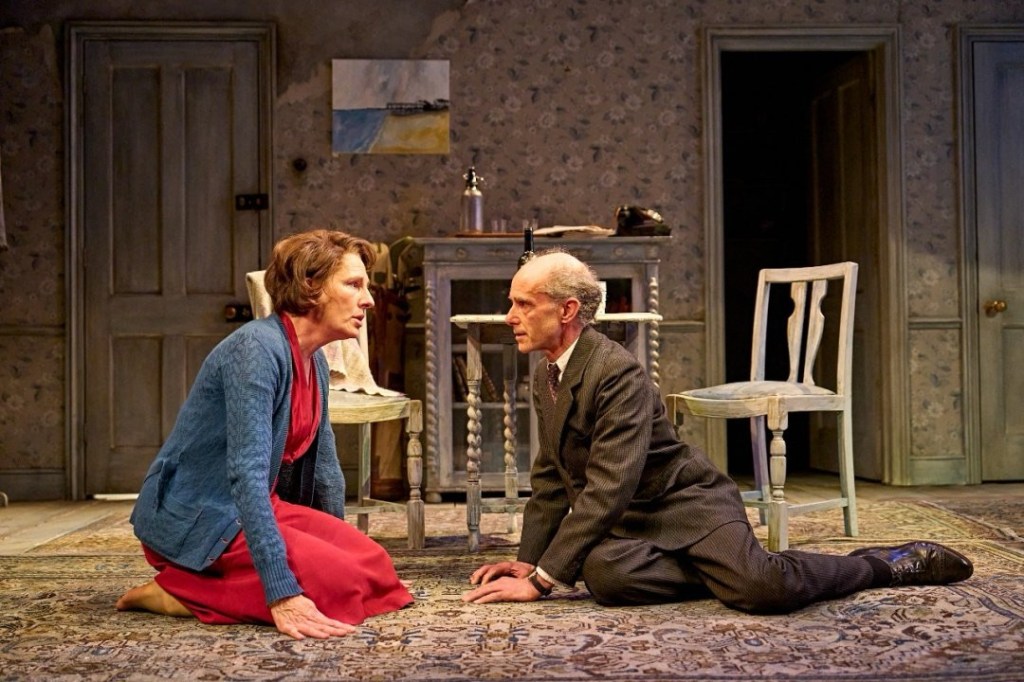
If Lindsay Posner’s Theatre Royal Bath production, first seen last year and now in London for a limited season at the Haymarket, feels less astonishing than that earlier reinvention, it’s still, on closer inspection, subversive in its own way. From the moment the curtain first rises on Peter McKintosh’s drab, detailed bedsit – all mismatched furniture, peeling wallpaper and hideous drapes, the kind of room where hope goes to die – it’s clear this is at least going to look like a conventional Deep Blue Sea.
Cleaving nearer to the original spirit of the text than the expressionistic, expansive Carrie Cracknell revival for the National in 2016 which featured the late, great Helen McCrory as a sex pot, drama queen Hester, it’s clear that Posner trusts the play. So he should, as it’s an out-and-out masterpiece, but he still manages to cast some fascinating new lights onto it.
For starters, Freddie Page, the test pilot for whom Hester abandoned her life of privilege and comfort, frequently played as a sort of youthful homme fatal, is significantly older than usual. Hadley Fraser, who previously played the role opposite Nancy Carroll nearly a decade ago in Chichester, is certainly attractive and, when required, charming, but his maturity also lends a chilling edge to Freddie’s less sensitive treatment of Hester: casual carelessness becomes cruelty, and it feels all the more shocking. Similarly, the character’s excessive drinking, if not excused at least explained by the man’s youth in more conventional readings, seems more nihilistic, more hell bent on oblivion when Freddie is older. It also makes the dynamic between him and Hester, where she at times seems more mother figure than lover, all the more twisted. Fraser pierces through to the self-hatred at the core of this handsome loser more than any other actor I’ve seen in the role.
Tamsin Greig delivers a richly textured, multi-layered Hester Collyer. Every inch the vicar’s daughter who became a perfect society cohort, she’s a people pleaser who appals even herself when she gives full rein to desires and urges she’s kept locked away. She finds great power in stillness, but also lets us see Hester thinking on her feet as she manoeuvres an increasingly tortuous emotional life with a combination of manipulation, stealth and sheer desperation.
Greig uses several voices, all connected: there’s the mellifluous, cello-like sound of an urbane woman at home with small talk and dinner parties, and able to deal maturely and squarely with her lovelorn, needy QC husband (a beautiful performance by Nicholas Farrell). Then there’s the slightly infantilised ‘little girl’ voice Hester has probably employed as a palliative and a buffer since youth, and, finally, when the stakes get really high, and control and composure have slipped away, a banshee-like screech that denotes a woman at the very edge of reason, which is truly horrible to hear. It’s a riveting account of the role, in charge but generous to the other actors, full of subtle details and unexpected choices, reconfirming Greig as one of this country’s greatest working actresses.
The first half runs acts one and two together which makes it punishingly long, despite the quality of the production and performances. The second half is utterly compelling though. Greig finds a heroic, classical intensity and strength in Hester’s final dealings with the feckless Freddie and is almost unbearably moving as she resolves, at the urging of Finbar Lynch’s unflinching, brilliant struck-off Doctor, to turn her back on her suicidal urges and live without any hope but also “without despair”. Lynch is quietly astounding: dry as dust but full of kindness and a rich inner life.
Selina Cadell finds impressive colours and nuances in the cheerfully gossipy landlady, a role that in lesser hands can easily slip into standardised ‘Cockney char’ territory. There’s lovely, period-authentic work from Preston Nyman and Lisa Ambalavanar as the younger couple residing in the boarding house and who become inadvertently drawn into Hester and Freddie’s drama. Often played either too clipped or too hearty, these two get it just right, she betraying a surprising fragility as she confides in Hester that she cannot bear to be left alone, and he demonstrating a pretty shoddy attitude to women as he confesses to an affair.
Powerful as this revival is, there are moments where one can’t help but wonder how much more potently it must have played in Bath’s Ustinov Studio, where it originated. The ornate, chocolate box-y Haymarket inevitably keeps us at a slight remove, despite the vividness and authority of the performances. Where this production excels is in creating a world where ‘stiff upper lip’ behaving well is the norm, and so when the raw, anguished pain breaks through, it’s all the more shocking and devastating, like a cluster bomb of mess and shame detonating at high brow tea party. It may be defiantly unfashionable but work of this quality unquestionably ages well.
 ajhlovestheatre
Leave a comment