JOHN PROCTOR IS THE VILLAIN
by Kimberly Belflower
directed by Danya Taymor
Booth Theatre, New York City – until 7 September 2025
running time: 1 hour 40 minutes, no interval
https://johnproctoristhevillain.com
Rising star director Danya Taymor seems to be cornering the Broadway market when it comes to staging teenage angst and trauma. Hot on the heels of, and just along the street from, her Tony award-winning work on the thrilling Outsiders musical, she’s now directing the New York premiere of Kimberly Belflower’s 2022 response to Arthur Miller’s seminal witch hunt drama The Crucible. At first look, there’s a world of difference between the sweaty, testosterone-fuelled Greasers of late 1960s Tulsa and these vulnerable, funny, sometimes hysterical young women in a 2018 rural Georgia high school, trying to make sense of their increasingly maturing bodies, their relationships with the often less than admirable men they’re in contact with, and ultimately with Miller’s thorny text. But both productions have a bold theatrical flair and demonstrate a deep affection for, and understanding of, the troubled youngsters at their core.
Having a working knowledge of The Crucible isn’t essential to enjoy John Proctor Is The Villain – Belflower’s script is so punchy and funny, and the characters so vividly drawn and terrifically well acted that it’s impossible not to connect with it – though it would certainly enrich the experience. But it would also underline the differences between Miller’s aims versus those of Belflower: where the former created a thinly veiled allegory of the McCarthy witch hunt trials that scandalised and terrorised 1950s America, the latter’s young women are informed by the #MeToo movement and ignoring their voices is neither right nor fair. This play demands that we listen but is simultaneously a very good time in the theatre.
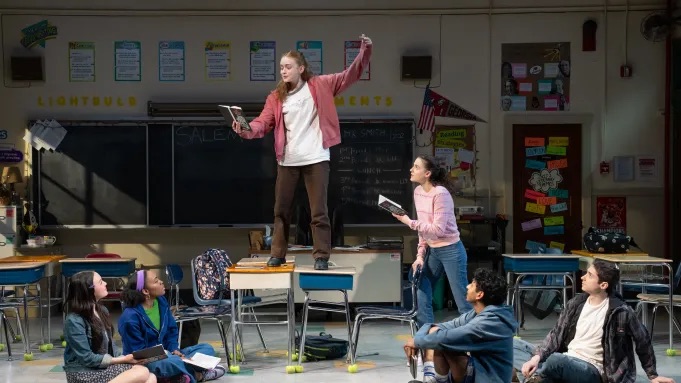
Bellflower, Taymor and a brilliant young cast led by screen star Sadie Sink (although really it’s a true ensemble piece) capture with almost alarming precision the intensity, idealism and the sense of shifting emotions constantly just under the surface of teenagers sometimes disaffected, sometimes belligerent, sometimes eager facades. The relationships between the characters are superbly fleshed out, you really believe that most of these youngsters have grown up together and, crucially, the gaucheness is never over-played.
Neither, when it breaks through, is their rage. Interpretive dance is an understandable bête noir for a lot of people, but it’s employed here (powerful movement direction by Tilly Evans-Krueger) in service of a story of young women whose lives are shattering open, and who can no longer toe the line. Lorde’s cynical but rollicking dance banger ‘Green Light’ has never seemed so potent.
There’s little doubt that Sink’s precocious, slightly unnerving Shelby and Amalia Yoo’s emotionally intense Raelynn whose youthful heart she’s helped to hurt, at least for now, are intended as historical first cousins to Miller’s Abigail, Mary etc. The same goes for their female classmates (Fina Strazza as high achiever Beth, Maggie Kuntz’s delicate Ivy whose father is a long way from the man she needs him to be, and Morgan Scott’s delightfully open newcomer Nell…all played exquisitely) but Belflower’s text is its own vital beast. Molly Griggs delivers first class work as the slightly neurotic student adviser who, as the young women are quick to point out, is only a couple of years older than themselves.
The men are equally impressive. Nihar Duvvuri, endearingly gawky, and a darkly manipulative Hagan Oliveras, play the immature male classmates with edge and detail. Gabriel Ebert is such a fine actor that the rather obvious placing of his hale and hearty, but motivationally questionable, teacher as stand-in for Miller’s Proctor rankles less than it might. There are a couple of moments where Taymor’s production is a little too emphatically on-the-nose, such as when a split second recollection of past abuse for Shelby prompts an ominous sound effect and the hyper-naturalistic classroom set is plunged into momentary gloom (the scenery is by Amp featuring Teresa L Williams, with sound by Palmer Heffernan and lighting by Natasha Katz).
Ultimately though, this is exactly the sort of play that every young man should see as an encouragement to do better, and young women will love as it explores what is and isn’t acceptable, and communicates the power of female unity: it infuses this Broadway season with fresh blood and a jolt of youthful energy. It demands that you listen. Plus, on top of all that, John Proctor Is The Villain is wildly entertaining. Sink’s return to Broadway (she was a replacement Annie in the musical’s last Main Stem run at the Palace) is a triumph, and I would especially love to bring my 15-year-old niece to see it.
 ajhlovestheatre
Leave a comment