MIDNIGHT COWBOY
Book by Bryony Lavery
Music and lyrics by Francis ‘Eg’ White
based on the novel by James Leo Herlihy
Southwark Playhouse – Elephant, London – until 17 May 2025
running time: 2 hours, 30 minutes including interval
https://southwarkplayhouse.co.uk/productions/midnight-cowboy/
If you like your musicals upbeat and life-affirming then this Bryony Lavery-Francis ‘Eg’ White collaboration probably won’t be for you. But then anybody who has seen John Schlesinger’s acclaimed 1969 film version of the James Leo Herlihy novel will know that Midnight Cowboy is a merciless trawl through the seamy underbelly of New York, so it’s hardly feelgood. As a musical, with a plot that’s literally a stream of worst case scenarios unfolding, punctuated by White’s suitably melancholic Cowpunk songs, it makes Rent feel positively cosy. Personally, I mostly loved it, but then I’ve always been a sucker for a dark musical, and this one is pitch black.
It’s not without its faults, but the evocation in Nick Winston’s staging of mid-1960s Manhattan as a dingy hellscape populated with desperate chancers and emotional vampires scuttling like beetles between the dark corners where the neon can’t quite reach, is tremendously powerful and entirely in tune with Herlihy’s bleak original vision. Crucially, Midnight Cowboy never falls into the trap that befell the Arlene Phillips-led Saturday Night Fever whereby the tropes of exhilarating, mass-populist musical theatre were grafted, Frankenstein’s monster-like, onto a fairly brutal tale of social deprivation and the desire to escape dead-end existences. Nope, here the the nihilism and sheer seediness are given full rein and honestly, it’s pretty hard to take at times, but it’s seldom less than engrossing.
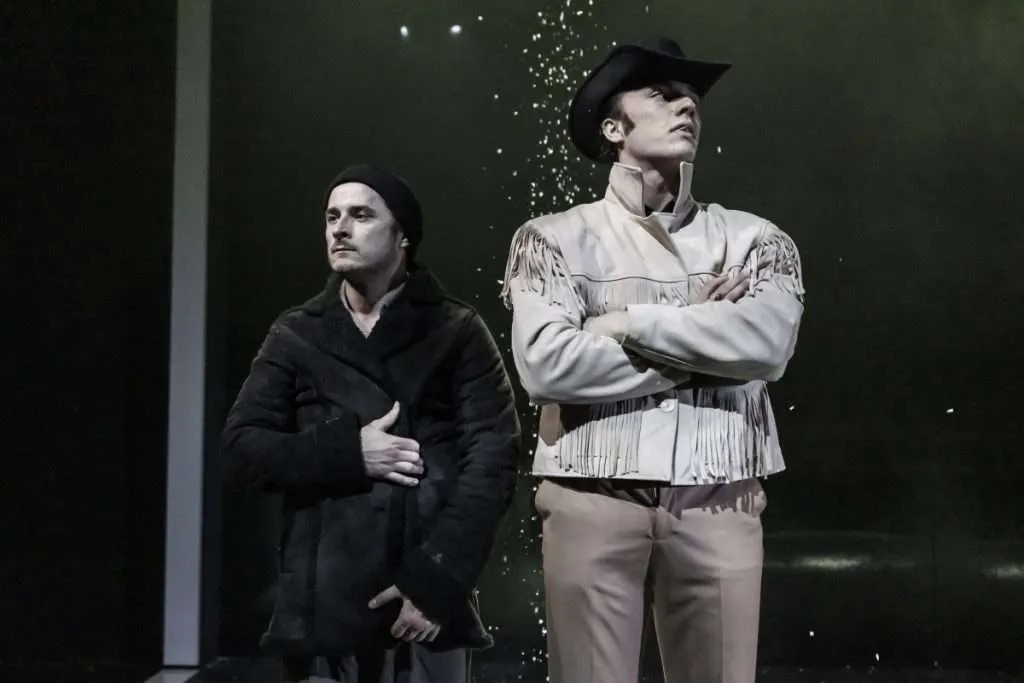
Inheriting Jon Voight’s cowboy boots as deeply damaged country boy-turned-hustler Joe Buck, newly arrived in the big city and aiming to monetise his potent sexuality and increasingly shopworn charm, is Paul Jacob French. It’s a difficult role – much of Joe’s behaviour is appalling but the naivety and even kindness beneath the disaffected stud exterior has to be discernible or none of the story makes sense – and French absolutely nails it. He has a careless sex appeal tempered with a laser-sharp focus that quickly flips into grasping desperation when things don’t go his way (which they seldom do). He’s a child in a man’s body (an impression confirmed in Lavery’s script by repeated flashbacks to an upbringing blighted by neglect and leavened by sex), cynical yet vulnerable with the uneasy threat of violence never more than one or two setbacks away. He has a powerful, rangy singing voice and applies a C&W yelp which suits White’s music perfectly.
Equally astonishing is former EastEnders star Max Bowden as Rico ‘Ratso’ Rizzo, the disabled, sickly grifter that sees Joe as a meal ticket out of the stews of New York and off to the sunlit beaches of faraway Florida where he mistakenly thinks all his problems will be solved. Bowden is so truthful and vivid as this pitiful product of privations and the brutal streets that he all but obliterates memories of Dustin Hoffman’s Oscar-nominated turn in the film. Both Bowden and French are delivering unforgettable, career-redefining work here.
A hat-trick of sensational central performances is completed by Tori Allen-Martin doubling as a glamorous, manipulative Park Avenue type who spectacularly turns the tables on the hapless Joe, then as a marginally more wholesome woman he later picks up at a drug-fuelled party. Allen-Martin’s iridescent star presence and glorious voice elevates every scene she’s in; she’s so good that you barely notice that her second act solo, the lilting ‘Good Morning Joe’, while lovely, feels like filler.
The well-crafted songs often have a sweetness that work in powerful counterpoint to the grimness of the action: both acts end with ‘Don’t Give Up On Me Now’, a lyrical, haunting affirmation of positivity that is heart-breakingly ironic given the squalor and sadness of the protagonists’s predicament. At other times they have a rumbling, menacing energy that is more obviously apposite to this carnival of sleaze and misfortune. Lavery’s writing is punchy and engaging, with many straight lifts from the original text that work superbly well, and the turning-full-circle nature of the storytelling (Joe’s blood-soaked appearance in the opening scene is explained near the end of act two, and it ain’t pretty) is satisfyingly theatrical.
Nick Winston’s consistently well-acted, sometimes shockingly sexy, production has a compelling fluidity suggestive of a swirling nightmare unfolding, although you need to be sitting centrally to appreciate it properly. His choreography is disappointingly generic, and a bit modern, often feeling a little too clean and executed with too much polish to be really effective. Ultimately, this matters surprisingly little given that when the two men are front and centre, the show is dynamite.
The supporting cast is faultless, even if some of their contributions seem surplus to the requirements of the raw meat of the main story. That’s certainly not true though of Rohan Tickell and Matthew White both of whom turn in brilliantly judged studies of tortured souls in limbo that begin as sexual predators but end up as victims, essential to our understanding of the way Joe operates.
Where the show is devastatingly effective is in its sense of the alienation and dehumanisation of the big city. I was occasionally reminded of the much missed (by some), hugely divisive American Psycho musical. Lavery’s script also suggests, with clear-eyed compassion, how a combination of bad luck and worse choices can so easily cause lives to spiral into degradation and despair. Impressively, despite what they get up to, neither Rico nor Joe entirely lose our sympathy, and the ending is genuinely moving. The unusual placements of songs and emphasis are so quirky, and feel like valid creative decisions rather than incompetence, that when a more traditional number arrives, such as the party scene ‘Here Comes The High’, it’s a bit of a surprise in what is almost an anti-musical.
Charlie Ingles’s orchestrations and band are wonderful, and sound period-specific, and all of the singing is excellent. Visually it’s a gloomy, stark show, almost monochromatic but stylish, and there’s a strong impression that designers Andrew Exeter (set and lighting), Sophia Pardon (costumes) and Jack Baxter (video) are all singing from the same grungy urban hymn-sheet.
One could perhaps ask why this story is being told right now, but man’s inhumanity to his fellow man and the monetisation of sexuality are timeless themes, and it’s commendable how uncompromisingly the musical cleaves to Herlihy’s compassionate hopelessness. It’s rare to see a tuner that, for the most part, really delivers on the courage of its convictions. It definitely won’t be for everyone: it’s raw, sometimes nasty, but impressive, a musical odyssey for grown-ups, with little glitz or even hope, but French and Bowden’s battered losers will haunt your dreams, and so I suspect will some of White’s songs. I enjoyed it considerably more than many conventional musicals.
 ajhlovestheatre
Leave a comment