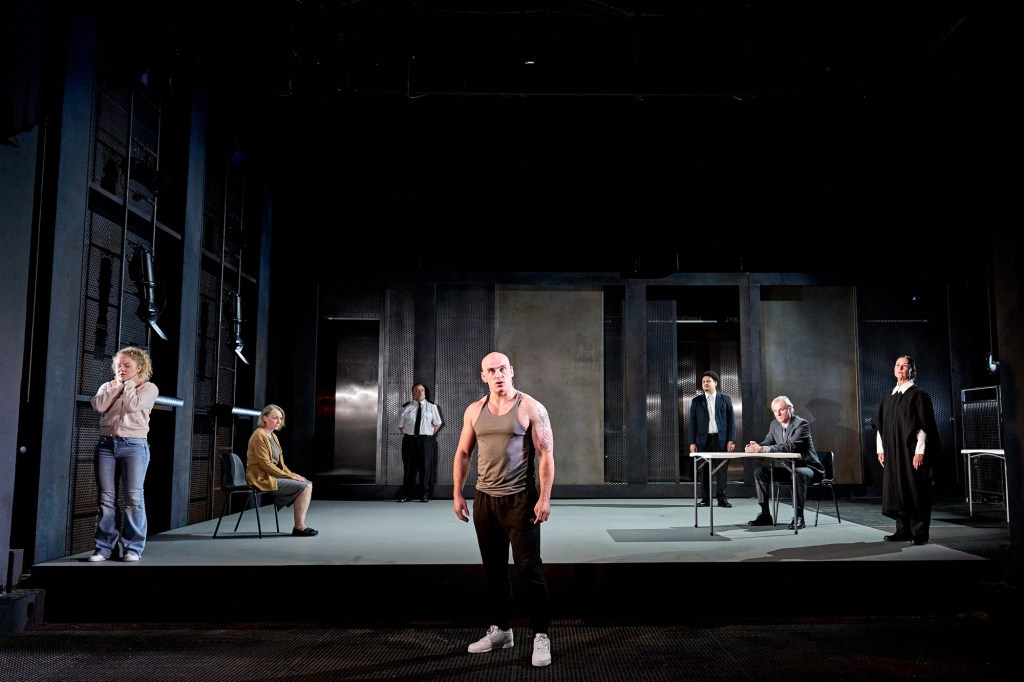
MANHUNT
written and directed by Robert Icke
Royal Court Theatre, London – until 3 May 2025
running time: 95 minutes no interval
https://royalcourttheatre.com/whats-on/manhunt/
Toxic masculinity and the long term effects of a traumatic childhood are under the microscope in Robert Icke’s Royal Court debut. The title Manhunt is ambiguous: on the one hand it refers to the extensive 2010 police search for Northumberland murderer Raoul Moat, which is the central focus of this intense, unusual play. But there’s potentially an alternative meaning, which is the quest and struggle that male-presenting humans have to face in order to understand what actually makes a man.
Icke is best known for his world-beating contemporary adaptations of the classics which reached an apotheosis with his multi-award winning Oedipus (set to go to Broadway this autumn). Here though he is onto something quite different. Serving as director and writer, he seems to be interested as much in the circumstances and experiences that combine to create a hyper-violent criminal as in the specific case of Moat himself, who famously waged war on the police after murdering his ex-girlfriend’s new partner who he mistakenly believed to be in the force before maiming his ex. As described by one of the characters here, he ended up wandering the Northumbrian countryside “like a Frankenstein’s monster with a sawn-off shotgun” before turning the weapon on himself after a six hour stand-off with police.
It’s a grim tale played out on a metallic grey stage (set by Icke’s regular collaborator Hildegard Bechtler) with the masterful manipulation and combination of sophisticated technical elements that typifies Icke’s work as a director. The aesthetic is characteristically spare and cool, with a surprising scenic transformation near the end. Ash J Woodward’s video contributions, whether spying on Samuel Edward-Cook’s dangerous Moat from above as though he’s under surveillance, or giving the audience regular reminders of the date as the action ticks down to the final catastrophic showdown, is a dazzling, essential contribution. So is Tim Gibbon’s sound design which brews an atmosphere of shuddering suspense, making vivid the contrast between the often distressing content of the script and the banal popular music that accompanies it. The silences, when they come, are telling and powerful.
The writing is perhaps less satisfying than the bravura staging. The play is a cats cradle of viewpoints and situations, eschewing linear storytelling for a dynamic ricochet around Moat’s troubled history, set in motion by an imagined court appearance where the fugitive is defending himself against past misdemeanours. There are distressing scenes of domestic violence and parental neglect but also a surprising lurch into sentimentality as a child comes on to represent a youthful Moat, while another plays his daughter. Icke even presents the notorious moment when footballer Paul ‘Gazza’ Gascoigne attempted to break through Moat’s standoff with the police. It’s written here as a funny but unsettling man-to-man therapy session (brilliantly played by Trevor Fox) that unravels alarmingly, although the actual event is even more bizarre, with the former sportsman turning up high on coke and offering to take Moat fishing.
The ambiguity is all. It’s never clear if Moat ever did make the requests for mental health support that he claims were ignored, and which could have helped steered his life in a different direction. He also claimed to be of French origin and bilingual but that isn’t confirmed. Neither is the identity of the man who purports to be his long-absent father (Nicolas Tennant, strangely moving) who comes to talk him down when he’s in direst trouble. All of this lends the evening an elliptical shape that intrigues but also slightly confounds.
A lengthy section set entirely in pitch darkness commemorates PC David Rathband who was blinded by Moat in an attack and ended up taking his own life. It’s a striking, affecting sequence, with a devastating vocal performance by Tennant) but it unhelpfully renders everything prior to it as a little clichéd, despite the exciting staging, while what comes later as the play hurtles towards its harsh conclusion is much more interesting. The suggestion that Moat had to turn violent to make people take note is probably the most unsettling thing the play throws up…is bad behaviour the only way some men can signal their issues?
Clearly Icke and his artistic adviser, journalist Andrew Hankinson who wrote the book that inspired this project, are interested in what makes such a person as Raoul Moat tick. It’s certainly a fascinating subject and the lack of preemptive judgement is to be commended, but the glow of the footlights inevitably lends the subject a certain Bonnie and Clyde-style glamour, especially as played by the charismatic Edward-Cook. This muddles the creative intentions somewhat as we in the audience aren’t given sufficient leads to make fully informed conclusions, and the bathos in the text further obfuscates what they’re getting at. Are we supposed to feel sympathy for Raoul? Should we be raging at the failures of the welfare state?
Regardless of these niggles, this is affecting, stirring theatre. Technically it’s wonderful and the multi-rolling cast acquit themselves with a fine combination of attack and finesse. Whether or not it changes one’s opinion on Moat is a question, and one you’re likely to be mulling over long after the curtain comes down. If Robert Icke is a more accomplished director than a writer, he remains one of British theatre’s most iconic talent, and Manhunt is already, and inevitably, a very hot ticket.
 ajhlovestheatre
Leave a comment