THE WOMEN OF LLANRUMNEY
by Azuka Oforka
directed by Patricia Logue
Theatre Royal Stratford East, London – until 12 April 2025
running time: 2 hours, 15 minutes including interval
https://www.stratfordeast.com/whats-on/all-shows/the-women-of-llanrumney
The participation of Wales in the international slave trade is a curiously underexplored subject, despite the fact that one of the principality’s most notorious sons of the 17th century, Sir Henry Morgan, was governor of Jamaica for several years and so would have directly benefited from the servitude and exploitation of countless Black souls. Azuka Oforka’s interesting new play The Women of Llanrumney, playing a brief London season after premiering last year at Cardiff’s Sherman Theatre, while not an unqualified success, is to be applauded for shedding a stark light on this traumatic tranche of shameful history.
Set on the Llanrumney plantation (named after an area of the Welsh capital) in Jamaica, it’s a tale of brutality, humiliation and betrayal, the stuff of meaty drama. It has moments of brilliance and certainly pulls no punches in its descriptions of the inhumane horrors that slaves endured while working in the sugar cane fields and mills, yet it remains frustratingly inert as a piece of theatre. Oforka’s script derives much of its power from its retelling of the vile cruelties serving women Annwyn (Suzanne Packer) and Cerys (Shvorne Marks) have borne witness to, their Welsh first names a direct reference back to the master who controlled them. Some of the descriptions are truly, and necessarily, horrible, but the constant storytelling at the expense of action becomes wearisome.
The three female characters – Annwyn -Annie for short- the middle aged mixed heritage housekeeper who upgraded from slavery to domestic service and is determined to hold on to her position at all costs, her darker-skinned daughter Cerys, rebellious and hungry for change, and their mistress Elizabeth (Nia Roberts), debt ridden, privileged and grossly insensitive – fall rather too neatly into a trio of archetypes. One is afraid to destroy the old order as that may take away what little comfort there is in her life, the second knows that freedom is hard won but is worth making sacrifices for, and the third reaps the rewards of slavery so will never willingly relinquish the reins of power. Putting women firmly at the centre of this examination of this worst of humanity is a tremendous idea and, at its best, The Women of Llanrumney leaves you with no doubt about the fire in its belly, but it’s all a little too on-the-nose, especially when the play lurches into full on melodrama in the second act.
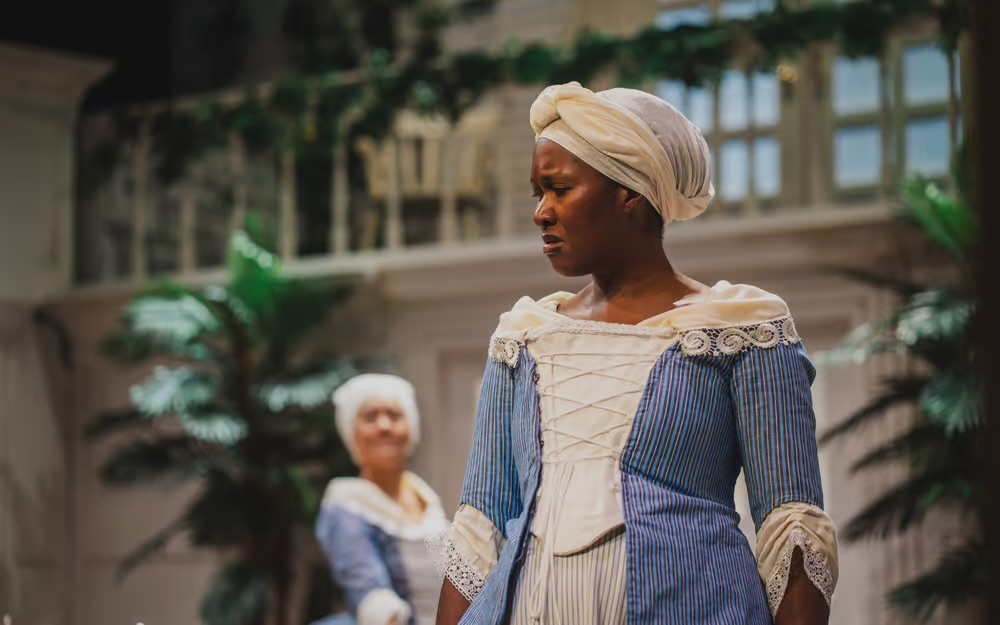
Patricia Logue’s production, played out on a too-pristine set by Stella-Jane Odoemelam that nonetheless suggests a tropical homestead, with green foliage sprouting everywhere and illuminated portraits of dead masters staring down from the walls, is a little rough around the edges. This manifests mainly in a quartet of uneven acting performances. Packer, one of Wales’s finest actresses, suggests with wonderful economy the pain behind Annie’s haunted, fearful eyes but pushes her desperation a little too hard from the outset so that her final outburst as all hell breaks loose around her doesn’t have as much impact as it might. She’s still a powerful presence though.
Roberts is another superb actor but her Elizabeth feels like a misfire, a shrill, rouged, powdered brat, first cousin to Miranda Richardson’s Queenie from TV’s Black Adder but with a mouth like a docker. Initially she bowls on like the comic relief but as the play progresses one becomes acutely aware of how deeply unpleasant and mendacious this woman is. The problem is that Roberts isn’t allowed to develop the characterisation much beyond the fruity voiced comic charlatan so, even at her worst, she’s never as dangerous and chilling as she really ought to be. Only Marks, terrific as watchful, scornful Cerys, gets the tone absolutely right, and the final conclusion for this fierce young woman is an authentic gut punch. Matthew Gravelle, the sole man, does creditable, dexterous work as three contrasting characters who are more plot devices than fully fledged humans. As the play’s title implies, it’s the women that are the focus here.
Oforka makes valid points about how extreme circumstances can turn morality and culpability into luxuries, and galvanises the play towards a righteously exciting climax. The naked racism in some of the dialogue is pretty hard to listen to, but is essential to appreciate the milieu in which these women existed. It’s an uneven piece of theatre but it provides plenty to mull over, and the causes and aims of its fury and outrage are never in doubt, and it’s fascinating to see another angle on a lamentable tranche of human history.
 ajhlovestheatre
Leave a comment